


Lucian / Lucian of Samosata. Luciani Samosatensis Opera - Graece et Latine - Ad
Luciani Samosatensis Opera – Graece et Latine – Ad editionem Tiberii Hemsterhusii et Ioannis Frederici Reitzii accurate expressa, cum varietate lectionis et annotationibus. Studiis Societatis Bipontinae.
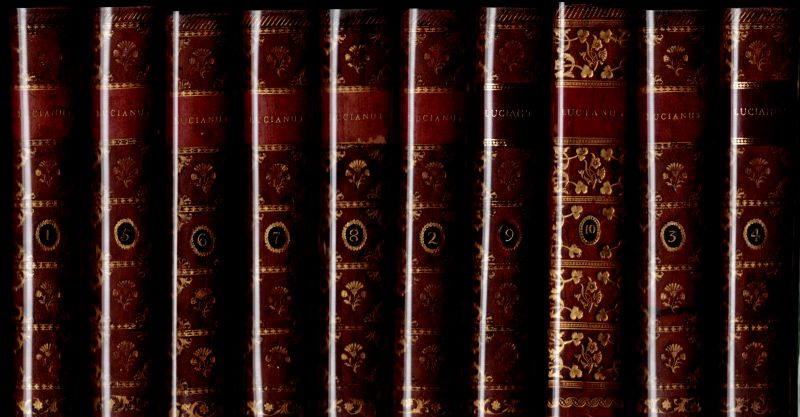
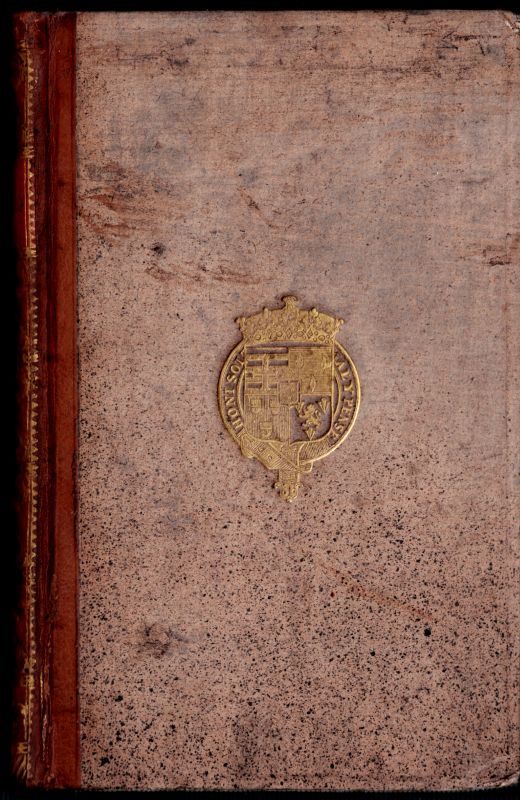
Ten Volumes (complete) / 10 Volumes (complete). Biponti [Zweibruecken], Ex Typographia Societatis, 1789-1793. Octavo (13.4 cm wide x 20 cm high). Ten Volumes with c. 4500 pages. Hardcover / Original half-leather with gilt lettering and golt ornament to spine. Armorial supralibro on covers of each Volume. Very good condition with only minor signs of wear.
Bipont Editions (also known as the Bipontine Editions), the name of a famous series of editions, in 50 volumes, of Greek and Latin classical authors, so called from Bipontium, the modern Latin name of Zweibrücken (also referred to as “Deux Ponts”; English, “two bridges”) in the Rhineland-Palatinate where they were first issued by the Societas Bipontina (under the supervision of Friedrich Christian Exter and Georg Christian Crollius) in 1779. Their place of publication was afterwards transferred to Strasbourg (referred to on the title pages by the Latin name of “Argentoratum”).
__________________________________________________________________________________
Tiberius Hemsterhuis (9 January 1685 – 7 April 1766) was a Dutch philologist and critic.
Hemsterhuis was born in Groningen. His father, a learned physician, gave him a good early education and he entered the university of his native city in his fifteenth year, where he proved himself the best student of mathematics. After a year or two at Groningen, he was attracted to the University of Leiden by the fame of Perizonius. While there, he was entrusted with the duty of arranging the manuscripts in the library. Though he accepted an appointment as professor of mathematics and philosophy at Amsterdam in his twentieth year, he had already directed his attention to the study of the ancient languages.
In 1717 Hemsterhuis was appointed a professor of Greek at the University of Franeker to replace Lambert Bos, but he did not enter on his duties there till 1720. In 1738 he became a professor of national history as well. Two years afterward, he was called to teach the same subjects at Leiden, where he died on 7 April 1766. He was the father of Frans Hemsterhuis.
In 1706, he completed the edition of Julius Pollux’s Onomasticon begun by Jean-Henri Lederlin (1672–1737), but the praise he received from his countrymen was more than counterbalanced by two letters of criticism from Bentley, which mortified him so keenly that for two months he refused to open a Greek book. Hemsterhuis was the founder of a Dutch school of criticism which had disciples in Lodewijk Caspar Valckenaer, Jacob van Lennep and David Ruhnken. (Wikipedia)
His major writings were:
Luciani colloquia et Timon (1708)
Aristophanis Plutus (1744)
Notae, etc., ad Xenophontem Ephesium in the Miscellanea critica of Amsterdam, vols. iii. and iv.
Observationes ad Chrysostomi homilias (1784)
Orationes (1784)
a Latin translation of the Birds of Aristophanes, in Kuster’s edition
notes to Bernard’s Thomas Magister, to Alberti’s Hesychius of Alexandria, to Johann August Ernesti’s Callimachus and to Pieter Burmann the Younger’s Propertius.
________________________________________________________________
Lucian of Samosata (c. 125 – after 180) was a Hellenized Syrian satirist, rhetorician and pamphleteer who is best known for his characteristic tongue-in-cheek style, with which he frequently ridiculed superstition, religious practices, and belief in the paranormal. Although his native language was probably Syriac, all of his extant works are written entirely in ancient Greek (mostly in the Attic Greek dialect popular during the Second Sophistic period).
Everything that is known about Lucian’s life comes from his own writings, which are often difficult to interpret because of his extensive use of sarcasm. According to his oration The Dream, he was the son of a lower middle class family from the city of Samosata along the banks of the Euphrates in the remote Roman province of Syria. As a young man, he was apprenticed to his uncle to become a sculptor, but, after a failed attempt at sculpting, he ran away to pursue an education in Ionia. He may have become a travelling lecturer and visited universities throughout the Roman Empire. After acquiring fame and wealth through his teaching, Lucian finally settled down in Athens for a decade, during which he wrote most of his extant works. In his fifties, he may have been appointed as a highly paid government official in Egypt, after which point he disappears from the historical record.
Lucian’s works were wildly popular in antiquity, and more than eighty writings attributed to him have survived to the present day, a considerably higher quantity than for most other classical writers. His most famous work is A True Story, a tongue-in-cheek satire against authors who tell incredible tales, which is regarded by some as the earliest known work of science fiction. Lucian invented the genre of comic dialogue, a parody of the traditional Socratic dialogue. His dialogue Lover of Lies makes fun of people who believe in the supernatural and contains the oldest known version of “The Sorcerer’s Apprentice”. Lucian wrote numerous satires making fun of traditional stories about the gods including The Dialogues of the Gods, Icaromenippus, Zeus Rants, Zeus Catechized, and The Parliament of the Gods. His Dialogues of the Dead focuses on the Cynic philosophers Diogenes and Menippus. Philosophies for Sale and The Carousal, or The Lapiths make fun of various philosophical schools, and The Fisherman or the Dead Come to Life is a defense of this mockery.
Lucian often ridiculed public figures, such as the Cynic philosopher Peregrinus Proteus in his letter The Passing of Peregrinus and the fraudulent oracle Alexander of Abonoteichus in his treatise Alexander the False Prophet. Lucian’s treatise On the Syrian Goddess satirizes cultural distinctions between Greeks and Syrians and is the main source of information about the cult of Atargatis.
Lucian had an enormous, wide-ranging impact on Western literature. Works inspired by his writings include Thomas More’s Utopia, the works of François Rabelais, William Shakespeare’s Timon of Athens and Jonathan Swift’s Gulliver’s Travels. (Wikipedia)
- Keywords: Catalogue No.10 – International Literature · Catalogue No.18 – Classical Literature · Classical Literature · Classical Literature – Rare · Lucian of Samosata · Syria · Syrien
- Language: Greek / Latin
- Inventory Number: 32337AB
EUR 1.280,--

We ship per DHL Express
Contact
Inanna Rare Books Ltd.
Woodley House
Castletownshend Road
P81 D262 Skibbereen, County Cork
Ireland
Phone: ++353 - (0) 87 - 102 5412
E-Mail: info@inannararebooks.com
Internet: https://www.inannararebooks.com
Online Bookshop specialized in rare
and secondhand books.
Newsletter and E-Catalogue Sign Up
Payment Options


© 2026 Inanna Rare Books Ltd. | Powered by HESCOM-Software

