Varia (8252 items)

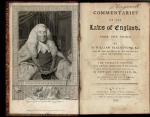
William Blackstone / Edward Christian - Commentaries on the Laws of England by Sir William Blackstone

81. Blackstone, William.

Commentaries on the Laws of England by Sir William Blackstone, Knt. One of the Justices of his Majesty’s Court of Common Pleas. The Twelfth Edition, with the Last Corrections of the Author; and with Notes and Additions by Edward Christian, Esq.

The Rare Edward Christian Edition. Four Volumes (complete set). London, A. Strahan and W. Woodfall, Law-Printers to the King’s most excellent Majesty, for T. Cadell, in the Strand, 1793,1794,1795. Octavo. Pagination: Volume I: X, [6], III, [1], 487 pages / Volume II: [8], 520, XX pages / Volume III: Frontispiece-Portrait, [8], 455, XXXV, [1], 16 pages with three more portraits bound-in / Volume IV: [8], 443, VIII, [72] pages. With four Portraits in total and one large folding table showing the “Table of Descents”. The Portraits which are bound into Volume III of the set are: I. Portrait of British Judge “William Murray, 1st Earl of Mansfield” / II. Portrait of “Lord Chief Baron Gilbert” [Sir Jeffrey Gilbert, Lord Chief Baron of the Exchequer in both Ireland and England] / III. Portrait of english Judge and Member of Parliament, Sir John Comyns, Knt. / IV. Portrait of english lawyer and Lord High Chancellor Philip Earl of Hardwicke. Hardcover / Original edition of the 18th century, rebacked by a master-binder with 20th century leather-spines in the style of the 18th century. This extremely rare edition Edward Christian – Edition of Blackstone, with the last corrections before Blackstone’s death, published for the first time by Edward Christian in the years 1793-1795. This set is used with some minor spotting to pages but overall a very desirable and important version of Blackstone’s commentaries on the Laws of England. [The set comes also with a stunning Limited Edition of the four-volume- Reprint of the First Edition of Blackstone’s Commentaries (1766)].

EUR 2.800,-- 

Show details   Add to cart

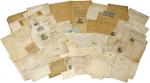
Levy, Archive / Collection of more than 300 letters, documents, ephemera

82. Levy, Arthur Joseph / Zangwill, Israel.

Archive / Collection of more than 350 items, letters, documents, ephemera, pamphlets, manuscript notes, receipts , manuscript letters from the private library of Providence (Rhode Island) lawyer, Arthur (Art) Joseph Levy. The collection includes an important, controversial typescript-essay (8 pages) on Israel Zangwill’s address before the American Jewish Congress at Carnegie Hall on October 14th, 1923 (″Watchmen, what of the Night ?”); with manuscript annotations and remarks on Israel Zangwill’s position “the hopes of Jewry for the establishment of a Jewish State in Palestine are doomed to disappointment”. The collection includes a plethora of interesting letterheads of jewish organizations and also important documentation of Levy’s contribution to and support for the “Palestine Foundation Fund”, (receipt from Boston, Mass. June 1923). Levy, who was a graduate of Brown and Boston University Law School, practiced law in Providence, Rhode Island and led an active life as a member and leader of several Jewish civic organizations, such as the Jewish Family and Children’s Service, which he established and led for twenty years, Rhode Island Jewish Historical Society, the Temple Beth-El Brotherhood, the Miriam Hospital, the Touro Fraternal Association and the Jewish Home for the Aged of Rhode Island. He was also a prominent member of the American Bar Association, the Brown University Alumni Association and the Brown Club of Rhode Island. Highly regarded as a jurist, he was a member of the Commission to Consolidate State Laws, a member of the Advisory Committee of the Federal Tax Institute of New England and an editor of the Rhode Island Bar Journal. Included in this archive are a group of letters written during World War I discussing his role in the Jewish Welfare Board of the United States Army and Navy, an invitation to a fund-raising dinner for the Jewish Orphanage of Rhode Island, a group of documents and letters discussing the establishment of a Jewish country club in Providence, several documents from the early 1920s concerning the mostly Jewish fraternity Phi Epsilon Pi and several items relating to Levy’s personal life, such as personal letters, bills from clothiers and invitations to social events. (Main source of the description of this archive is the research of our colleague Greg Talbot from The Lawbook Exchange).

Providence (Rhode Island), Cambridge (Massachusetts), New York, 1917 – 1931. Octavo and A4. Two heavy folders with original documents. Very good condition with only minor signs of external wear.

EUR 2.800,-- 

Show details   Add to cart

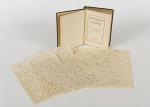
Viereck, Collection of Manuscript Material by the author Georg Sylvester Viereck.

83. Viereck, George Sylvester / [Frederick Franklin Schrader] / [Mentioning of Oscar Wilde / Lord Alfred Douglas].

Collection of early Manuscript Material (which is a Manuscript Ballad / Poem), a two-page Manuscript Letter (which is a MLS mentioning Oscar Wilde, Lord [Alfred] Douglas, Viereck’s literary tastes etc.) and the personal copy of “House of the Vampire”, all by the controversial german-american author George Sylvester Viereck. The collection includes: 1. One six-page, hitherto unpublished Manuscript – Ballad [Poem], called “Die Ballade vom Sündigen Glück” [Translates: “The Ballad of sinful Pleasure”]/ 2. A lengthy and extremely insightful Two-Page Manuscript Letter, signed in New York, 1902, which accompanied and talks about the enclosed Six-Page Manuscript – Ballad [The letter and Poem was not conclusively but very likely addressed by Viereck to Frederick Franklin Schrader, then editor of the New York Dramatic Mirror and shortly thereafter co-founder with George Sylvester Viereck of “The Fatherland” / 3. The collection also includes Viereck’s personal copy of his publication “The House of the Vampire” with handwritten, manuscript entry of his name, address in New York City as well as a pasted statement on the endpaper by the author Viereck: “Concerning “The House of the Vampire” : This book went through several editions when it was first published and was dramatized. It played for eight weeks in New York and for two years on the road under the management of the Shuberts. Critics have compared it to such books as Dr.Jekyll and Mr.Hyde, Lady Into Fox, and Dorian Gray”]. The two-page letter is of great value and touches on Viereck’s admiration for Schrader and his “Blatt” [Newspaper]. Viereck is advertising himself to Schrader by introducing himself as a critical admirer with substantial references (Viereck details his working for numerous newspapers in America). Viereck mentions his secessionist tendencies and name-drops Oscar Wilde, Rosetti and Lord Douglas (whom he claims to know personally). This amazing, autographed/signed Manuscript-Material was created by Viereck directly during his transition from writer to propagandist and is an example of his early, bullish personality, which wants to be heard, which needs attention and it is here, in 1912, where his career begins to develop. This large Archive of manuscript material [8 pages in total] is stunning and unpublished (see partial Transcription of the original german material on our website). Viereck’s close friends included Nikola Tesla and even Theodore Roosevelt was among his acquaintances.

New York, Moffat, Yard & Company, 1902-1912. Play and Letters: 20.3 cm x 25.3 cm / Book: 13 cm x 19,5 cm. Pagination: Balld (Poem): 6 pages / Manuscript Letter (MLS): 2 pages / Book: 190 pages. Original Hardcover / Blue publisher’s cloth with gilt lettering on spine in protective collector’s mylar / The play protected in clear folder. The manuscript pages overall in excellent condition besides page IV of the play which has two abrasions with small parts of the text missing only. The book in excellent condition with only minor signs of external wear. Viereck’s usual vanity made him add the lovely littel note of critical success. The personal copy of this controversial author’s most interesting book is a unique possibility for each collector of unusual Vampire material. Extraordinary collection !

EUR 2.800,-- 

Show details   Add to cart

Montague / Dorgan - Typescript Draft MS for a book of poetry by Theo Dorgan. With occasional manuscript corrections

85. [John Montague Collection] – [Montague, John] Dorgan, Theo.

Typescript Draft MS for a book of poetry by Theo Dorgan. With occasional manuscript corrections / suggestions / annotations by Dorgan’s early mentor John Montague, the Typescript MS was held among the private papers of John Montague in his West Cork Home. The typescript includes poems like “Closed Circuit”, “The Promised Garden”. Montague is approving several of the poems by simply applying a tick. John Montague made suggestions in pencil on the structure of “Elegy for a Schoolfriend” and more in depth-suggestions on “Nasty Archer”, “Her Body”,″The Width of a Room Between Us”, “Return”, “Reconciliation”, “Sunday Afternoon”. When asked about helping to date this early draft of his poetry, Theo Dorgan immediately gets back to us and he places it from memory into the early 1980’s. Theo Dorgan was surprised and seemingly chuffed that John Montague held on to this Manuscript and he recalls: “These poems, some in revised versions, make up the backbone of my first published collection, ‘The Ordinary House of Love’.” Dorgan continues: “I’m happy to say that most of them survived Montague’s eagle eye, which was of course a great comfort to me at the time. Still is!” Some of these poems selected had previously been published as broadsheets etc. but the skeleton of the Draft hints already at readying it for publication. Theo Dorgan graciously gives us even more information: “Some of the poems in the eventual book go back to when I was a student, others were definitely written in the second half of the 80s. The bulk of it, however, is in this MS. I base my estimation in part on the fact that what you have is a typescript produced, it appears, on the IBM golfball machine that was the pride and joy of Triskel Arts Centre. That machine was bought in 1980 or 1981, I’m fairly sure of that. I was Literature Officer there, then.” Theo Dorgan was part of John Montague’s circle of mentored poets, even though in an email-exchange with him about this typescript he mentions that “John Montague worked far more with Thomas McCarthy, Maurice Riordan and Gregory O’Donoghue than he did with me, and in many ways Gregory O’Donoghue was at that stage the most accomplished of us all – the only one included in JM’s Faber Book.” What followed then in our conversation with Theo Dorgan is a great example why manuscripts, letters, autographs, typescripts and the connections we often make with documents from the past have such meaning in explaining our emotional ties with people who matter to us on our way of forming personality. They are memories transforming into images, floods of empathy and nostalgia for personal moments lost but treasured because they helped us form our values. Presented with the old typescript, Theo Dorgan’s emotionality is tangible and he confesses more in an internal dialogue with himself and John Montague than with us: “I’m sorry to say that the reason John Montague worked with those others more than he did with me is because, in my shameful, youthful arrogance, I much preferred to trust my own judgement, and also, I suspect, because I was closest to John in temperament and feared coming unduly under his influence. That said, there was no-one whose good opinion of a poem I valued more, and we were close all our lives after. Very likely it was a case of old stag/young stag ! Montague taught us by indirection, he made his extensive library of modern and contemporary poetry available to us without stint, would wait for us to find an affinity (as, e.g. mine with Robert Graves and Galway Kinnell) and would then, in a long, ongoing conversation, help us to understand what it might mean for our own poems that we felt such affinities. A guided companionship in reading and making, if you will.”

Ireland, c.1981-1982. A4. 43 pages typescripts. Paperclipped. Very good condition with only minor signs of external wear. Some fingerstaining and residue of rust from the paperclip. Wonderful and extremely valuable document of not only a collaboration between two of Ireland’s landmark writers but moreover witness to the becoming, the birth of a true poet. Also included (from a different source) is a second printing of the first edition of the subsequent publication “The Ordinary House of Love” – signed by Theo Dorgan. Right at the beginning of the printed version, instead of a dedication to John Montague, Theo Dorgan placed a quote from Montague’s poem “Wine Dark Sea”: ‘For there is no sea / it is all a dream there is no sea / except in the tangle / of our minds; / the wine dark / sea of history on which we all turn / turn and thresh / and disappear.’ (Collected Poems, page 255). Provenance of the annotated typescript: From the private collection of John Montague’s papers in his recently sold West Cork Home.


Show details

[Gore-Booth, Two Manuscript Sketch-Books [12” x 10”] bearing the Bookplate "Lady Gore Booth - Lissadell, Sligo

87. [Gore-Booth, Colum Robert] / [Lady Eva Selina Laura Gore-Booth] / [Constance Georgine Markievicz née Gore-Booth] / [Lissadell House County Sligo].

Two Manuscript Sketch-Books [12” x 10”] bearing the Bookplate “Lady Gore Booth – Lissadell, Sligo [No.43]”. Both Folio-Size Sketch Books titled ‘The “Wood” Sketch Book’, both issued by ‘St. John’s Wood Art School’: 29, Elm Tree Road, London, NW 8. [Founded 1878]. Each Sketch-Book has 50 pages and most pages have manuscript sketches with a few loose sketches tipped in. The very accomplished drawings all appear to be in pencil and show landscapes, trees, horses, portraits, male and female figures, skulls. They all appear to be in the same hand. Also, tipped in is a b/w photo, 6” x 4” mounted on a card. It is signed in pencil by Roberts of Paris. Stamped on the back is “Roberts” 11, Rue du Havre. In pencil, it states “Elizabeth aged 11, May 1922”. From our research it is certain, that Colum Robert Gore-Booth (1913-1959) attended St.John’s Wood Art School and these appear to be his Sketch-Pads, the only other member of the Gore-Booth family who went to London in order to become an artist was Colum’s aunt, Constanze Markiewicz, who attended Slade School of Art at the turn of the century but the drawings do not fit her style.

Two Volumes. London, St.John’s Wood Art Schools / Lissadell House County Sligo, c.1920 – 1930. Folio. Volume I: 118 pages (59 perforated sheets), with 87 studies, often with sketching on both sides of the sheets / Volume II: 100 pages (50 perforated sheets), with 46 studies inside the sketch-book plus two portrait-sketches loosely inserted, plus the photograph of one “Elizabeth”, dated May 1922 and signed by photographer “Roberts” 11, Rue du Havre, Paris. Publisher’s illustrated Hardcover. Very good condition with only minor signs of wear.

EUR 2.800,-- 

Show details   Add to cart

Page: 1 2 ... 6 7 8 9 10 11 12 ... 825 826
: