Complete Catalog (8479 items)

Rawls, "Justice as Fairness" [First Edition of the First Appearance of John Rawls' Theory of "Justice as Fairness"

112. Rawls, John / [Provenance: Henry David Aiken Collection].

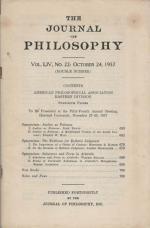
“Justice as Fairness” [First Edition of the First Appearance of John Rawls’ Theory of “Justice as Fairness” which would lead to “A Theory of Justice”. This is the very rare Double Number of the separate Double Number-Issue in its original wrappers-version; Provenance: from the library of John Rawls’ friend, Henry David Aiken. [in: “The Journal of Philosophy” – Volume LIV. No.222: October 24, 1957 (Double Number) – Contents: American Philosophical Association Eastern Division – Symposium Papers – To be presented at the Fifty-Fourth Annual Meeting, Harvard University, December 27-29, 1957: Symposium: “Justice a Fairness” – I. “Justice as Fairness”: John Rawls [pages 653 – 651] / II.Justice as Fairness: “A Modernized Version of the Social Contract”: Everett W. Hall [pages 662 – 669] / Symposium: “The Evidence for Esthetic Judgment” – I. “The Importance of a Choice of Context”: Mortimer R. Kadish [pages 670 – 678] / II. On the Grounds of Esthetic Judgment: Albert Hofstadter [pages 679 – 687] / Symposium: “Substance and Form in Aristotle” – I. “Substance and Form in Aristotle”: Wilfrid Sellars [pages 688 – 698] / II. Forms of Particular Substances in Aristotle’s Metaphysics: Rogers Albritton [pages 699 – 707]//

New York, The Journal of Philosophy, 1957. Octavo. pages 653 – 712. Original Offprint / Stapled Wrappers. Very good condition with some minor signs of wear only and some mild staining to front and rear wrapper. From the library of Professor Henry David Aiken.

EUR 2.800,-- 

Show details   Add to cart

John Payne - Universal Geography - Formed Into A New And Entire System; Describing Asia, Africa, Europe And America

113. Payne, John / Zachariah Jackson [Dublin Printer].

Universal Geography – Formed Into A New And Entire System; Describing Asia, Africa, Europe And America ; With Their Subdivision Of Empires, Kingdoms, States And Republics : The Extend, Boundaries, and remarkable Appearances of each Country ; Cities, Towns, and Curiosities of Nature and Art. Also giving A general Account of the Fossil and Vegetable Production of the Earth, and of every Species of Animal : The History of Man, In all Climates, Regions, And Conditions ; Customs, Manners, Laws, Governments, And Religions : The State of Arts, Sciences, Commerce, Manufactures, And Knowledge : Sketches of the Ancient and Modern History of each Nation and People. To which is added, A Short View of Astronomy, As Connected With Geography ; Of The Planetary System to which the Earth belongs ; And of the Universe in General. With a Set of Maps, drawn from the best Materials, every one of which is very neatly coloured ; And a great Variety of Copper-Plates ; Descriptive of the most Remarkable Curiosities in the World. [This Edition with all three Volumes but only with 14 Maps, 3 Colour-Engravings and 5 Black-and-White Engravings (see detailed listing of these Maps and Engravings at the end of this Bibliography)].

Two Volumes in Three Parts (bound in Two Volumes). Dublin, Printed by Zachariah Jackson, 1793 – 1794 Quarto (23 cm wide x 28 cm high). Pagination: Volume I: Hand-coloured Frontispiece, VI [Subscribers], XIII, 894 pages [page 555 misprinted as 454] [Stating “The End” at the end of the Volume] with Four Maps and Three engravings (including Frontispiece) / Volume II: Hand-coloured Frontispiece, 792 pages [Stating “End Of The Second Volume” at the end of Volume II] with Ten Maps and One Engraving (Frontispiece) / [Volume III] is Bound to the rear of Volume II and is falsely ending with “End of The Second Volume” even though it is the “Continuation of Book IV” and in all other listings of this book internationally is accepted to be Volume III. Pagination of [Volume III]: Hand-coloured Frontispiece, [No separate titlepage], 416 pages, XXXIII pages of an Index, 1 page “Directions to the Binder”, 10 pages “A Chronological Table of Remarkable Events, Discoveries and Inventions”, with Four Engravings (including Frontispiece). Hardcover / Modern Binding in the style of the 18th century. Full leather with gilt lettering on spine. Very minor signs of neglectable, minimal wormhole-damage. Obviously this work was robbed of many of the maps but those which remain have the original hand-colouring in stunning condition (see description). Overall near Fine condiiton of this extremely rare set, with only minor signs of wear. Page 199/200 of Volume II with longer cut (Text not effected). All the engravings and maps without defects.


EUR 2.800,-- 

Show details   Add to cart

Small Collection of very rare original materials from the library german Mathematician and Inventor of Optical, Medical & Scientific Instruments, Dr. Gottfried Tauber

115. [Optician / Optiker / Optische Instrumente] – Tauber, Gottfried.

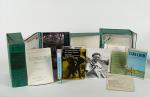
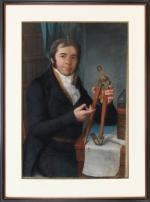
Small Collection of very rare original materials from the library of german Mathematician and Inventor of Optical, Medical & Scientific Instruments, Dr. Gottfried Tauber. The collection includes: 1. A stunning, allegorical Painting of Gottfried Tauber by Daniel Caffe (pinxit 1808) which is beautifully framed, with a significant but repairable tear 2. Gottfried Tauber’s personal Manuscript-Notebook [which he obviously kept during his early studies at “Schola Altenburgensis”], titled: “Physic a Tauber – Penticoste’s Tempore – 1784” with Drawings and detailed scientific experiments, 3. An important, printed publication from Tauber’s Institute, titled: “Anweisung Anweisung für auswärtige Personen, wie dieselben aus dem Optisch-Oculistischen Institute zu Leipzig… mit Zuverlässigkeit solche Augengläser bekommen können”. The publication explains not only in detail Tauber’s ability to select the right eye glasses for different stages of loss of sight. The publication, printed in 1851, also advertises the optical and medical inventions of Tauber (Microscopes, Tattoo-Presses, Needles for Inoculation, Camera Lucida, Camera Obscura, Thermomoeters, Meteorological Instruments etc. etc.). Gottfried Tauber was the founder of the Optical – Oculistic Institute in Leipzig / Germany and became famous for the invention of Glasses and several scientific instruments in the fields of Optic and medicinal as well as meteorological instruments . The Manuscript Notebook in the collection includes Gottfried Tauber’s personal elaborations on significant scientific experiments, even mentioning Benjamin Franklin’s Kite-Experiment from 1752 (″Doct. Fränklin in Amerika gab 1752 die erste Nachricht im Dienst von Ableitern…”). Tauber’s many talents led to him being installed as teacher of mathematics already six years after starting his manuscript notebook in 1784. Many of the experiments Tauber noted down in his manuscript and embellished with drawings, would later lead to his own inventions of tools and instruments useful for medicine and science in the ever experimental 19th century.

Altenburg / Leipzig, Gottfried Tauber, 1784 – 1851. Octavo / Quarto. Pagination: Manuscript – 146 pages with numerous drawings (some in ink and some in watercolour) / Pagination: Pamphlet: Portrait: The Portrait is framed, a tear in the portrait is visible / Manuscript: Both Hardcover boards of the manuscript are cleanly detached and rubbed with some minor damages. Drawings and interior manuscript notations very good. Very good condition with only minor signs of wear. Extra Shipping Costs required due to the artwork.

EUR 2.800,-- 

Show details   Add to cart

Collection of interesting and important publications by and on James Joyce.

118. [Joyce, James].

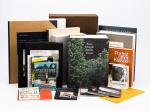
Collection of interesting and important publications by and on James Joyce. Including a portrait of Joyce, First editions and essential Textversions of his Masterpieces and literary criticism etc. etc. [Please enquire for access to excellent photographs and descriptions to each title, included in this collection]. The collection includes: 1. Ulysses [The Corrected Text]. The Corrected Text – Edited by Hans Walter Gabler with Wolfhard Steppe and Claus Melchior and with a New Preface by Richard Ellmann. Corrected Edition of the critical and synoptic edition from 1984. / 2. Ulysses [A Reader’s Edition]. Edited by Danis Rose. Completely revised edition. / 3. McHugh, Roland. Annotations to Finnegans Wake. / 4. The Restored Finnegans Wake. Edited and with a Preface and Afterword by Danis Rose and John O’Hanlon. Note by Seamus Deane. / 5. Ellmann, Richard. James Joyce. New and Revised Edition [The First Revision of the 1959 Classic]. / 6. Ellmann, Richard. Selected Letters of James Joyce. / 7. Joyce, James. Chamber Music. / 8. Eco, Umberto. The Middle Ages of James Joyce – The Aesthetics of Chaosmos. Translated from the Italian by Ellen Esrock. / 9. Freund, Gisèle. Three Days with Joyce – Photographs by Gisèle Freund. Preface by Richard Ellmann. / 10. Bowker, Gordon. James Joyce – A Biography. / 11. James Joyce – Poems and Shorter Writings – Including ‘Epiphanies’, ‘Giacomo Joyce’ and ‘A Portrait of the Artist’. Edited by Richard Ellmann, A Walton Litz and John Whittier-Ferguson. / 12. [Joyce, James] Synge, John Millington. Riders to the Sea. La Cavalcata al Mare. Italian translation James Joyce and Nicolo Vidacovich. Introduction and Notes Dario Calimani. / 13. [Joyce, James] Krewani, Angela [Hrsg.]. Artefacts, artefictions. crossovers between contemporary literatures, media, arts and architectures = Artefakte, Artefiktionen ; for Christian W. Thomsen on the occasion of his 60th birthday [Including articles on Joyce: Kurt Otten – James Joyce and the Rise of Early Modernism in English Literature / Ralf Schnell – Beuys and Joyce]. Articles in english and german. / 14. Gilbert, Stuart. James Joyce’s Ulysses. A Study. / 15. [Joyce, James] Beach, Sylvia / Laughlin, James (Introduction). Shakespeare and Company. New Edition. Lincoln, 1991. / Joyce, James. Pomes Penyeach. London, Faber & Faber, 1952. / 16. Joyce, James. The Mime of Mick, Nick and the Maggies – A Fragment from Work in Progress. [The Initial Letter, Tail-Piece and Cover were specially designed by the author’s daughter, Miss Lucia Joyce]. No. 564 of a limited edition of 1000 copies. The Hague / New York, The Servire Press / Gotham Book Mart, 1934. /

London and other places, Penguin / Picador / Oxford University Press / etc., 1975 – 1997. Octavo. More than 2000 pages. Original Hardcover / Original Softcover. Very good condition with only minor signs of wear. The price of the collection includes free international shipping per UPS Express.

EUR 2.800,-- 

Show details   Add to cart

Montague / Dorgan - Typescript Draft MS for a book of poetry by Theo Dorgan. With occasional manuscript corrections

119. [John Montague Collection] – [Montague, John] Dorgan, Theo.

Typescript Draft MS for a book of poetry by Theo Dorgan. With occasional manuscript corrections / suggestions / annotations by Dorgan’s early mentor John Montague, the Typescript MS was held among the private papers of John Montague in his West Cork Home. The typescript includes poems like “Closed Circuit”, “The Promised Garden”. Montague is approving several of the poems by simply applying a tick. John Montague made suggestions in pencil on the structure of “Elegy for a Schoolfriend” and more in depth-suggestions on “Nasty Archer”, “Her Body”,″The Width of a Room Between Us”, “Return”, “Reconciliation”, “Sunday Afternoon”. When asked about helping to date this early draft of his poetry, Theo Dorgan immediately gets back to us and he places it from memory into the early 1980’s. Theo Dorgan was surprised and seemingly chuffed that John Montague held on to this Manuscript and he recalls: “These poems, some in revised versions, make up the backbone of my first published collection, ‘The Ordinary House of Love’.” Dorgan continues: “I’m happy to say that most of them survived Montague’s eagle eye, which was of course a great comfort to me at the time. Still is!” Some of these poems selected had previously been published as broadsheets etc. but the skeleton of the Draft hints already at readying it for publication. Theo Dorgan graciously gives us even more information: “Some of the poems in the eventual book go back to when I was a student, others were definitely written in the second half of the 80s. The bulk of it, however, is in this MS. I base my estimation in part on the fact that what you have is a typescript produced, it appears, on the IBM golfball machine that was the pride and joy of Triskel Arts Centre. That machine was bought in 1980 or 1981, I’m fairly sure of that. I was Literature Officer there, then.” Theo Dorgan was part of John Montague’s circle of mentored poets, even though in an email-exchange with him about this typescript he mentions that “John Montague worked far more with Thomas McCarthy, Maurice Riordan and Gregory O’Donoghue than he did with me, and in many ways Gregory O’Donoghue was at that stage the most accomplished of us all – the only one included in JM’s Faber Book.” What followed then in our conversation with Theo Dorgan is a great example why manuscripts, letters, autographs, typescripts and the connections we often make with documents from the past have such meaning in explaining our emotional ties with people who matter to us on our way of forming personality. They are memories transforming into images, floods of empathy and nostalgia for personal moments lost but treasured because they helped us form our values. Presented with the old typescript, Theo Dorgan’s emotionality is tangible and he confesses more in an internal dialogue with himself and John Montague than with us: “I’m sorry to say that the reason John Montague worked with those others more than he did with me is because, in my shameful, youthful arrogance, I much preferred to trust my own judgement, and also, I suspect, because I was closest to John in temperament and feared coming unduly under his influence. That said, there was no-one whose good opinion of a poem I valued more, and we were close all our lives after. Very likely it was a case of old stag/young stag ! Montague taught us by indirection, he made his extensive library of modern and contemporary poetry available to us without stint, would wait for us to find an affinity (as, e.g. mine with Robert Graves and Galway Kinnell) and would then, in a long, ongoing conversation, help us to understand what it might mean for our own poems that we felt such affinities. A guided companionship in reading and making, if you will.″

Ireland, c.1981-1982. A4. 43 pages typescripts. Paperclipped. Very good condition with only minor signs of external wear. Some fingerstaining and residue of rust from the paperclip. Wonderful and extremely valuable document of not only a collaboration between two of Ireland’s landmark writers but moreover witness to the becoming, the birth of a true poet. Also included (from a different source) is a second printing of the first edition of the subsequent publication “The Ordinary House of Love” – signed by Theo Dorgan. Right at the beginning of the printed version, instead of a dedication to John Montague, Theo Dorgan placed a quote from Montague’s poem “Wine Dark Sea”: ‘For there is no sea / it is all a dream there is no sea / except in the tangle / of our minds; / the wine dark / sea of history on which we all turn / turn and thresh / and disappear.’ (Collected Poems, page 255). Provenance of the annotated typescript: From the private collection of John Montague’s papers in his recently sold West Cork Home.

Show details

Page: 1 2 ... 9 10 11 12 13 14 15 ... 847 848
: