


[Knight, The Penny Magazine of The Society for the Diffusion of Useful Knowledge
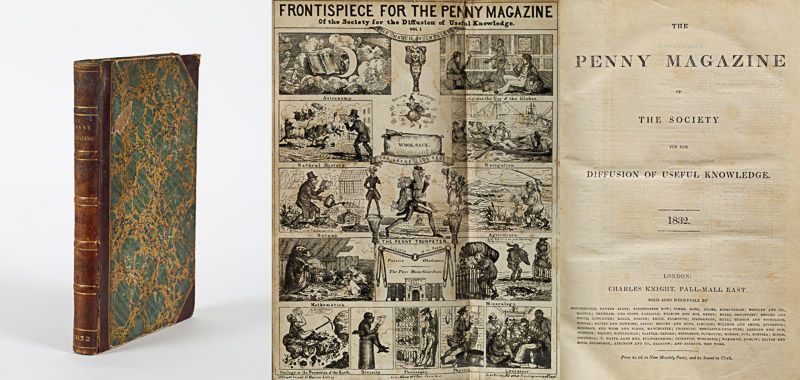
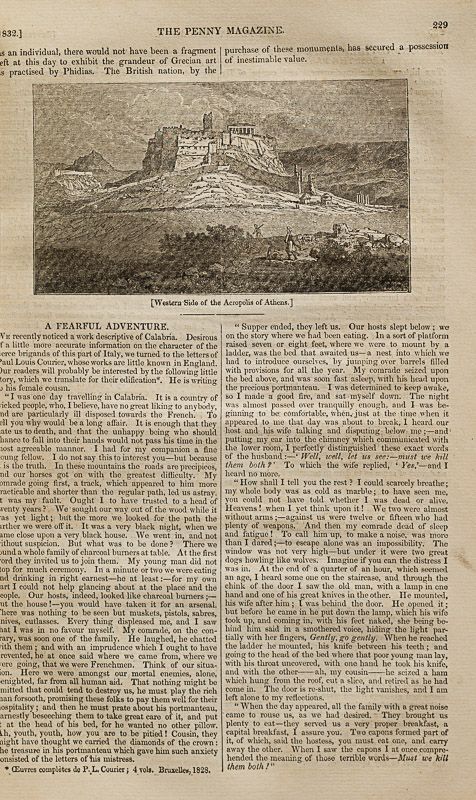
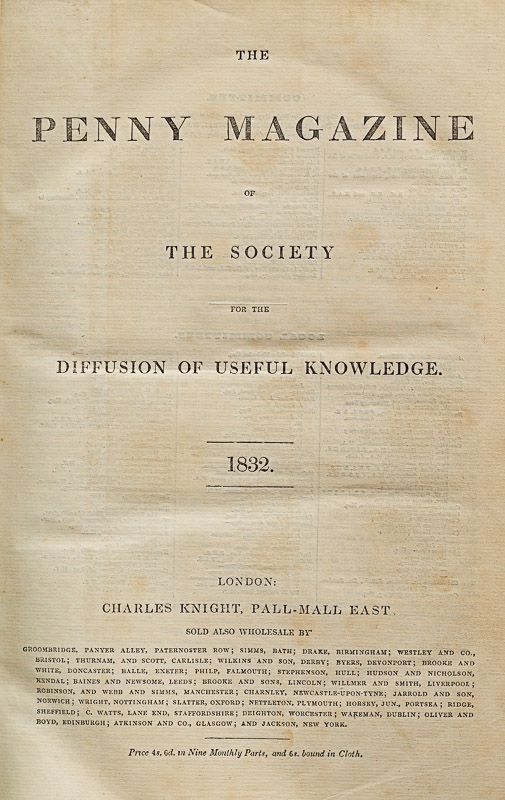
The Penny Magazine of The Society for the Diffusion of Useful Knowledge – Volume I: Number 1 – Number 48. [The Inaugural Volume – With an article on “The Elgin Marbles” and the two illustrations: “Remains of the Parthenon” and “Western Side of the Acropolis of Athens” ].
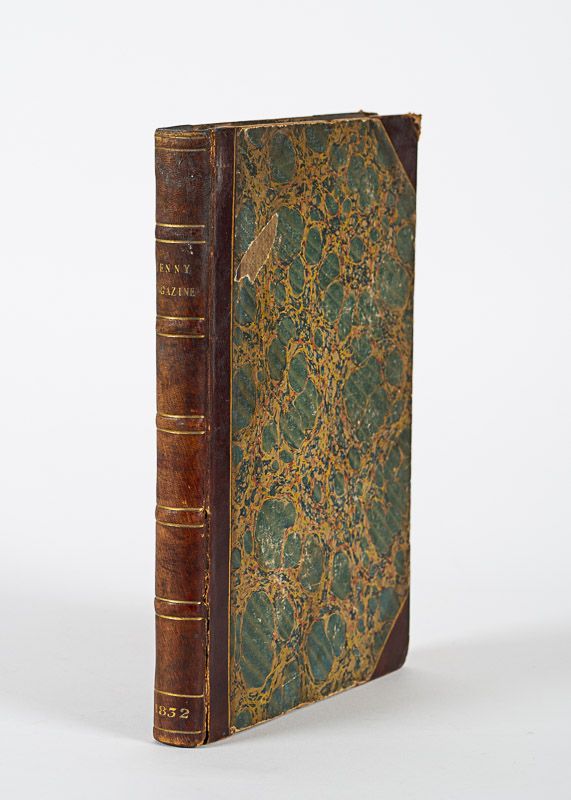
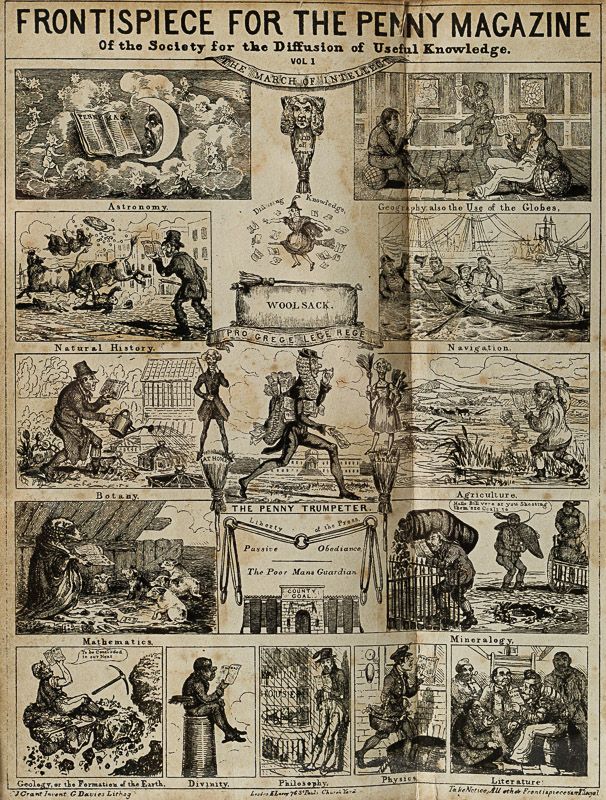
London, Charles Knight, Pall-Mall East, March 1832 – December 1832. Quarto. Folded Frontispiece, 389 pages with 215 illustrations throughout plus two pages of Index and a List of Illustrations. Hardcover / Original half-leather with gilt lettering on spine. Front endpaper detached, otherwise in very good condition with only minor signs of wear. This being the very rare, inaugural Volume in unusually excellent condition.
The Penny Magazine was an illustrated British magazine aimed at the working class, published every Saturday from 31 March 1832 to 31 October 1845. Charles Knight created it for the Society for the Diffusion of Useful Knowledge in response to Chambers’s Edinburgh Journal, which started two months earlier. Sold for only a penny and illustrated with wood-engravings, it was an expensive enterprise that could only be supported by very large circulation. Though initially very successful—with a circulation of 200,000 in the first year—it proved too dry and too Whiggish to appeal to the working-class audience it needed to be financially viable. Its competitor—which included a weekly short story—grew more slowly, but lasted much longer. (Wikipedia)
The Elgin Marbles (/’?lg?n/ ELG-in)[1][2] are a collection of Ancient Greek sculptures from the Parthenon and other structures from the Acropolis of Athens, removed from Ottoman Greece in the early 19th century and shipped to Britain by agents of Thomas Bruce, 7th Earl of Elgin, and now held in the British Museum in London. The majority of the sculptures were created in the 5th century BC under the direction of sculptor and architect Phidias.
The term Parthenon Marbles or Parthenon Sculptures refers to sculptures—the frieze, metopes and pediments—from the Parthenon held in various collections, principally the British Museum and the Acropolis Museum in Athens.
From 1801 to 1812, Elgin’s agents removed about half the surviving Parthenon sculptures, as well as sculptures from the Erechtheion, the Temple of Athena Nike, and the Propylaia, sending them to Britain in efforts to establish a private museum. Elgin said that he removed the sculptures with the permission of the Ottoman officials who exercised authority in Athens at the time. The legality of Elgin’s actions has been disputed.
Their presence in the British Museum is the subject of longstanding international controversy. In Britain, the acquisition of the collection was supported by some, while others, such as Lord Byron, likened Elgin’s actions to vandalism or looting. A British parliamentary inquiry in 1816 concluded that Elgin had acquired the marbles legally. Elgin sold them to the British government in that year, after which they passed into the trusteeship of the British Museum. In 1983, the Greek government formally asked the British government to return them to Greece and listed the dispute with UNESCO. The British government and the British Museum declined UNESCO’s offer of mediation. In 2021, UNESCO called upon the British government to resolve the issue at the intergovernmental level.
The Greek government and supporters of the marbles’ return to Greece have argued that they were obtained illegally or unethically, that they are of exceptional cultural importance to Greece, and that their cultural value would be best appreciated in a unified public display with the other major Parthenon antiquities in the Acropolis Museum. The British government and the British Museum have argued that they were obtained legally, that their return would set a precedent which could undermine the collections of the major museums of world culture, and that the British Museum’s collection allows them to be better viewed in the context of other major ancient cultures and thus complements the perspective provided by the Acropolis Museum. Discussions between British and Greek officials are ongoing.
The Elgin Marbles are named after the 7th Earl of Elgin, who, between 1801 and 1812, oversaw their removal from the Parthenon, the Erechtheion, the Temple of Athena Nike and the Propylaia and their shipment to England. By an act of parliament, the British Museum Act 1816, the collection was transferred to the British Museum on the condition that it be kept together and named “the Elgin Marbles”. The term “Parthenon Marbles” or “Parthenon Sculptures” refers to the sculptures and architectural features removed specifically from the Parthenon. These are currently held in seven museums around the world, principally the Acropolis Museum and the British Museum. The term “Parthenon Sculptures” is used in this sense by both the British Museum and the Greek government.
Mario Trabucco della Torretta argues that while “Elgin Marbles” is the legal name of the collection, those advocating restitution prefer “Parthenon Sculptures”. (Wikipedia)
- Keywords: 19th Century · 19th Century – Rare · 19th century Magazine · Catalogue Greek History & Philosophy · Elgin Marbles · English History – Rare · English History in the 19th century · Magazine
- Language: English
- Inventory Number: 31947AB
EUR 480,--

We ship per DHL Express
Contact
Inanna Rare Books Ltd.
Woodley House
Castletownshend Road
P81 D262 Skibbereen, County Cork
Ireland
Phone: ++353 - (0) 87 - 102 5412
E-Mail: info@inannararebooks.com
Internet: https://www.inannararebooks.com
Online Bookshop specialized in rare
and secondhand books.
Newsletter and E-Catalogue Sign Up
Payment Options


© 2026 Inanna Rare Books Ltd. | Powered by HESCOM-Software

