


[Lancelot, A New Method of learning with facility the Greek Tongue : Containing
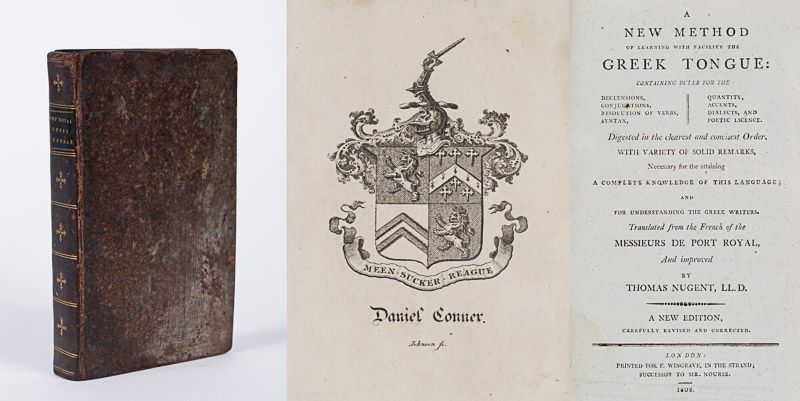
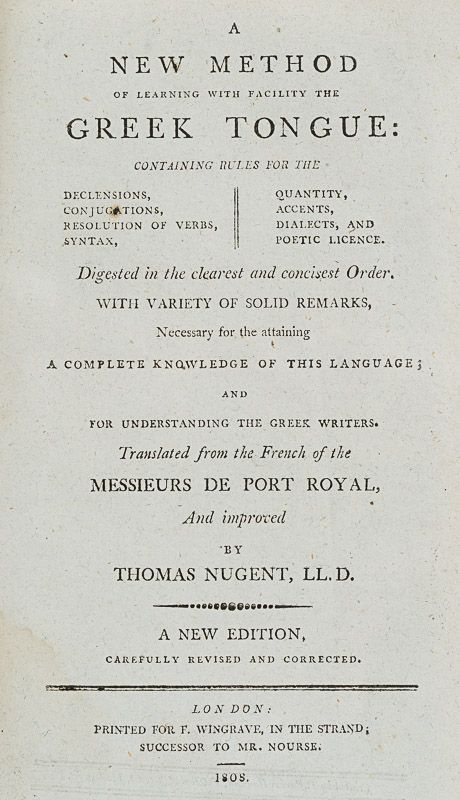
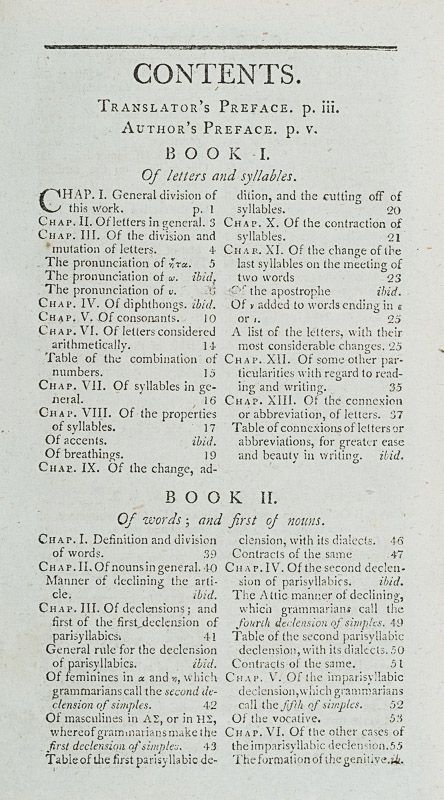
A New Method of learning with facility the Greek Tongue : Containing Rules for the Declensions, Conjunctions, Resolution of Verbs, Syntax, Quantity, Accents, Dialects, And Poetic Licence. Digested in the clearest and concisest order. With Variety of solid remarks, necessary for the attaining A complete knowledge of this language; And for understanding the Greek writers. Translated from the French of the Messieurs de Port-Royal, And improved by Thomas Nugent, LL.D.
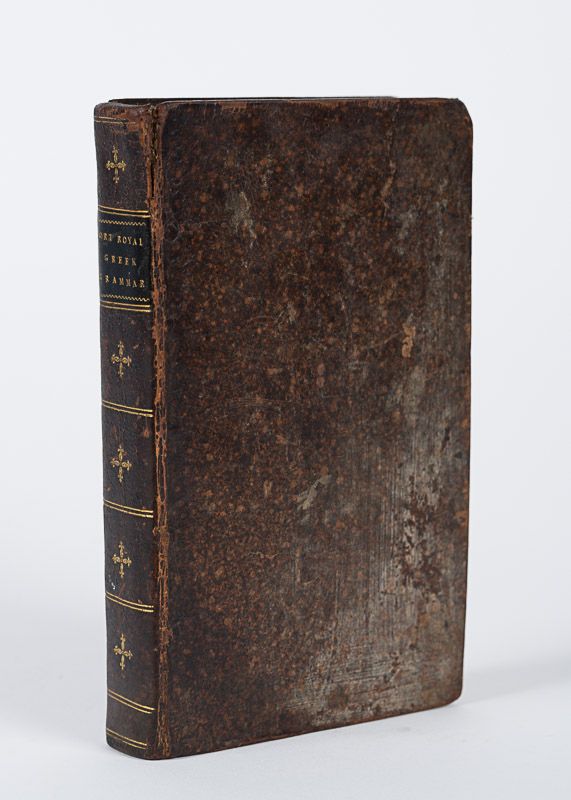
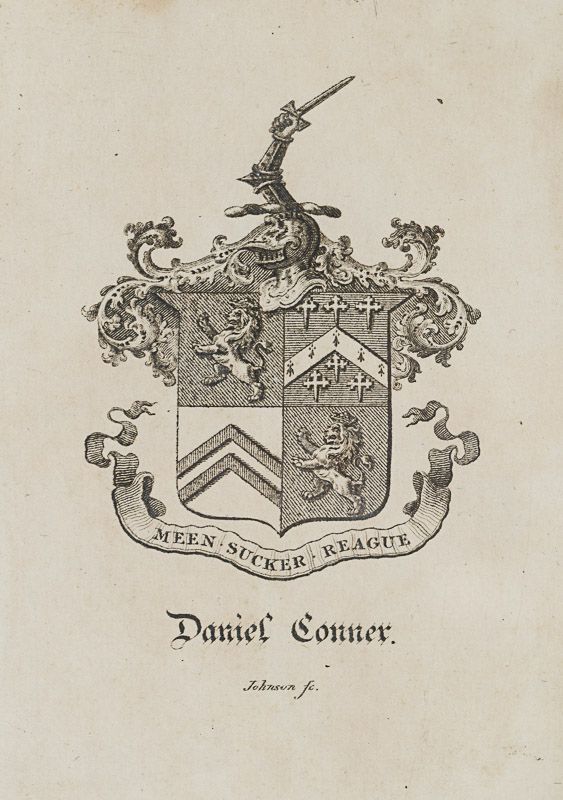
A New Edition, carefully revised and corrected. London, Printed for Wingrave, in the Strand, Successor to Mr. Nourse, 1808. Octavo. XXX, [10], 476 pages. Hardcover / Original, full leather, with gilt lettering and ornament to spine. Upper hinge slightly split. Besides a minor discoloration to the front board, in very good and firm condition with only minor signs of wear. From the library of Daniel Conner (Connerville / Manch House), with his Exlibris / Bookplate to pastedown.
Claude Lancelot (c. 1615 – 1695) was a French Jansenist monk and grammarian.
Lancelot was born in Paris. He participated in the creation of the Petites écoles de Port-Royal in May 1638 (then under the spiritual guidance of Jean Duvergier de Hauranne, the abbot of Saint-Cyran). Lancelot was in charge of the education of the duke of Chevreuse and of the princes of Conti. From 1638 until 1660, Lancelot continued to be associated with the religious community around the Abbey of Port-Royal-des-Champs.
Lancelot authored Nouvelle méthode pour apprendre la langue latine or New Method of Learning Latin (1644); Nouvelle méthode pour apprendre la langue grecque or New Method of Learning Greek (1655); Jardin des racines grecques or Garden of Greek Roots (1657), first published under the name Racines Grecques de Port-Royal; and, with Antoine Arnauld, Grammaire générale et raisonnée or General and Rational Grammar (1660), otherwise known as the Port-Royal Grammar.
In early 1660, Lancelot was forced to leave the Abbey, and was ultimately exiled to Brittany.
Lancelot died near the Holy-Cross Abbey, in Quimperlé, in 1695. (Wikipedia)
___________________________________________________________________________________________
Thomas Nugent (c. 1700 – 27 April 1772 in Gray’s Inn, London) was an erudite Irish historian and travel writer. Today he is best known for his travelogue of the Grand Tour, which was at that time popular particularly among English noblemen taking educational tours through Europe. His detailed descriptions of the France, Italy, Germany, and the Netherlands of the time provide a rich source for historians of the situation in the second half of the 18th century.
Little is known regarding his early years. He admittedly came from Ireland, though he spent most of his life in London. There he occupied himself as an author and translator. In the year 1749, he published the multi-volume work “The Grand Tour – containing an exact description of most of the cities, towns and remarkable places of Europe”. This was the first detailed guidebook for English gentlemen wanting to go on the Grand Tour of Europe. Whether Nugent had actually undertaken this tour himself in unknown, although it is assumed on the basis of the detailed information and evident knowledge of the places depicted therein.
Nugent devoted himself in the following years to translating works by prominent jurists, philosophers, and political thinkers of his time, mostly from French into English. This included a 1750 translation of Montesquieu’s De l’esprit des lois into English as The Spirit of Laws, a 1751 translation of Jean-Jacques Burlamaqui’s Principes du droit politique as Principles of Politic Law (1752), and in 1756 a translation of Étienne Bonnot de Condillac’s Essai sur l’origine des connaissances humaines as Essay on the Origin of Human Knowledge.
Also in 1756, a newly updated version of his travelogue was published with the title “The Grand Tour, or, A journey through the Netherlands, Germany, Italy and France”. In the year 1759, he published a translation of the French historian Philippe Macquer (1720-1770) of Roman History (″Chronological Abridgement of the Roman History”). He then devoted himself to the French history of Charles-Jean-Francois Henault, (″Chronological Abridgment of the History of France”, 1762). Nugent received a doctorate of law from the Scottish University of Aberdeen in 1765. After this he planned to write a history of the Vandals, thus studying the source material on his trip to Germany. He traveled through northern Germany, from Hamburg through Lübeck to Mecklenburg, where he suspected to be the original homeland or the early settlement of the Vandals.
On his return to England, he not only published his history of the Vandals (″The History of Vandalia Containing the ancient and present state of the country of Mecklenburg”) in 1766, but also in 1768 was published his German travel experiences in the form of several letters to a fictitious friend at home. This work (original title: Travels through Germany: containing observations on customs, manners, religion, government, commerce, arts, and antiquities: with a particular account of the Courts of Mecklenburg in a series of letters to a friend) was written, amongst others, at Hamburg, Lübeck and several cities and villages in the then Mecklenburg-Schwerin and Mecklenburg-Strelitz, including Schwerin, Rostock, Wismar, Ludwigslust, Doberan, Güstrow, Bützow, Waren, Neustrelitz, Mirow and Neubrandenburg.
In 1771 he wrote a book about the Florentine Renaissance sculptor Benvenuto Cellini. Inspired by the success of his travelogue, he now translated a guidebook of London which was the first work aimed at foreign readers visiting England. This book (original title: “A tour to London, or, New observations on England and its inhabitants”) appeared in 1772, the same year that Nugent died in London.
Following his death, his guidebooks enjoyed yet even greater popularity. A third edition of his “Grand Tour” appeared in 1778. His two-volume travelogue about northern Germany – Travels through Germany – which appeared in 1768 gave great interest there. The Mecklenburg-based Professor Lorenz Karsten translated the work into German and published it in 1781 by Friedrich Nicolai. This book, in which among other things the Lübeck Dance of Death [Totentanz] is described, made Nugent famous in Germany and was largely abridged in 1938, as well as appearing in new annotated editions in 1998 and 2000. Goethe’s translation of the life of Benvenuto Cellini from the year 1803 was partly based on the Italian original, and partly based on the English version by Thomas Nugent. (Wikipedia)
- Keywords: 18th / 19th Century Country House Library of Daniel Conner – Manch House · 18th Century – Irish Country House Library · Altphilologie · Catalogue Greek History & Philosophy · Catalogue Irish History Seven – Irish Literature – Poetry – Music – Theatre · Catalogue Irish History Two – Origins of Irish Identity · Classical Literature · Classical Literature – Rare · Classical Philology · Classical Studies · Classical Studies – Rare · Classics · Daniel Conner Library · Daniel Conner Library (Connerville / Manch House / Bandon) · Greek Grammar · Greek History · Greek Language · Greek Literature · Greek Philosophy · Irish History – Rare · Philologie · Philology
- Language: Greek - English
- Inventory Number: 32397AB
EUR 375,--

We ship per DHL Express
Contact
Inanna Rare Books Ltd.
Woodley House
Castletownshend Road
P81 D262 Skibbereen, County Cork
Ireland
Phone: ++353 - (0) 87 - 102 5412
E-Mail: info@inannararebooks.com
Internet: https://www.inannararebooks.com
Online Bookshop specialized in rare
and secondhand books.
Newsletter and E-Catalogue Sign Up
Payment Options


© 2026 Inanna Rare Books Ltd. | Powered by HESCOM-Software

