


[Homer, Apollonius of Rhodes / Apollonius Rhodius. Apollonii Rhodii Argonautica
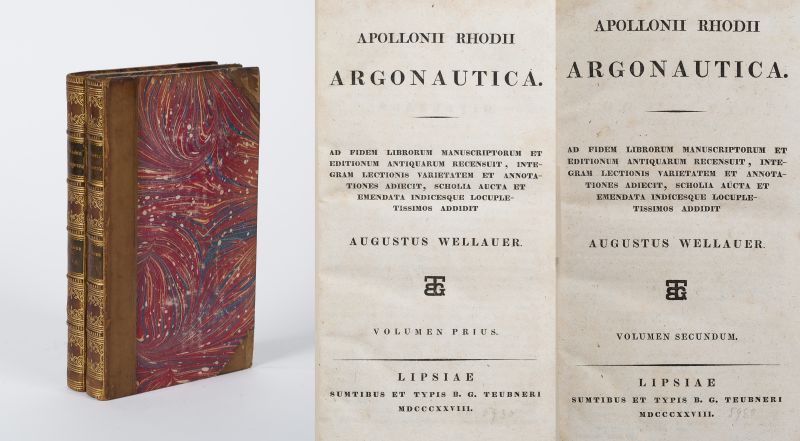
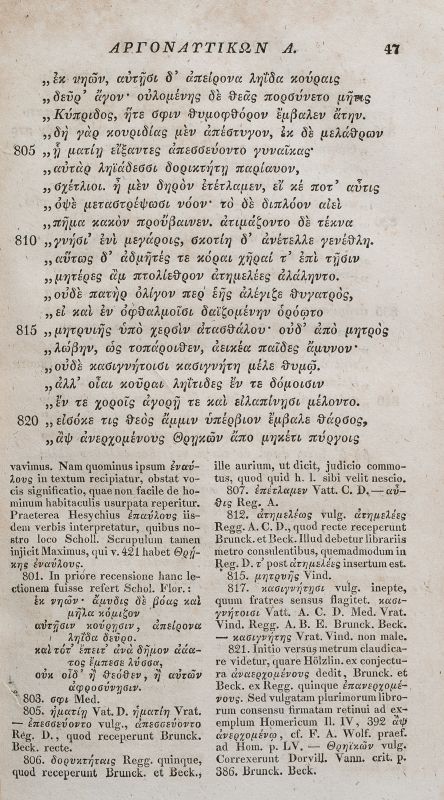
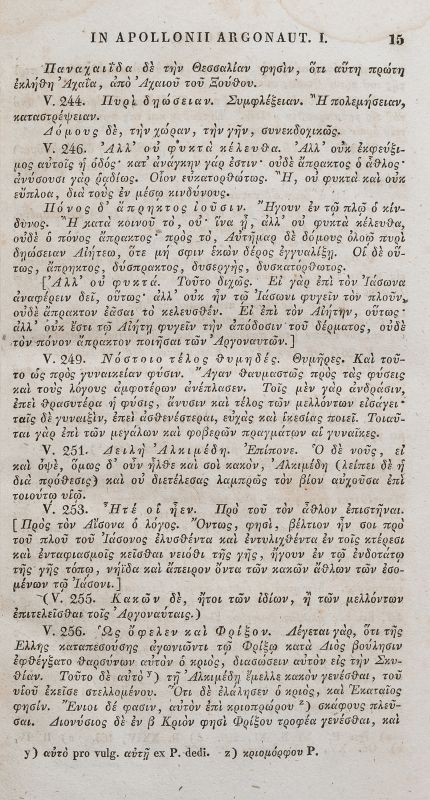
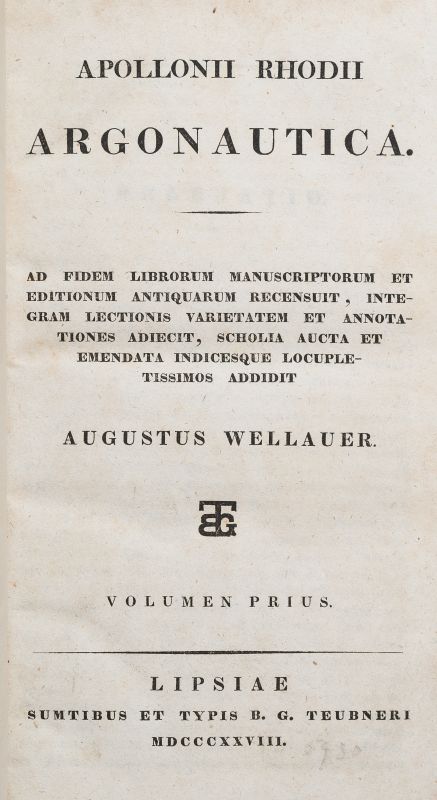
Apollonii Rhodii Argonautica – Ad Fidem Librorum Manuscriptorum Et Editionum Antiquarum Recensuit, Integram Lectionis Varietatem Et Annotationes Adiecit, Scholia Aucta Et Emendata Indicesque Locupletissiomos Addidit Augustus Wellauer.
Two Volumes (complete set). Leipzig, B.G. Teubner, 1828. Octavo. Pagination: Volume I: XIV, 293 pages / Volume II: 318 pages. Hardcover / Very decorative, original full leather with gilt lettering and ornament on spine. Very good condition with only minor signs of wear. Minor signs of a faded dampdstain to outer margins
Apollonius was among the foremost Homeric scholars in the Alexandrian period. He wrote the period’s first scholarly monograph on Homer, critical of the editions of the Iliad and Odyssey published by Zenodotus, his predecessor as head of the Library of Alexandria. Argonautica seems to have been written partly as an experimental means of communicating his own researches into Homer’s poetry and to address philosophical themes in poetry. It has even been called “a kind of poetic dictionary of Homer”, without at all detracting from its merits as poetry. He has been credited with scholarly prose works on Archilochus and on problems in Hesiod. He is also considered to be one of the period’s most important authors on geography, though approaching the subject differently from Eratosthenes, his successor at the library and a radical critic of Homer’s geography. It was a time when the accumulation of scientific knowledge was enabling advances in geographical studies, as represented by the activities of Timosthenes, a Ptolemaic admiral and a prolific author. Apollonius set out to integrate new understandings of the physical world with the mythical geography of tradition and his Argonautica was, in that sense, a didactic epic on geography, again without detracting from its merits as poetry. (Wikipedia)
Apollonius of Rhodes (Ancient Greek: Apollonios Rhódios; Latin: Apollonius Rhodius; fl. first half of 3rd century BC) was an ancient Greek author, best known for the Argonautica, an epic poem about Jason and the Argonauts and their quest for the Golden Fleece. The poem is one of the few extant examples of the epic genre and it was both innovative and influential, providing Ptolemaic Egypt with a “cultural mnemonic” or national “archive of images”, and offering the Latin poets Virgil and Gaius Valerius Flaccus a model for their own epics. His other poems, which survive only in small fragments, concerned the beginnings or foundations of cities, such as Alexandria and Cnidus places of interest to the Ptolemies, whom he served as a scholar and librarian at the Library of Alexandria. A literary dispute with Callimachus, another Alexandrian librarian/poet, is a topic much discussed by modern scholars since it is thought to give some insight into their poetry, although there is very little evidence that there ever was such a dispute between the two men. In fact, almost nothing at all is known about Apollonius and even his connection with Rhodes is a matter for speculation. Once considered a mere imitator of Homer, and therefore a failure as a poet, his reputation has been enhanced by recent studies, with an emphasis on the special characteristics of Hellenistic poets as scholarly heirs of a long literary tradition writing at a unique time in history.
The most reliable information we have about ancient poets is largely drawn from their own works. Unfortunately, there is little to no evidence that Apollonius of Rhodes revealed information about himself in his writings. Most of the biographical material comes from four sources: two are texts entitled Life of Apollonius found in the scholia on his work (Vitae A and B); a third is an entry in the 10th-century encyclopaedia the Suda; and fourthly a 2nd-century BC papyrus, P.Oxy. 1241, which provides names of several heads of the Library of Alexandria. Other scraps can be gleaned from miscellaneous texts. The reports from all the above sources however are scanty and often self-contradictory.
Ancient biographies often represent famous poets as going into exile to escape their ungrateful fellow citizens. Thus for example Homer was said to have left Cyme because the government there would not support him at public expense (Vit. Herod. 13-14), Aeschylus left Athens for Sicily because Athenians valued him less than some other poets (Vit. Aesch.), while Euripides fled to Macedonia because of humiliation by comic poets (Vit. Eur.). Similarly Vitae A and B tell us that Apollonius moved to Rhodes because his work was not well received in Alexandria. According to B, he redrafted the Argonautica in such fine style at Rhodes that he was able to return to Alexandria in triumph, where he was rewarded with a post in the library and finally a place in the cemetery next to Callimachus. These stories were probably invented to account for the existence of a second edition of Argonautica, indicated by variant readings in ancient manuscripts. (Wikipedia)
______________________________________________________
August Wellauer (* 9. Juni 1798 in Breslau; † 26. Juni 1831 in Wien) war ein deutscher Klassischer Philologe und Gymnasiallehrer.
Schon in seiner Kindheit zeigte Wellauer eine große Begabung: Nach Privatunterricht kam er mit sieben Jahren auf das Maria-Magdalenen-Gymnasium und mit neun Jahren auf das Friedrichsgymnasium, wo er mit sechzehn Jahren die Reifeprüfung ablegte. Anschließend studierte er Philologie und Theologie an der Universität Breslau, wo er 1817 in das pädagogische Seminar aufgenommen und im Oktober 1819 promoviert wurde. Zu seinen akademischen Lehrern gehörten Karl Ernst Christoph Schneider und Franz Passow.
Ein Jahr nach der Promotion folgte Wellauers Habilitation an der Universität (Oktober 1820), an der er seitdem als Privatdozent Vorlesungen und Übungen abhielt, auch nachdem er 1821 am Maria-Magdalenen-Gymnasium als siebter Lehrer arbeitete. Erst 1826 gab er seine Lehrtätigkeit an der Universität auf. 1827 wurde er zum Prorektor und Gymnasialprofessor am Elisabeth-Gymnasium ernannt. Er starb bereits im Alter von 33 Jahren an den Folgen einer langwierigen Brustkrankheit auf der Rückkehr von einer Kurreise nach Triest.
Neben seiner Lehrtätigkeit an Universität und Schule war Wellauer auch wissenschaftlich tätig. Er verfasste zahlreiche Aufsätze über die griechische Literatur. Neben seinen Qualifikationsschriften über den Tragiker Aischylos (1819) und das attische Fest der Thesmophorien (1820) gab er Textausgaben des Aischylos (zwei Bände, Leipzig 1823–1824. Nachdruck Cambridge 1827) und des Epikers Apollonios von Rhodos (zwei Bände, Leipzig 1828) sowie ein Lexicon Aeschyleum (Leipzig 1831) heraus. Seine kritischen Edition des Apollonios bedeutete einen großen Fortschritt, da Wellauer verschiedene Handschriften heranzog, Textvarianten sorgfältig dokumentierte und für die Textgestalt philologische tragfähige Emendationen vornahm. (Wikipedia)
- Keywords: Altphilologie · Catalogue Greek History & Philosophy · Classical Literature · Classical Literature – Rare · Classical Philology · Classical Studies · Classical Studies – Rare · Classics · Greek History · Greek Philosophy · Philologie · Philology
- Language: Latin
- Inventory Number: 32398AB
EUR 280,--

We ship per DHL Express


Contact
Inanna Rare Books Ltd.
Woodley House
Castletownshend Road
P81 D262 Skibbereen, County Cork
Ireland
Phone: ++353 - (0) 87 - 102 5412
E-Mail: info@inannararebooks.com
Internet: https://www.inannararebooks.com
Online Bookshop specialized in rare
and secondhand books.
Newsletter and E-Catalogue Sign Up
Payment Options


© 2026 Inanna Rare Books Ltd. | Powered by HESCOM-Software

