


[Aeschines / Attic orator] / [Demosthenes] / [Taylor, Aischinou Ho kata Ktesipho
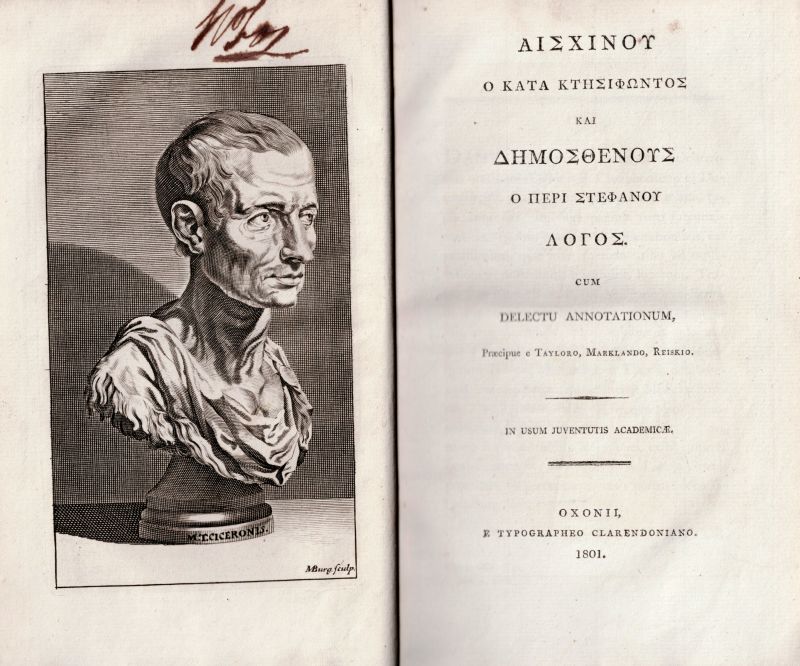
Aischinou Ho kata Ktesiphontos kai Demosthenous Ho peri stephanou logos. Cum Delectu Annotationum, Præcipue e Tayloro, Marklando, Reiskio. In Usum Juventutis Academicae.
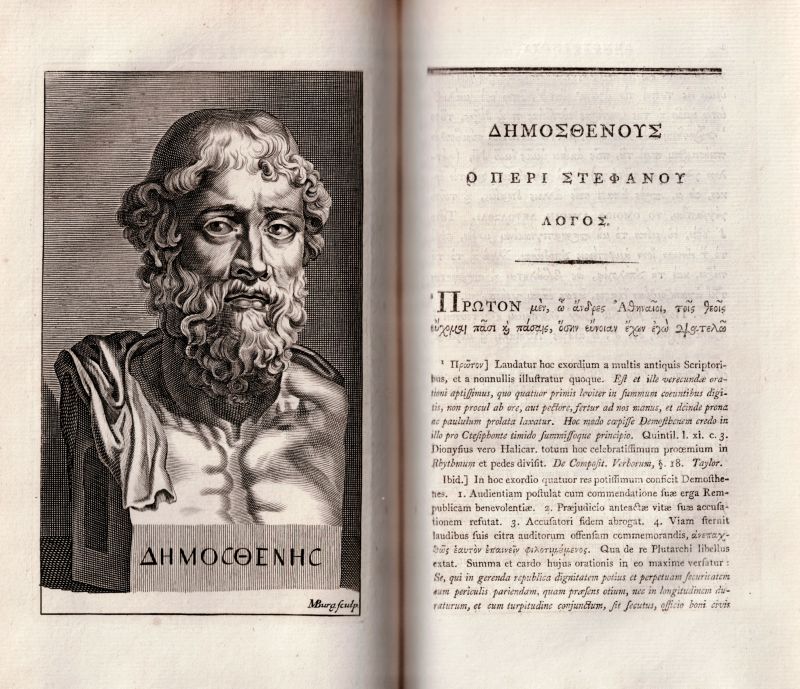
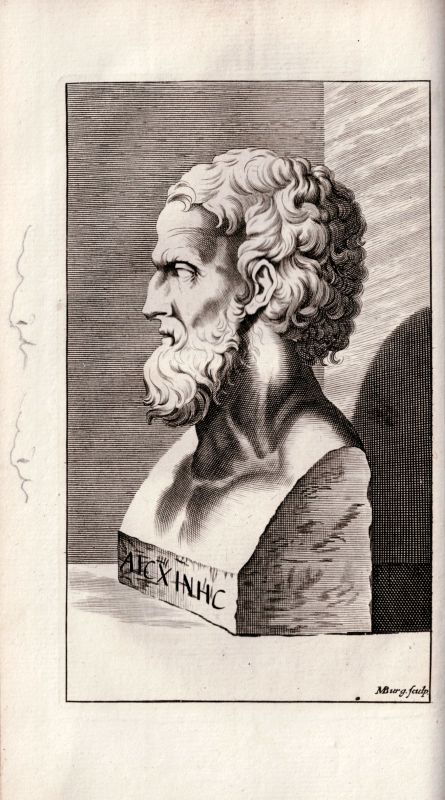
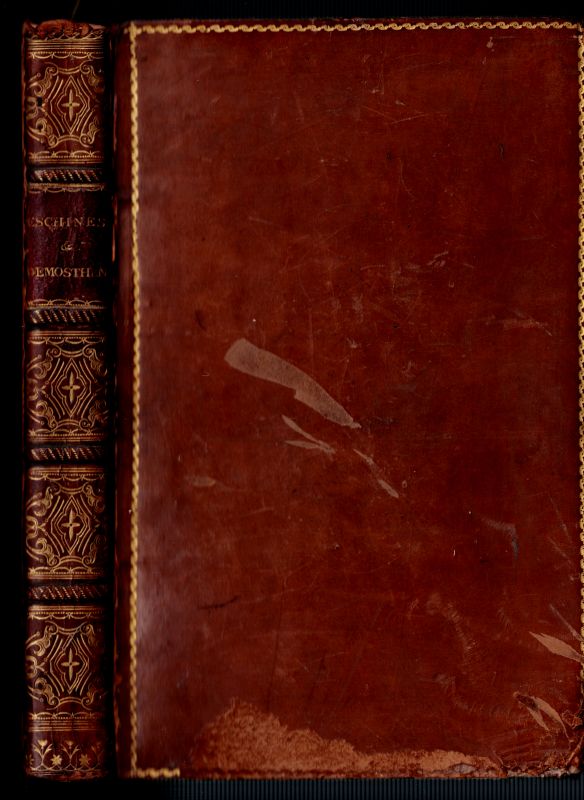
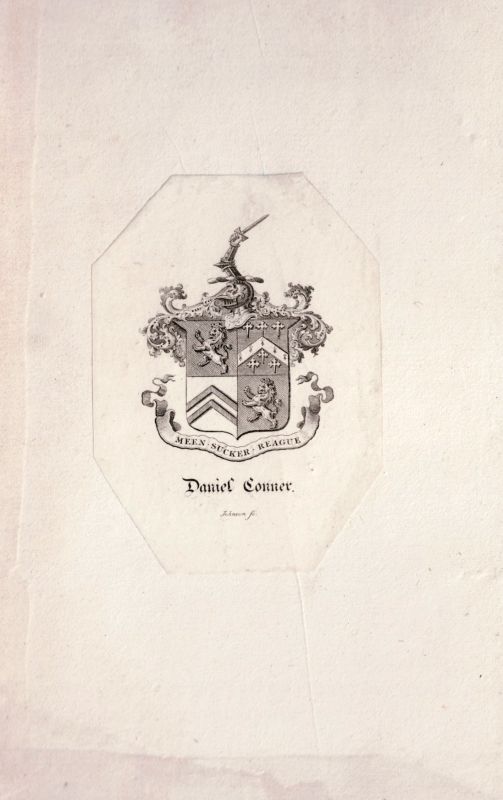
Two Volumes in one (complete), Oxford, Clarendon Press, 1801. Octavo. Pagination: Volume I: Portrait-Frontispiece of Cicero, XLVIII, [2], Portrait of Aeschines, 130 pages / Volume II: XXI, Portrait of Demosthenes, 165 pages plus 24 unnumbered pages of an “Index sive Vocum Difficiliorum”. Hardcover / Original, full leather with original spine-label and gilt lettering and ornament to spine. Front hinge starting. Binding a bit scuffed to upper hinge but beautifully firm and with the endpapers intact. Some very interesting, contemporary annotations in ink. From the library of Daniel Conner (Connerville / Manch House), with his Exlibris / Bookplate to pastedown. A very rare book !!
This is the very interesting Clarendon edition of Aeschines’ Against Ctesiphon and Demosthenes’ of the competing speeches “On the Crown” by Aeschines and Demosthenes.
The work includes a selection of notes (″delectu annotationum”), primarily from three of the most eminent 18th-century classical scholars: John Taylor, Jeremiah Markland and Johann Jacob Reiske [also ‘Reiskio’].
″On the Crown” is the most famous judicial oration of the prominent Athenian statesman and orator Demosthenes, delivered in 330 BC.
Historical background
Despite the unsuccessful ventures against Philip II of Macedon and Alexander the Great, the Athenian people still respected and admired Demosthenes, maybe even more than the pro-Macedonian politicians, especially Demades and Phocion, who ruled the city during this period. In 336 BC the orator Ctesiphon proposed that Athens honor Demosthenes for his services to the city by presenting him, according to custom, with a golden crown (stephane). This proposal became a political issue in 330 BC, and Aeschines prosecuted Ctesiphon for having violated the law on three points:
For making false allegations in a state document.
For unlawfully conferring a crown to a state official (Demosthenes) who had not yet rendered a report of his term of office.
For unlawfully offering the crown at the Dionysia.
Content of the speech
In On the Crown, which is considered one of the most splendid political pleas ever written, Demosthenes not only defended Ctesiphon but also attacked vehemently those who would have preferred peace with Macedon. In this trial, Demosthenes’ entire political career was at issue, but the orator repudiated nothing of what he had done. He begins with a general view of the condition of Greece when he entered politics and describes the phases of his struggle against Philip. He then deals with the Peace of Philocrates and blames Aeschines for his role during the negotiations and the ratification of the treaty. He also launches a personal attack against Aeschines, whom he holds up to ridicule as born of low and infamous parents. To this he adds charges of corruption and treason, and attributes the disaster of Chaeronea to the conduct of his political opponent, when representing Athens in the council of the Amphictyonic League. He underscores that he alone stood up to promote a coalition with Thebes. The orator asserts that, although Athens was defeated, it was better to be defeated in a glorious struggle for independence, than to surrender the heritage of liberty.
Demosthenes finally defeated Aeschines by an overwhelming majority of votes. As a result, Ctesiphon was acquitted and Aeschines fined and forced into exile.
Many scholars have concluded that Aeschines’s speech presented a very plausible, although not incontrovertible, legal case.
Assessments
On the Crown has been termed “the greatest speech of the greatest orator in the world”. Scholar Richard Claverhouse Jebb, analysing the oratorical contest between Demosthenes and Aeschines in 330 BC, underscores that this fierce debate illustrates the last great phase of political life at Athens. Noteworthy, the combat of eloquence attracted to Athens an immense concourse of spectators. “The theory of Greek eloquence had its final and its most splendid illustration in that trial which brought forth the two speeches On the Crown: nor could this part of our discussion conclude more fittingly than with an endeavour to call up some faint image of Demosthenes as in that great cause he stood opposed to Aeschines.” (Wikipedia)
___________________________________________________
Aeschines (389–314 BC) was a Greek statesman and one of the ten Attic orators.
Although it is known he was born in Athens, the records regarding his parentage and early life are conflicting; but it seems probable that his parents, though poor, were respectable. Aeschines’ father was Atrometus, an elementary school teacher of letters. His mother Glaukothea assisted in the religious rites of initiation for the poor. After assisting his father in his school, he tried his hand at acting with indifferent success, served with distinction in the army, and held several clerkships, amongst them the office of clerk to the Boule. Among the campaigns that Aeschines participated in were Phlius in the Peloponnese (368 BC), Battle of Mantinea (362 BC), and Phokion’s campaign in Euboea (349 BC). The fall of Olynthus (348 BC) brought Aeschines into the political arena, and he was sent on an embassy to rouse the Peloponnese against Philip II of Macedon.
In spring of 347 BC, Aeschines addressed the assembly of Ten Thousand in Megalopolis, Arcadia urging them to unite and defend their independence against Philip. In the summer 347 BC, he was a member of the peace embassy to Philip, where he found it necessary, in order to counteract the prejudice vigorously fomented by his opponents, to defend Philip and describe him at a meeting of the Athenian popular assembly as being entirely Greek. His dilatoriness during the second embassy (346 BC) sent to ratify the terms of peace led to him being accused by Demosthenes and Timarchus on a charge of high treason. Aeschines counterattacked by claiming that Timarchus had forfeited the right to speak before the people as a consequence of youthful debauches which had left him with the reputation of being a whore and prostituting himself to many men in the port city of Piraeus. The suit succeeded and Timarchus was sentenced to atimia and politically destroyed, according to Demosthenes. This comment was later interpreted by Pseudo-Plutarch in his Lives of the Ten Orators as meaning that Timarchos hanged himself upon leaving the assembly, a suggestion contested by some modern historians.
This oration, Against Timarchus, is considered important because of the bulk of Athenian laws it cites. As a consequence of his successful attack on Timarchus, Aeschines was cleared of the charge of treason.
In 343 BC the attack on Aeschines was renewed by Demosthenes in his speech On the False Embassy. Aeschines replied in a speech with the same title and was again acquitted. In 339 BC, as one of the Athenian deputies (pylagorae) in the Amphictyonic Council, he made a speech which brought about the Fourth Sacred War.
By way of revenge, Aeschines endeavoured to fix the blame for these disasters upon Demosthenes. In 336 BC, when Ctesiphon proposed that his friend Demosthenes should be rewarded with a golden crown for his distinguished services to the state, Aeschines accused him of having violated the law in bringing forward the motion. The matter remained in abeyance till 330 BC, when the two rivals delivered their speeches Against Ctesiphon and On the Crown. The result was a complete and overwhelming victory for Demosthenes.
Aeschines went into voluntary exile at Rhodes (to avoid the judgement of the jury, which was likely a large sum of money), where he opened a school of rhetoric. He afterwards removed to Samos, where he died aged 75. His three speeches, called by the ancients “the Three Graces,” rank next to those of Demosthenes. Photius knew of nine letters by him which he called The Nine Muses; the twelve published under his name (Hercher, Epistolographi Graeci) are not genuine. (Wikipedia)
- Keywords: 18th / 19th Century Country House Library of Daniel Conner – Manch House · Altphilologie · Catalogue Greek History & Philosophy · Classical Literature · Classical Literature – Rare · Classical Philology · Classical Studies · Classical Studies – Rare · Classics · Daniel Conner Library · Daniel Conner Library (Connerville / Manch House / Bandon) · Greek History · Greek Philosophy · Law – Rare · Philologie · Philology
- Language: Greek - Latin
- Inventory Number: 32412AB
EUR 780,--

We ship per DHL Express

Contact
Inanna Rare Books Ltd.
Woodley House
Castletownshend Road
P81 D262 Skibbereen, County Cork
Ireland
Phone: ++353 - (0) 87 - 102 5412
E-Mail: info@inannararebooks.com
Internet: https://www.inannararebooks.com
Online Bookshop specialized in rare
and secondhand books.
Newsletter and E-Catalogue Sign Up
Payment Options


© 2026 Inanna Rare Books Ltd. | Powered by HESCOM-Software

