


[Gifford, The Anti-Jacobin Review and Magazine ; Or Monthly Political and Litera
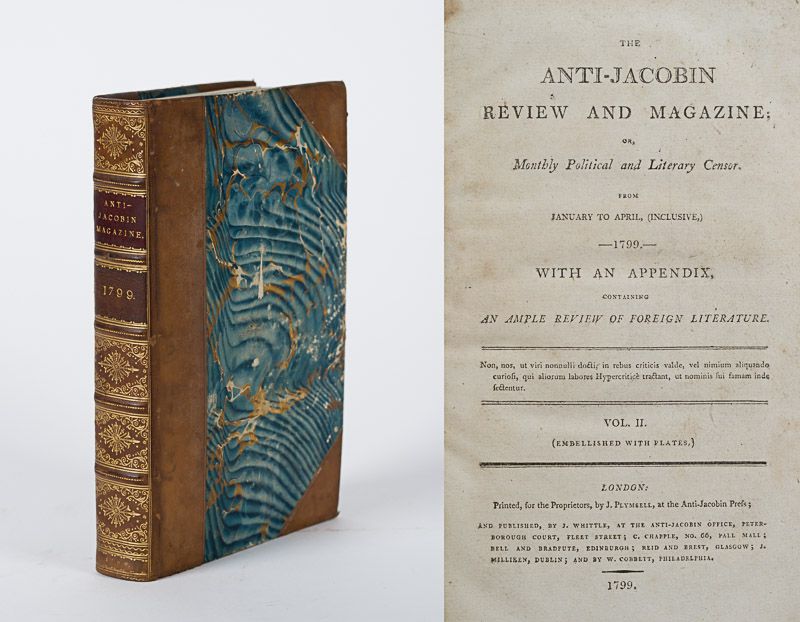
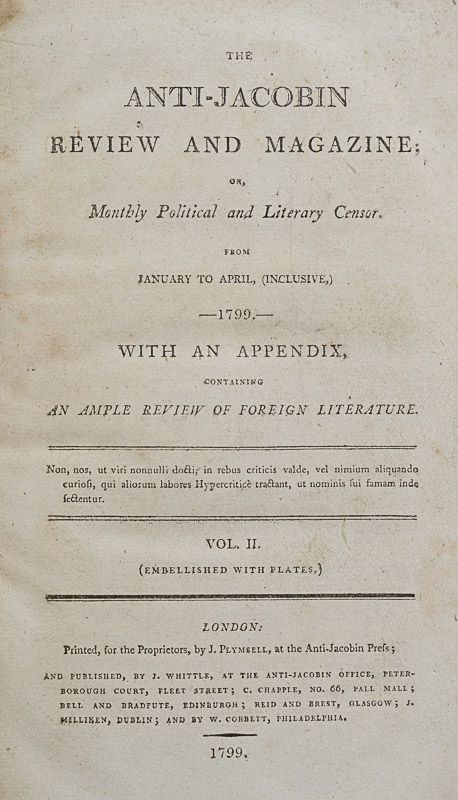
The Anti-Jacobin Review and Magazine ; Or Monthly Political and Literary Censor. From January to April, (Inclusive) 1799 – With an Appendix, containing An Ample Review of Foreign Literature. [This being the Rare Volume which deals with the 1798 Irish Rebellion and its aftermath reflected in publications]. Volume II (Embellished with Plates).
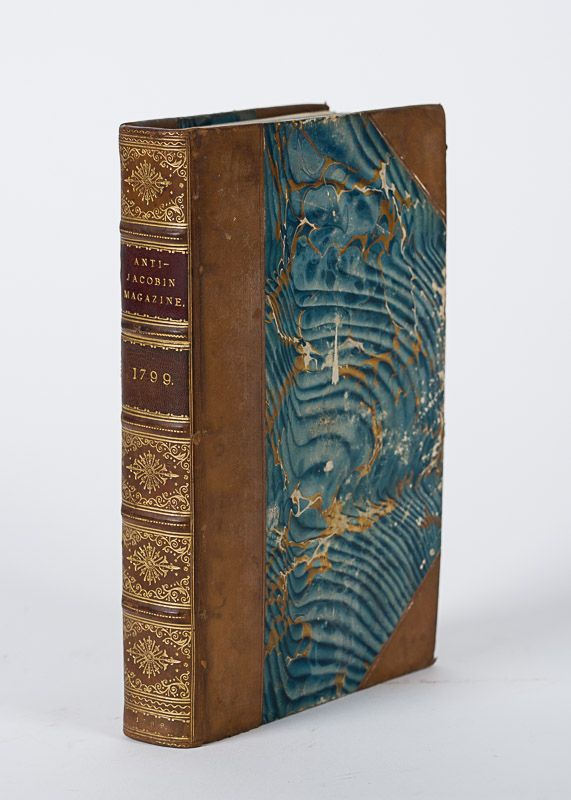
London, Printed for the Proprietors, by J. Plymell, at the Anti-Jacobin Press, 1799. Octavo (14 cm wide x 22.5 cm high). IV, 586 pages. With three Illustrations (Two XXL-Fold-out Caricatures by Thomas Rowlandson and one Engraving on Nelson in Octavo by Alexander Davison). Hardcover / Original, very decorative half-leather with gilt lettering and prnament on spine and marbled-paper-covered boards. In protective Collectors-Mylar. Very good condition with only minor signs of wear. Very Rare original edition in its original binding !
Includes the following, original engravings:
1. Thomas Rowlandson:
Extra-Large Fold-Out Plate by caricaturist Thomas Rowlandson:
″A charm for a Democracy, reviewed, analysed & destroyed Jany 1st 1799 to the confusion of its affiliated friends”.
Size: 46.5 cm wide x 30.7 cm high / Condition: Very minor tear only but overall in excellent condition.
2. Alexander Davison:
″Nelson’s Medal” Engraved by permission of Alexander Davison
Size: 21.7 cm wide x 12 cm high / Minor, faded dampstain to margin only.
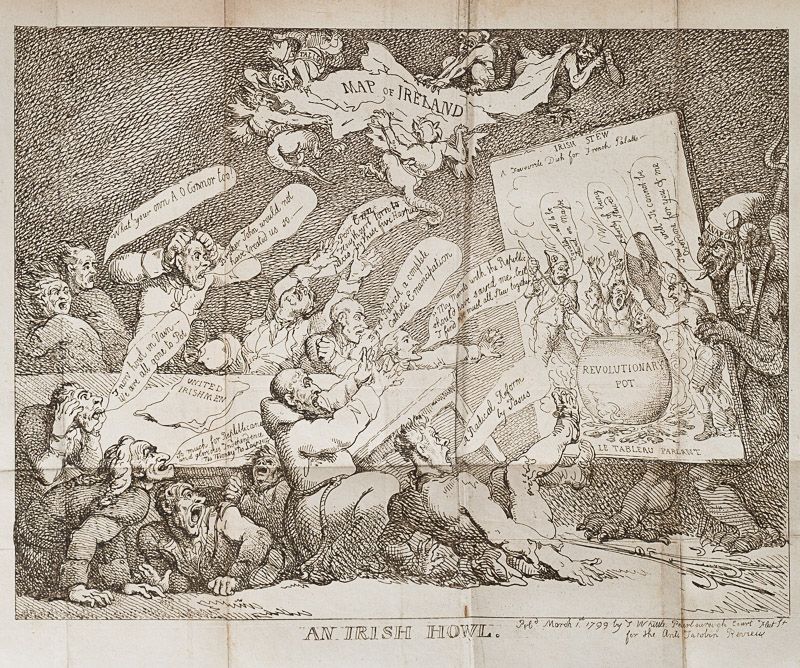
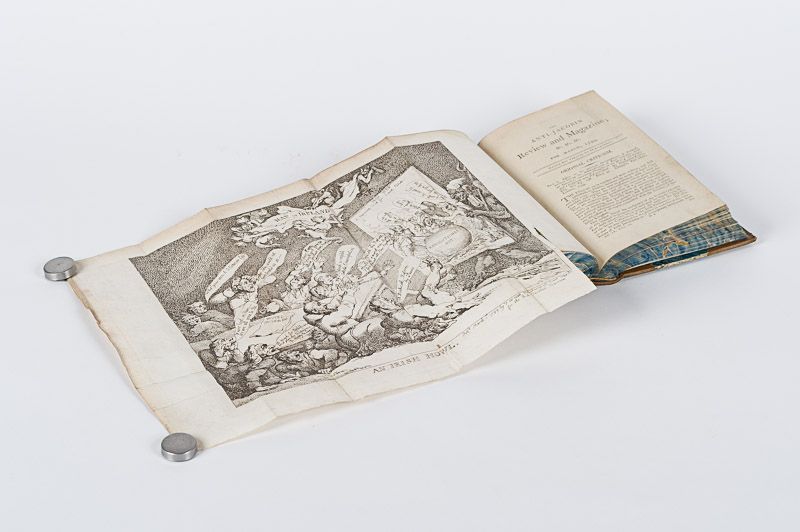
3. Thomas Rowlandson:
Extra-Large Fold-Out Plate by caricaturist Thomas Rowlandson:
″An Irish Howl” (With the famously bullied “Map of Ireland”)
Size: 36.7 cm wide x 28 cm high / Excellent condition !
This is Volume II of “The Anti-Jacobin Review and Magazine.
The Volume includes four monthly sections from January, 1799 – April, 1799 plus an Appendix
January 1799 includes for example the following Essays (just a selection):
Article I. Thomas Walter Williams, Esq. of the Inner Temple, Barrister at Law:
″An Abridgement of Cases argued and determined in the Courts of Law, during the Reign of his present Majesty King George III″
Article II. Robinson’s View of the Causes and Consequences of English Wars
Article VII. A Short Account of the Principal Proceedings of Congress, in the late Session, and a Sketch of the State of Affairs between the United States and France, in July 1798 – In a Letter from Robert Goodloe Harper, Esq. of South Carolina, to one of his Constituents.
[″The Genius of Demnocracy…]
Article XI. An Address to the People on the present relative Situation of England and France, with reflections on the Genius of Democracy and on Parliamentary Reform. By Robert Fellowes.
Article XII. Travels through the States of North America, and the Provinces of Upper and Lower Canada, during the Years 1795, 1796 and 1797. By Isaac Weld, junior
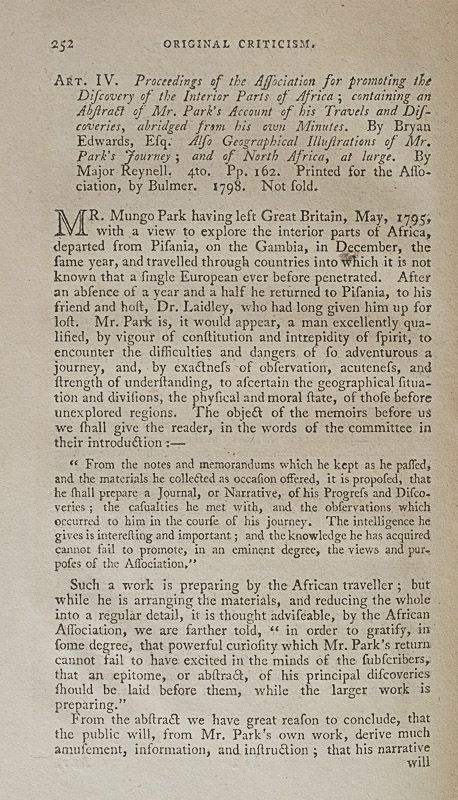
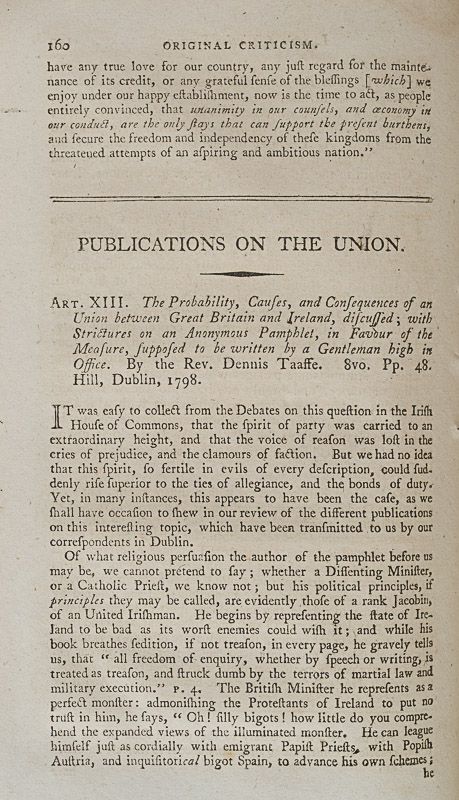
The March Section includes for example on of the many articles and reviews on publications which deal with the Irish Rebellion:
″Original Criticism”: Art. I:
″Essays on the political Circumstances in Ireland, writtend uring the Administration of Earl Camden, with an Appendix, containing Thoughts on the Will of the People” By Alexander Knox
etc. etc.
The Anti-Jacobin Review and Magazine, or, Monthly Political and Literary Censor, was a British conservative political journal active from 1798 to 1821. Founded by John Gifford after the cancellation of William Gifford’s periodical Anti-Jacobin, the journal contained essays, reviews, and satirical engravings. Its content has been described as “often scurrilous” and “ultra-Tory” and was a prominent element of British hostility to Jacobinism and the broader ideals of the French Revolution.
The first edition was published on 1 August 1798 and was advertised in The Times as “containing Original Criticism; a Review of the Reviewers; Miscellaneous Matter in Prose and Verse, Lists of Marriages, Births, Deaths and Promotions; and a Summary of Foreign and Domestic Politics.” Gifford served as its editor until 1806. The periodical was covertly funded by the British government.
Contributors included Robert Bisset (1758/9–1805), John Bowles (1751–1819), Arthur Cayley (1776–1848), James Gillray, George Gleig, Samuel Henshall (1764/5–1807), James Hurdis, James Mill, John Oxlee (1779–1854), Richard Penn (1733/4–1811), Richard Polwhele, John Skinner (1744–1816), William Stevens (1732–1807), and John Whitaker (1735–1808), though as items were frequently published anonymously attributions are often unclear.
Gifford called the periodical a champion of “religion, morality, and social order, as supported by the existing establishments, ecclesiastical and civil, of this country.
The periodical promoted conspiracy theories of attempts to establish Jacobinism in Britain, accusing the Monthly Review, the Analytical Review and The Critical Review of spreading Jacobinism through “secret channels, disguised in various ways.” It supported the passage of the Unlawful Societies Act 1799 and the Combination Act 1799, arguing that the state needed the “wisdom to repress” in order to effectively defeat “domestic traitors.” It also opposed the Irish Rebellion of 1798. (Wikipedia)
__________________________________________________________________
Thomas Rowlandson (13 July 1757 – 21 April 1827)[1] was an English artist and caricaturist of the Georgian Era, noted for his political satire and social observation. A prolific artist and printmaker, Rowlandson produced both individual social and political satires, as well as a large number of illustrations for novels, humorous books, and topographical works. Like other caricaturists of his age such as James Gillray, his caricatures are often robust or bawdy. His caricatures included those of people in power such as the Duchess of Devonshire, William Pitt the Younger and Napoleon Bonaparte. Rowlandson also produced erotica for a private clientele; this was never published publicly at the time and is now only found in a small number of collections.
Rowlandson was born in Old Jewry, in the City of London. He was baptised on 23 July 1757 at St Mary Colechurch, London, to William and Mary Rowlandson. The baptismal record for St Mary, now in the London archives, clearly gives his birth-date as 13 July 1757, not 1756 as given in most earlier biographies. His father, William, had been a weaver, but had moved into trading supplies for the textile industry. After overextending himself, he was declared bankrupt in 1759. Life became difficult for William in London and, in late 1759, he moved his family to Richmond, North Yorkshire. Thomas’s uncle James died in 1764, and his widow Jane probably provided both the funds and accommodation which allowed Thomas to attend school in London.
In 1765 or 1766 Rowlandson started at the Soho Academy of Dr Cuthbert Barwis at 8 Soho Square, then “an academy of some celebrity”. One of his classmates was Richard Burke, son of the politician Edmund Burke. As a schoolboy, Rowlandson “drew humourous characters of his master and many of his scholars before he was ten years old,” covering the margins of his schoolbooks with his artwork. There is no documentary evidence that Rowlandson took drawing classes at the mainly business-oriented school, but it seems likely, as on leaving school in 1772, he became a student at the Royal Academy. According to his obituary of 22 April 1827 in The Gentleman’s Magazine, Rowlandson was sent to Paris at the age of 16 (1772), and spent two years studying in a “drawing academy” there. In Paris he studied drawing “the human figure” and continued developing his youthful skill in caricature. It was on his return to London that he took classes at the Royal Academy, then based at Somerset House.
Rowlandson spent six years studying at the Royal Academy, but about a third of this time was spent in Paris where he may have studied under Jean-Baptiste Pigalle. He later made frequent tours to the Continent, enriching his portfolios with numerous sketches of life and character. In 1775 he exhibited a drawing of Dalilah Payeth Sampson a Visit while in Prison at Gaza at the Royal Academy and two years later received a silver medal for a bas-relief figure. He was spoken of as a promising student. On the death of his aunt, he inherited £7,000 with which he plunged into the dissipations of the town and was known to sit at the gaming-table for 36 hours at a stretch.
In time poverty overtook him; and the friendship and examples of James Gillray and Henry William Bunbury seem to have suggested caricature as a means of earning a living. His drawing of Vauxhall, shown in the Royal Academy exhibition of 1784, had been engraved by Pollard, and the print was a success. Rowlandson was largely employed by Rudolph Ackermann, the art publisher, who in 1809—issued in his Poetical Magazine The Schoolmaster’s Tour—a series of plates with illustrative verses by Dr. William Combe. They were the most popular of the artist’s works. Again engraved by Rowlandson himself in 1812, and issued under the title of the Tour of Dr Syntax in Search of the Picturesque, they had attained a fifth edition by 1813, and were followed in 1820 by Dr Syntax in Search of Consolation, and in 1821 by the Third Tour of Dr Syntax in Search of a Wife. He also produced a body of erotic prints and woodcuts.
The same collaboration of designer, author and publisher appeared in the English Dance of Death, issued in 1814–16 and in the Dance of Life, 1817. Rowlandson also illustrated Smollett, Goldsmith and Sterne, and his designs will be found in The Spirit of the Public Journals (1825), The English Spy (1825), and The Humorist (1831).
Vauxhall Gardens (1785). The two women in the centre are Georgiana, Duchess of Devonshire, and her sister Lady Duncannon. The man seated at the table on the left is Samuel Johnson, with James Boswell to his left and Oliver Goldsmith to his right. To the right the actress and author Mary Darby Robinson stands next to the Prince of Wales, later George IV.
Rowlandson’s designs were usually done in outline with the reed-pen, and delicately washed with colour. They were then etched by the artist on the copper, and afterwards aquatinted—usually by a professional engraver, the impressions being finally coloured by hand. As a designer he was characterised by his facility and ease of draughtsmanship. He dealt less frequently with politics than his fierce contemporary, Gillray, but commonly touching, in a rather gentle spirit, the various aspects and incidents of social life. His most artistic work is to be found among the more careful drawings of his earlier period; but even among the exaggerated caricature of his later time we find hints that this master of the humorous might have attained to the beautiful had he so willed.
His work included a personification of the United Kingdom named John Bull who was developed from about 1790 in conjunction with other British satirical artists such as James Gillray and George Cruikshank. He also produced many works depicting the characters involved in election campaigns and race meetings. However, his satirical works of London’s street life such as the “pleasure gardens at Vauxhall, jostling with soldiers, students, tarts and society beauties”, which exhibit acute social observation and commentary are amongst his finest.
Rowlandson’s caricatures include those on the medical profession which developed through his friendship with John Wolcot around 1778. He also earned money illustrating books of physicians and quacks. Later in life, he also produced caricatures on medical themes.
His patron and friend Matthew Michell collected hundreds of his paintings which Michell displayed at his country residence, Grove House in Enfield, Middlesex. After Michell’s death his nephew, Sir Henry Onslow, sold the contents of Grove House at an eight-day sale in November 1818. One of the best-known of Rowlandson’s paintings is “Hengar House the seat of Matthw [sic] Mitchell Esqr., Cornwall” (1812) which was sold at the Sir Richard Onslow sale, Sotheby’s, 15 July 1959. Another of Rowlandson’s paintings is “Glorious Defeat of the Dutch Navy Octr 10 1797, by Admirals Lord Duncan and Sir Richard Onslow, with a View Drawn on the Spot of the Six Dutch Line of Battle Ships Captured and Brought into Yarmouth” (1797). Rowlandson also painted early scenes of Brighton where Michell’s sister, Lady Anne Onslow, lived after the death of her husband Sir Richard Onslow, 1st Baronet. Rowlandson’s painting “Mr Michell’s Picture Gallery at Grove House, Enfild” was sold by Sotheby’s, London, on 4 July 2002.
Rowlandson died on 21 April 1827 aged 69 years, at his lodgings at 1 James Street, Adelphi, London, after a prolonged illness. He was buried at St Paul’s, Covent Garden on 28 April 1827. Some authors have suggested that his housekeeper Betsy Winter who inherited his belongings was his mistress but this has been rejected by others. (Wikipedia)
- Keywords: 1798 Irish Rebellion · 1798 Rebellion · Caricature · Catalogue Irish History Two – Origins of Irish Identity · English History · English History – Rare · English History in the 18th century · Irish History · Irish History – Rare · Irish History in the 18th century · Irish History of the 18th century · Irish History of the 18th century in Caricature · Jacobinism · Jacobite Movement · Jakobiner · Rowlandson, Thomas (Illustrator)
- Language: English
- Inventory Number: 32430AB
EUR 880,--

We ship per DHL Express


Contact
Inanna Rare Books Ltd.
Woodley House
Castletownshend Road
P81 D262 Skibbereen, County Cork
Ireland
Phone: ++353 - (0) 87 - 102 5412
E-Mail: info@inannararebooks.com
Internet: https://www.inannararebooks.com
Online Bookshop specialized in rare
and secondhand books.
Newsletter and E-Catalogue Sign Up
Payment Options


© 2026 Inanna Rare Books Ltd. | Powered by HESCOM-Software

