


O'Connor, Roger & Arthur O'Connor - Collection. A set of four Titles (in five Vo
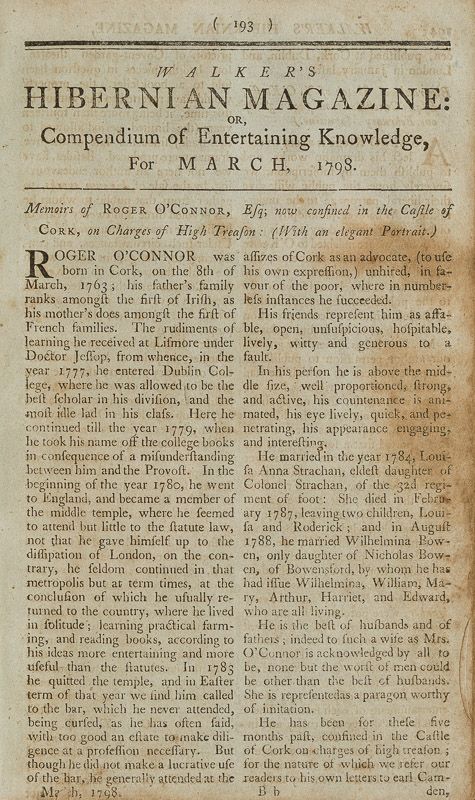
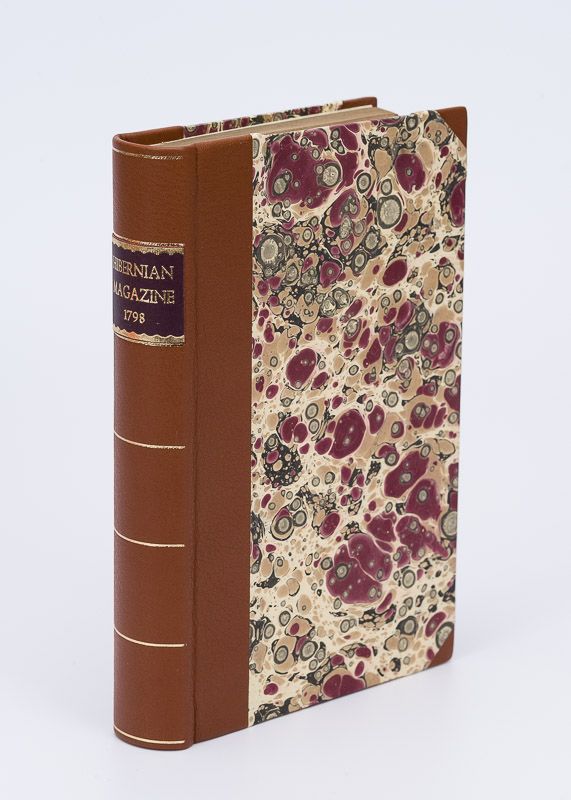
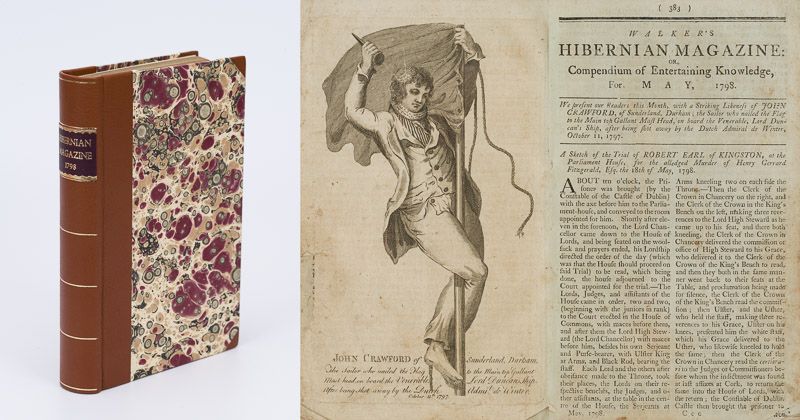
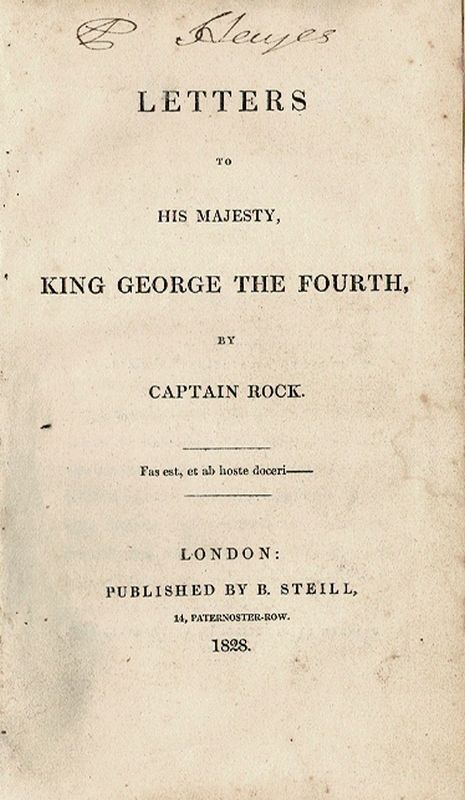
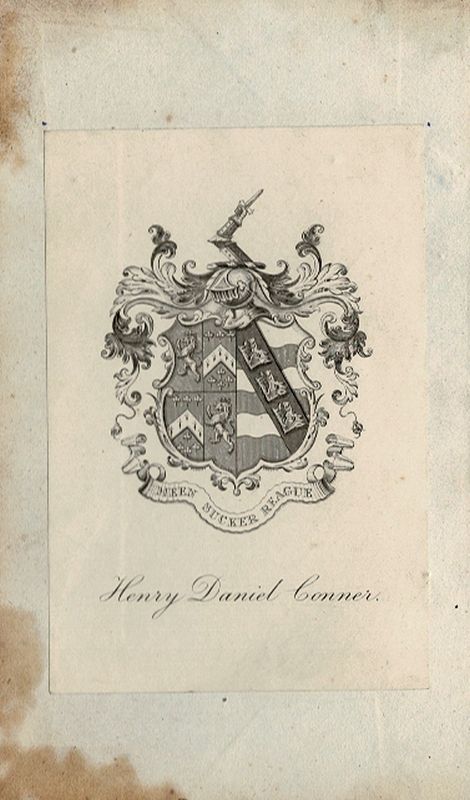
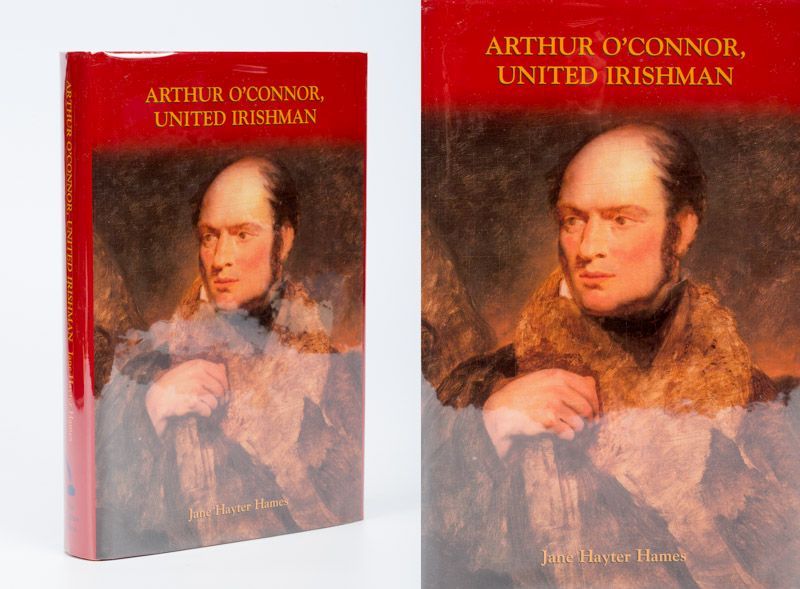
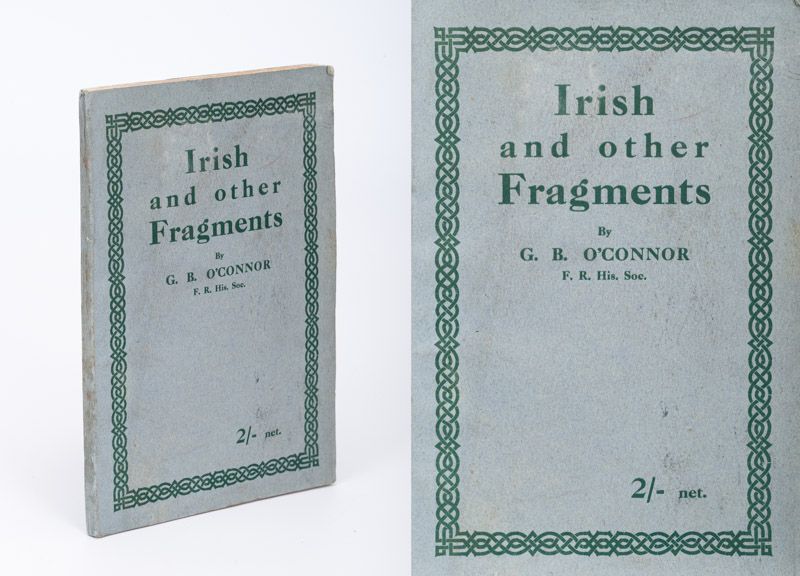
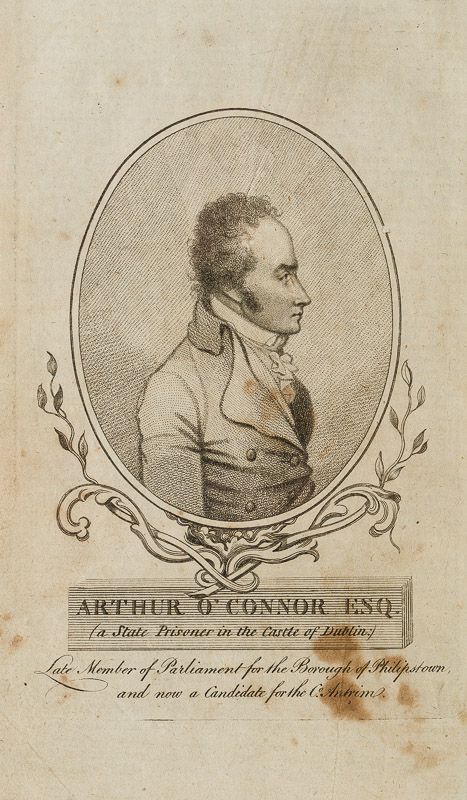
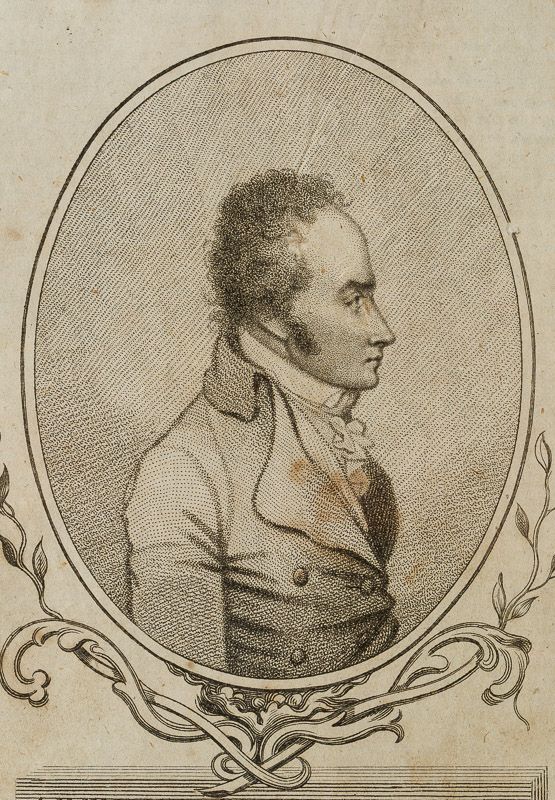
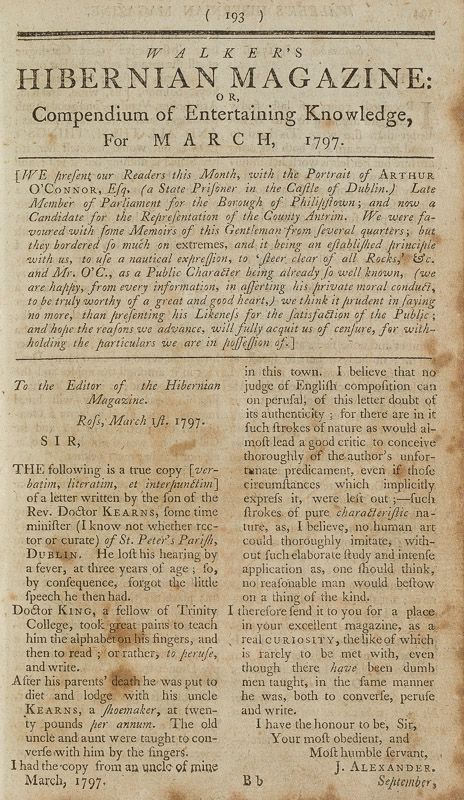
Roger O’Connor & Arthur O’Connor – Collection. A set of five Titles (in six Volumes) from the Library of Henry Daniel Conner and Daniel Conner at Manch House (Ballineen / Dunmanway]. Rare Volumes connected to the History of the Brothers Roger O’Connor [″Chronicles of Eri”] and Arthur O’Connor [″United Irishmen”]. From the 18th-19th century library at Manch House. The collection includes: 1. [O’Connor, Roger] Captain Rock – Letters to His Majesty, King George the Fourth. [This is the Volume owned by the Conner – Family of Manch House and it bears the Bookplate of Henry Daniel Conner] / 2. O’Connor, Arthur [United Irishman] & O’Connor, Roger [Irish Nationalist and Publisher of The Chronicles of Eri] / 3. G.B. O’Connor – O’Connor, G.B. Irish and other Fragments. [Includes the following essays: Irish Ethical Problems / Marshal Saxe and Diminishing Populations / The Irish Republican Demand / The Anglo-Saxon Myth / Irish Facts and Foreign Fictions / The Irish and the Law / Some Anglo-Irish Writers / A National Delusion / The Irish Lord Lieutenant]. Dublin, Hodges, Figgis & Co., no year (c. 1920). Small Octavo. 73 pages. Original Softcover. Very good condition with only minor signs of external wear. A very rare book ! / 4. [O’Connor, Arthur / United Irishmen] Hayter-Hames, Jane. Arthur O’Connor, United Irishman. Cork, Collins Press, 2001. 24 cm. xi, 338 pages, 8 unnumbered pages of plates : illustrations, portraits. Original Hardcover with original dustjacket in protective collector’s mylar. Very good condition with only minor signs of external wear / 5. [Fox, Charles James] / [Arthur O’Connor] / Trotter, John Bernard [Late Private Secretary to Mr.Fox] Memoirs of the Latter Years of the Honourable Charles James Fox [with a lengthy report on a meeting with Irish Revolutionary Arthur O’Connor in Calais]. Third Edition. London, Printed for Richard Phillips, 1811. Includes a longer section in which John Bernard Trotter discusses a chance meeting of Fox with irish Revolutionary, Arthur O’Conno, in a section called the “Independent conduct towards Mr.O’Connor [Arthur O’Connor, brother of Roger O’Connor]: “An incident occured at Calais, which as it excited much remark, and roused a good deal of censure at the time, I shall advert to more length than would otherwise be necessary. It happened that Mr.Arthur O’Connor had arrived at the inn at which we stopped very shortly before. He waited on Mr.Fox, was received by him with that urbanity and openness which distinguished him, and was invited to dinner by him, which invitation he accepted of. It is is well known that, after a long confinement at Fort George, he, and some other Irish gentlemen, agreed with the Irish Government to expatriatethemselves for life. Mr.O’Connor was now on his way to Paris accordingly; when chance brought him to Quillac’s Inn, at the same time with Mr.Fox. His manners were extremely pleasing….” Trotter continues at length to elaborate on the meeting and conduct of Arthur O’Connor, their subsequent visit to the Theatre and three other times of meeting in Calais.
Dublin / London, 1797-1828. Octavo. Hardcover. Very good condition with only minor signs of wear. See full description of these titles on our website under “Libraries and Collections”.
Roger O’Connor (1762–1834) was an Irish nationalist and writer, known for the controversies surrounding his life and writings, notably his fanciful history of the Irish people, the Chronicles of Eri. He was the brother of the United Irishman Arthur O’Connor, and the father of the Chartist leader Feargus O’Connor and of Francisco Burdett O’Connor who was to fight in the Spanish American wars of independence.
O’Connor was born in Connorville, County Cork, into an Irish Protestant family. He studied law and was called to the bar in 1784. He married Louisa Anna Strachan, who died after giving birth to two children, Louise and Roderic. He remarried in 1788, to Wilhelmina Bowen, who bore him four sons and three daughters.
Roger’s younger brother Arthur O’Connor was one of the United Irishmen. Roger was himself associated with the movement, editing the nationalist journal Harp of Erin. His two other brothers, Daniel and Robert, were firm loyalists and, after 1800, Irish unionists. After his oldest brother Daniel got into debt, Roger bought out his inheritance for £5.000. These political and financial conflicts were deepened by a family dispute following the suicide of his sister Anne, who had not been allowed by the family to marry a Catholic man she was in love with. This led to a long feud between Roger and his brother Robert. According to historian James Dunkerley Robert, who was the local sheriff, “even tried to have Roger executed” for treason because of his involvement with Harp of Erin.
Roger and Arthur engaged in nationalist activities in London, building a network of contacts along with Jane Greg who was to return as an active “United Irishwoman” to Belfast. Roger went into hiding in the run-up to the abortive 1796 rebellion. He subsequently surrendered to the authorities and was released. In July 1797 he assisted in the defence of other accused persons. According to Roger, this act led to further plots against him led by his loyalist brother Robert. He and Arthur were arrested and held in various locations over a period of several years before being finally released. Though an avowed Irish nationalist, O’Connor denied that he had ever been party to treasonable conspiracies. In 1799 he published To the People of Great Britain and Ireland, a booklet that detailed what he considered to be his mistreatment. The O’Connors received considerable support from Whig politicians in Britain. MP and playwright Richard Brinsley Sheridan wrote that “the usage of Roger O’Connor, who is one of the finest fellows I ever saw, has been merciless beyond example”. O’Connor was held in Fort George near Inverness until 1801, when he was moved to London, but was barred from travelling to Ireland.
In 1803 O’Connor was finally allowed to return to Ireland. Following these troubles, O’Connor moved to Dangan Castle, Summerhill, County Meath having acquired the property on a permanently renewable lease from Thomas Burrowes of the East India Company. The castle had been the childhood home of Arthur Wellesley, who later became the Duke of Wellington. O’Connor asserted that he had acquired it as “a suitable residence in which to entertain Napoleon” after the anticipated success of Napoleon’s planned invasion of the United Kingdom. At this time he began his career as a writer, preparing commentaries on the Old Testament. He did so from a position of scepticism towards religion; he once said Voltaire was his God.
His wife Wilhelmina died in 1806. After her death O’Connor’s behaviour apparently became increasingly eccentric and extravagant. In 1809 a large part of the Castle was destroyed by fire. O’Connor was suspected of insurance fraud, as he had recently taken out a policy on the house. Many years later his son Francis (then known as Francisco) wrote in his autobiography that he had accidentally started the fire himself when melting lead to make bullets.
In 1817 O’Connor and his son Arthur were arrested on a charge of having organised a mail robbery five years earlier, during which a guard was shot and killed. Two of the robbers had been apprehended after attempting to pass some of the stolen property, and had implicated O’Connor. The robbers were labourers employed on O’Connor’s estate. It was alleged that O’Connor’s steward Martin McKeon had conspired with him to organise the robbery, with McKeon recruiting the robbers. O’Connor was allegedly motivated by debt. Both men were put on trial. Arthur was also arrested, but later released. O’Connor stated that his only connection to the robbery was that his son had found the abandoned mailbags on his land. An endorsement of O’Connor’s moral character was given by O’Connor’s close friend the MP Sir Francis Burdett, who stated that he was happy to lend any sum of money to O’Connor. O’Connor and McKeon were both acquitted, as the accusers’ evidence was not considered credible. O’Connor and his supporters pointed out that the robbers had been spared the death penalty for testifying against him. O’Connor published his version of events, in which he argued that there had been a conspiracy to have him convicted. He claimed this was only the most recent of ten conspiracies to kill him, “being the first against my character—the tenth against my life in the past twenty-four years”. Its real purpose was to destroy his reputation among the local people who “adored” him:
Charged with a highway robbery, in custody of a single constable, I ride through my own country thronged with a population that adored me — this is my crime,— this is the genuine source of all the plots and conspiracies formed against my life and character.
O’Connor’s later attempt to sue one of the accusers for perjury brought out details of events on the night of the robbery that led to continued suspicion against him. Local support was also undermined when he was cross-examined about his religious views, and asserted that the Bible was not a divine revelation. John P. Prendergast, in an article on O’Connor, says that “thenceforth Roger O’Connor stood condemned in public opinion of the robbery for the Galway mail”. Shortly after these events O’Connor’s landlord attempted to get him evicted from Dangan, but the attempt failed. Nevertheless, O’Connor left the property and moved to Paris. It was later alleged by McKeon’s son that the robbery was a cover for the interception of compromising letters written by Burdett to a married lover. This was supposed to explain Burdett’s support of O’Connor.
While these events were unfolding, O’Connor’s teenage sons Feargus and Francis fled the family home, travelled to London and asked to be looked after by Francis Burdett. Burdett took them in. O’Connor’s oldest son Roderic moved to Australia.
While in Paris, O’Connor prepared his best-known work, the Chronicles of Eri (1822), a book purporting to be a translation of ancient manuscripts detailing the early history of the Irish people. It was dedicated to his friend and supporter Sir Francis Burdett. The book was prefaced by a portrait of O’Connor holding a crown, the caption to which proclaimed that he was the “Head of his Race” and “Chief of the prostrated people of his nation”, a position he claimed as the supposed lineal descendant of the 12th-century king Ruaidrí Ua Conchobair.
According to O’Connor, he had attempted to write this book three times before, but had been frustrated by the machinations of his enemies, who stole his manuscripts. Another version of the book had been destroyed in the disastrous fire at Dangan in 1809.
The book gives a history of the Gaels from supposed records written by “Eolus”, who is said to have lived fifty years after Moses. It claims a continuous existence of the Gaelic people, originating among the ancient Phoenicians, migrating to Scythia, Spain and then Ireland. O’Connor interpreted Biblical stories and medieval Irish lore to support this narrative. William John Fitzpatrick in the Dictionary of National Biography stated that the book is “mainly, if not entirely, the fruit of O’Connor’s imagination”.
O’Connor returned to county Cork, but by this time had lost much of his money. He lived for the rest of his life in a fisherman’s cottage in Ballincollig, cohabiting with a local young woman he called the “princess of Kerry”. According to Richard Robert Madden, O’Connor genuinely believed that this “young girl of humble origin” was really a princess: “The enthusiasm with which he is said to have been wont to speak of the exalted claims of this princess of Kerry to an ancient Irish regal origin, left no doubt on the minds of many who heard him expatiate on this subject, that he had worked himself up into a firm belief in his fondly-imagined discovery.” She inherited “a considerable sum of money from him on his death.″
His oldest son Roderic O’Connor emigrated to Australia with his two sons, where he became a significant landowner and public official in Tasmania. Two of Roger’s sons were brought up by Burdett. One of these was Feargus O’Connor, one of the main leaders of the Chartists. The other was Francisco Burdett O’Connor, a commander in Simón Bolívar’s army and, later, a Bolivian politician.
Prendergast concludes that O’Connor showed great courage in his patriotic statements during his arrest and imprisonment for alleged sedition, but that his eccentric personality and Irish nationalism “rendered him so odious [in the eyes of his enemies] that the grossest charges would be willingly believed”. James Dunkerley says that several authors have described O’Connor as “a little mad”, adding that the Chronicles of Eri is a “colourful concoction – a more ‘imagined community’ it would be hard to locate outside of Atlantis”. Madden considered him to be possessed of considerable “cleverness, cunning, astuteness and plausibility”, but argued that the personal charm and persuasiveness that made his conversation and speech-making so powerful, was never translated into print. His writings were bombastic: “he wrote in the genuine Boanerges Bombastes-Furioso style, wherein the swaggering Pistol talked in the true Ercles vein. His various political pamphlets are couched in terms of extravagant hyperbole”. (Wikipedia)
________________________________________________________
Arthur O’Connor (4 July 1763 – 25 April 1852), was a United Irishman who was active in seeking allies for the Irish cause in England and in France. A proponent of radical democratic reform, in Ireland he was distinguished by publishing political appeals to women. Arrested on the eve of the 1798 rebellion, in 1802 he went into exile in France where, after being raised to the rank of General in a force that was to invade Ireland, fell out of favour with Napoleon. Among the positions he maintained publicly in his final years were a defence of the July Revolution in Paris and opposition to what he saw as the clericalism of Daniel O’Connell’s movement in Ireland.
O’Connor was born near Bandon, County Cork on 4 July 1763 into a wealthy Irish Protestant family. Through his brother Roger O’Connor, who was equally enthused by events in America was to share his republican politics, he was an uncle to Roderic O’Connor, Francisco Burdett O’Connor, and Feargus O’Connor among others. His other two brothers, Daniel and Robert, were pro-British loyalists. A sister, Anne, committed suicide, after having been forbidden by the family from marrying a Catholic man with whom she was in love.
O’Connor graduated with a law degree from Trinity College, Dublin, and was called to the bar in 1788. But inheriting a fortune worth £1,500 a year, he never practised.
From 1790 to 1795 O’Connor was a Member of Parliament in the Irish House of Commons for Philipstown. He attached himself to the patriot party of Henry Grattan, joining in the calls to advance the emancipation of the kingdom’s Roman Catholic majority and for other reforms.
At the time, this did not debar him from the influential Kildare Street Club, a bailiwick of the landed Protestant Ascendancy. But the accommodation was short lived. In 1796 O’Connor joined the Society of United Irishmen, whose purpose was to overturn the Ascendancy and establish a representative national government independent both of sacramental tests and of dictation from London.
In January 1797, with United Irish support, he contested what had been his uncle Lord Longueville’s parliamentary seat in Antrim. To the “free electors” of the county he commended the “entire abolition of religious distinctions” and the “establishment of a National Government”, while protesting the “invasion” of the country by English and Scottish troops and the Crown’s continued war against the French Republic. Arrests, including his own in February for seditious libel, frustrated his attempts to canvass. The Dublin Castle administration, he explained to “those who were electors”, had “destroyed every vestige of election by martial law”. With Lord Edward Fitzgerald and others in the United Irish leadership in Dublin his thoughts now turned to securing French support for a republican insurrection.
In a final address “To the Irish Nation” (February 1798) he asked:
Shall beggary and famine stalk through your country, so blessed with a temperate climate and a fertile soil, without the strongest suspicion that the people have not been done justice? Shall a brave, healthy, intelligent and generous people, be doomed to the most squalid misery at home, and be famed for enterprise, activity and industry in every country but their own, without the strongest suspicion that they have been made prey to peculation, injustice, and oppression. Shall a country … be most advantageously placed on the globe between the old and the new world, yet posses such inconsiderable foreign trade … without the strongest suspicion of perfidy in her government, and treason in her legislature?
He called for a “representative democracy”, based on “universal suffrage”, and tasked with breaking all “monopoly”—in property as well as in religion.
In London, with his brother Roger, O’Connor had moved in the same radical circles as the United Irish agent Jane Greg. Greg—possibly in the company of O’Connor—returned to Belfast where she was reported to the authorities as being “very active at the head of the Female [United Irish] Societies” in the town. O’Connor himself made a political appeal to women.
After the presses of the Northern Star in Belfast had been smashed by the military, with William Sampson and Drennan he founded a new paper, the Press, in Dublin. Writing in its pages in December 1797 as “Philoguanikos”, he called on women to take sides in the coming conflict. He assured them that “the youth of this country have totally changed their mode of thinking” regarding women and were ready to seek their “society”, their “friendship” and “alliance”. It was now only “brainless bedlams” that recoiled from “the idea of a female politician”.
In February 1798, O’Connor’s paper published a second address, signed “Marcus” (William Drennan). In this it was equally clear that women were being appealed to as “members of a critically-debating public”.
While travelling to France in March 1798 he was arrested alongside Father James Coigly, a Catholic priest, and two other United Irishmen Benjamin Binns (also of the London Corresponding Society), and John Allen. Coigly, found to be carrying clear evidence of treason (an address from “The Secret Committee of England” to the Directory of France), was hanged. O’Connor, able to call Charles James Fox, Lord Moira and Richard Brinsley Sheridan to testify to his character, was acquitted but was immediately re-arrested and imprisoned. On his way to confinement, he handed on a poem, which seemed to recant his republican beliefs. If the first line of the second stanza is read following the first line of the first stanza, and the alternating process is continued the opposite is the case: it is a ringing affirmation of his Painite convictions:
(1) The pomp of courts, and pride of kings,
(3) I prize above all earthly things;
(5) I love my country, but my king,
(7) Above all men his praise I’ll sing.
(9) The royal banners are display’d,
(11) And may success the standard aid:
(2) I fain would banish far from hence
(4) The Rights of Man and Common Sense.
(6) Destruction to that odious name,
(8) The plague of princes, Thomas Paine,
(10) Defeat and ruin seize the cause
(12) Of France, her liberty, and laws.
O’Connor was held at Fort George in Scotland with other leading United Irishmen, among whom he was not fondly regarded. He frequently quarrelled with his associates, and made clear his dislike for Thomas Addis Emmet, William MccNeven and William Lawless.
O’Connor was released in 1802 under the condition of “banishment”. He travelled to Paris, where he was regarded as the accredited representative of the United Irishmen by Napoleon. In February 1804, the future emperor appointed him General of Division for the Irish Legion being readied in Brittany for an invasion of Ireland. According to the Nouvelle biographie générale (Paris, 1855) the “openness of his character, and his unalterable attachment to the cause of liberty rendered him little agreeable to Napoleon” who, after abandoning plans for Ireland, did not again employ him. On the other hand, it is the recollection of Paul Barras, who had been President of the French Directory, that it been by “compliance and boasting” that he had obtained from Napoleon, as emperor, all that the Directory had denied him. In either case, as he had had no military experience, his appointment was resented by many of his compatriots in the Legion.
Robert Emmet did not entrust O’Connor in Paris with representing his plans for a renewed insurrection in Ireland. When Britain re-opened its war with France in May 1803, Emmett sent his own emissary, Patrick Gallagher, to Paris to ask “money, arms, ammunition and officers” but not, as O’Connor had urged, for large numbers of troops. After his rising in Dublin misfired in July, and he could no longer indulge his hostility to Napoleon’s imperial ambition, Emmet entrusted his plea for a French force to the rebel veteran Myles Byrne.
After Napoleon’s final defeat, O’Connor became a naturalised French citizen. He supported the 1830 insurrection in Paris which overthrew the increasingly absolutist King Charles X, publishing a defence of events in the form of an open letter to General Lafayette. After the revolution, he became mayor of Le Bignon-Mirabeau. He edited a paper on advanced/heterodox religious opinions—Journal de la Liberté Religieuse—and published a number of works on political and social topics. He also assisted his wife and her mother, Sophie de Condorcet (an accomplished translator of Thomas Paine and Adam Smith), to prepare a revised edition of the works of his father-in-law, the Marquis de Condorcet (published in twelve volumes between 1847 and 1849).
In 1834, O’Connor had been permitted to visit Ireland with his wife, to dispose of his estates that had been managed by his brother. Daniel O’Connell was then transforming what had been the Catholic Association into a movement for the repeal of the Act of Union. O’Connor was highly critical of what he perceived as the continued mobilisation (heavily reliant on the cooperation of the clergy) of a distinct Catholic interest. In his last work Monopoly: The Cause of all Evil (1848), a largely theological treatise in which he rejects the exclusionary claims of a “corporate priesthood”, he accused “O’Connell and his jesuit priests” of working to undo all that he, and the United Irish, sought to achieve in overcoming “religious hatred” and securing “union, love [and] fraternity” between Irishmen.
In 1807, although more than twice her age, O’Connor married Alexandrine Louise Sophie de Caritat de Condorcet (b 1790/1-1859), known as Eliza, the daughter of the French philosophe the Marquis de Condorcet and the celebrated salon hostess, Sophie de Condorcet (Sophie de Grouchy).
Following his marriage he borrowed money from fellow United Irish exile William Putnam McCabe to acquire a country residence. O’Connor’s tardiness in repaying the debt to McCabe, whose own investments into cotton spinning in Rouen failed, resulted in a lawsuit. Cathal O’Bryne suggests that the debt was behind O’Connor’s later suggestion to R. R. Madden that McCabe had been a double agent, a charge to which, Madden notes, the French government lent no credence.
O’Connor’s wife gave birth to five children, three sons and two daughters, almost all of whom predeceased him. Only one son, Daniel, married and had issue.
Daniel O’Connor (1810–1851), who married Ernestine Duval du Fraville (1820–1877), a daughter of Laurent-Martin Duval, Baron Duval du Fraville, in 1843. She died at Cannes in 1877. O’Connor died on 25 April 1852. His widow died in 1859.
His descendants continued to serve, as officers, in the French army and still reside at Château du Bignon. Through his only surviving son Daniel, he was a grandfather of two boys, Arthur O’Connor (1844–1909), who served in the French army, and Fernand O’Connor (1847–1905), a Brigade General who served in Africa and was made a Knight of the Legion of Honour. His grandson, Arthur, married Marguerite de Ganay (1859–1940), a daughter of Emily and Etienne, Marquis de Ganay, in 1878. They had two daughters, Elisabeth O’Connor, the wife of Alexandre de La Taulotte; and Brigitte Emilie Fernande O’Connor (1880–1948), who in 1904 married the Comte François de La Tour du Pin (1878–1914), who was killed ten years later at the Battle of the Marne. (Wikipedia)
- Keywords: Arthur O’Connor · Captain Rock (Roger O’Connor) · Catalogue Irish History Two – Origins of Irish Identity · Connerville · Connerville (Carrigmore) · Connorville · Henry Daniel Conner · Henry Daniel Conner · Irish History · Irish History – Rare · Roger O’Connor – Arthur O’Connor – Collection · Roger O’Connor of Connerville (Dunmanway) · West Cork
- Language: English
- Inventory Number: 32437AB
EUR 2.800,--

We ship per DHL Express




Contact
Inanna Rare Books Ltd.
Woodley House
Castletownshend Road
P81 D262 Skibbereen, County Cork
Ireland
Phone: ++353 - (0) 87 - 102 5412
E-Mail: info@inannararebooks.com
Internet: https://www.inannararebooks.com
Online Bookshop specialized in rare
and secondhand books.
Newsletter and E-Catalogue Sign Up
Payment Options


© 2026 Inanna Rare Books Ltd. | Powered by HESCOM-Software

