

Autograph – Rare (30 items)

Collection of Five (5) Manuscript Letters from Greek-American Philosopher, Raphael Demos

1. [Aiken, Henry David] Demos, Raphael.

Collection of Five (5) Manuscript Letters from Greek-American Philosopher, Raphael Demos to Philosopher Henry David Aiken. Besides very few personal matters (Aiken rented a Lice-infested house from Demos), the letters are lengthy and full of content regarding philosophical questions. Demos thanks Aiken for his “thoughtful comments about my article on ‘Society and the Individual’ and Demos reflects on Aiken: “Now as to your point that goodwill is addressed to me which is capable of joys and sorrows and not just an angel – I will distinguish between respect and goodwill. Angels, because rational, have intrinsic worth, and so claim respect certainly. Value and respectability don’t imply capacity for feeling. But goodwill does imply that the recipient is a striving, failing, succeeding, up-ended individual, who has sorrows & grip – not just an angelic being. While the Greek identify man with his rationality, it is noticeable that common sense proceeds otherwise; when the Radcliffe girls say their Professor is so human, they don’t mean he is intellectual, they mean the opposite – that he has non-rational impulses and feelings…..” / The collection of letters originates from the personal collection of Henry Aiken and also comes with a scathing letter from American Philosopher Arthur Edward Murphy in which Murphy writes to Aiken about Raphael Demos and does not hold back in his evaluation of Demos and his Philosophy: “I just saw your remarks re Demos in the Journal. Very well done ! I think Demos is not very bright, however, and it is perhaps better not to give him too much publicity. I don’t think he will convert any one except for those already suffering from dithers & blithers. And it is a waste to refute him. Intelligent people don’t have to be convinced. And bigots like R.D. can’t be convinced. Strictly speaking, before Demos creates an obligation in others… he ought to say in plain unemotional prose what he means by such concepts as ‘God’ & ‘evidence’. It is perfectly possible that if we knew how he uses these terms, we would agree that what he says is trivially true. This discussion is presumably in the domain of logic. But discussion on that domain when one of the parties refuses to make explicit the rules of his game can never terminate in illumination. Nevertheless, I think you handled him neatly & have done yourself no harm as general opinion is concerned. He is a perfect horrible example of retrogression. Ugh ! A perfectly low grade person morally & intellectually nonregarding as a seer & defender of orthodoxy…… Have you seen Lazerowitz’s [Morris Lazerowitz] paper in Mind on Universals. It is highly provocative. I would like to discuss it with you….”.

Westport Point (Massachusetts), c.1944 – 1967. Octavo. 13 pages of letters by Raphael Demos to Aiken / [Plus:] 1 page of a manuscript letter by Arthur Edward Murphy to Aiken about Demos. Very good condition with only minor signs of wear. Original Letters or anything published by Raphael Demos or Arthur Edward Murphy, are very rare !
Show details

Louis Cobbett - Two Manuscript Books of Laboratory Notes by student of bacteriology and later publisher of "The Causes of Tuberculosis", Louis Cobbett (1863 - 1947)

3. [Cobbett, Louis] [mentioned are: Behring, Emil von / Koch, Robert / Metchnikoff, Ilya (Élie) / Dönitz, Friedrich Karl Wilhelm / Ehrlich, Paul / Shield, Marmaduke and others]

Two Manuscript Books of Laboratory Notes by student of bacteriology and later publisher of “The Causes of Tuberculosis”, Louis Cobbett (1863 – 1947), dealing in these lab notes with the discovery of remedies for Tuberculosis and Diphtheria. Original, two-volume Manuscript-Compendium of research-notes regarding all the important discoveries in Bacteriology (Diphtheria and Tuberculosis) by contemporaries of Louis Cobbett during the years 1885 – 1908 (Behring, Koch, Metchnikoff etc.). The notes were started by Louis Cobbett in 1885, after graduating from Trinity College, Cambridge and while he was working towards his degree in 1899. The stunning documents are not only reading like a first-hand-journal of discoveries, citing and reflecting on all the important developments and medical advancements of the outgoing 19th and beginning 20th century, but these notes were written parallel to Robert Koch, Emil von Behring and others making their breakthrough discoveries for mankind’s desperately needed cures against Tuberculosis and Diphtheria. Cobbett reflects on the publications in the “Zeitschrift fuer Hygiene” and separately published books and articles. Louis Cobbett lists all the important and also the critical publications leading up to (for example) Koch’s discovery of Tuberculin (e.g.: Beck – “Ueber die diagnostische Bedeutung des Kochschen Tuberculins”), he mentions Emil von Behring, Paul Ehrlich’s “Ueber die Constitution des Diphteriegiftes”, he cites A.Jeffery Turner’s “Statistics on the Diphtheria mortality of the 3 principal Australian Colonies for the past 15 years” (published in 1899), he writes about Tuberculin production in fowl, he reflects on A.Calmette and G. Guerin, “supporting [Emil von] Behring in his contention that pulmonary tuberculosis is of intestinal origin”. Other mentions are “TB of human origin (from a cervical gland)”, he speculates on the publication by Fiebiger and Jensen regarding the transmission of tuberculosis from human to animal, he offers drawings of cultures with Rabbit emulsions, Bovine Characters, Avian cultural characters etc. A few lectures are referred to, including one by Sims Woodhead, a colleague of Louis Cobbett and no doubt attended by Cobbett himself; one newspaper report has been pasted in: ‘Important conference’ in Leeds, from Yorkshire Post 1899 / Louis Cobbett intensely elaborates on Kossel and his report on the english Tuberculosis – Commission in 1908 (H. Kossel – Die Tuberkulosefrage und die Arbeiten der englischen Tuberkulosekommission).

[Cambridge], c. 1885 – 1908. Octavo (17 cm x 21 cm). 90 blank leaves with manuscript entries in each volume, usually written on rectos only. Hardcover / Original half leather with dark blue cloth-covered boards bearing paper-labels to covers, detailing some of the sources cited within; marbled endpapers and edges. Very good condition with only minor signs of external wear.

EUR 1.000,-- 

Show details   Add to cart

Provenance: From the personal library of Adrian Liddell Hart / Collection of 28 Volumes of John Lehmann's "New Writing", some bearing the name of Adrian Liddell Hart

4. [Lehmann, John] / [Liddell Hart, Adrian] / [Harold Acton] / [Manuscript Postcards from Lehmann to Liddell Hart].

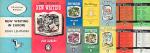
Provenance: From the personal library of Adrian Liddell Hart / Collection of three personal autograph/manuscript-postcards from John Lehmann to Adrian Liddell Hart, together with 28 Volumes of John Lehmann’s “New Writing”, some bearing the name of Adrian Liddell Hart, including Volume I (includes George Orwell’s “Shooting an Elephant” in second edition). Besides the 28 Volumes of Lehmann’s “New Writing”, the collection also includes: 1. John Lehmann’s personal copy of Sean O’Faolain’s “Vive Moi!” – An Autobiography (First Edition, London, Rupert Hart-Davies, 1965), with John Lehmann’s name on the front free endpaper and some markings in the text. / 2. John Lehmann – Pleasures of New Writing – An Anthology of Poems, Stories and other Prose Pieces from the pages of NEW WRITING. Edited by John Lehmann. (First Edition, London, John Lehmann, 1952). [Even though this Volume is also from Liddell Hart’s library, it bears a different name of a pre-owner on the half-title].

Mixed Editions. 30 Volumes. London, John Lehmann / Allen Lane – Penguin Books / Rupert Hart-Davis, 1940-1965. Octavo. [The Postcards written from Venice, Florence and Santa Barbarabetween the years 1952 and 1977 / Postcard I: From John Lehmann in Venice to Adrian Liddell Hart: “This city does not boast a supply of the “Sunday Dispatch”, and as the writer was gripped and enthralled by the last installment on June 1st, he hopes you will keep copies of the …for him to read on his return in ten Days time – J.” / Postcard II: From John Lehmann in Florence to Adrian Liddell Hart: “Am staying with [Sir] Harold Acton here in his marvellous Villa – calme luxe [″Villa La Pietra”], all night……pity, you aren’t with me. Off to the sea this afternoon – may post this in Porto Ercole. Your old friend is relaxing. Gracefully – Love J.” [Date hard to decipher, possibly in 1962] / 3. Postcard III: From John Lehmann in Santa Barbara in California to Adrian Liddell Hart: “Terribly sorry to hear about the broken leg, may it mend quickly, as surely it must undo the ministrations of Florence …..Nightingale. I expect to be in England all March, but then off again – to Jimmy Carter Country – Love J.” [20.2.77]. Hardcover and Softcover. Of the series of 28 Volumes of the “New Writing ″ Series, only three with stronger signs of wear and in poorer condition. All others in very good condition with only minor signs of wear. Lehmann’s personal copy of Sean O’Faolain’s Autobiography with the original dustjacket in poor condition but the Volume itself very good.

EUR 1.480,-- 

Show details   Add to cart

Typed Letter signed from american philosopher John Wild to Philosopher Henry David Aiken

5. [Maluf, Brother Francis] Wild, John / Aiken, Henry D.

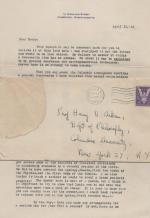
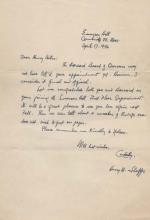
Typed Letter signed from american philosopher John Wild to Philosopher Henry David Aiken, informing Aiken: “I missed you especially two weeks ago when I attempted to defend a realistic view of ethics in terms of the concept of natural law. I am not sure, but I think you might have been in agreement with some of the points I tried to make as over against Lewis’ Kantian subjectivism and Demos’ [Raphael Demos] extreme Platonism….”. Besides some further niceties, John Wild talks in this letter intensely about Christian Arab Philosopher Francis Maluf, from Mashrah, Lebanon, who could be in John Wild’s mind the perfect “section man for your Phil A course”. Wild continues to praise the syrian, Maluf, who had been “teaching Mathematics and Physics in a war job out of Worcester and who has been keeping up his interest in philosophy by attenting courses around here, organizing discussion groups and other intellectual activities which amaze me by their versatility and intensity”. John Wild continues: “He has been offered a permanent job at the University of Beirut in Syria to teach Philosophy there (he is a friend of Malik’s) but if possible wants to stay around here for another year to study and learn before he goes back.” [Maluf had converted to catholicism in 1940 and was later known as Brother Francis Maluf.

Cambridge, April 15th, 1945. Octavo. 2 pages. Softcover. Very good condition with only minor signs of wear. Original two-page-letter with original envelope.

Show details

Montague / Dorgan - Typescript Draft MS for a book of poetry by Theo Dorgan. With occasional manuscript corrections

7. [John Montague Collection] – [Montague, John] Dorgan, Theo.

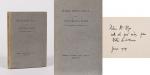
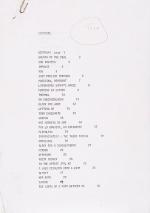
Typescript Draft MS for a book of poetry by Theo Dorgan. With occasional manuscript corrections / suggestions / annotations by Dorgan’s early mentor John Montague, the Typescript MS was held among the private papers of John Montague in his West Cork Home. The typescript includes poems like “Closed Circuit”, “The Promised Garden”. Montague is approving several of the poems by simply applying a tick. John Montague made suggestions in pencil on the structure of “Elegy for a Schoolfriend” and more in depth-suggestions on “Nasty Archer”, “Her Body”,″The Width of a Room Between Us”, “Return”, “Reconciliation”, “Sunday Afternoon”. When asked about helping to date this early draft of his poetry, Theo Dorgan immediately gets back to us and he places it from memory into the early 1980’s. Theo Dorgan was surprised and seemingly chuffed that John Montague held on to this Manuscript and he recalls: “These poems, some in revised versions, make up the backbone of my first published collection, ‘The Ordinary House of Love’.” Dorgan continues: “I’m happy to say that most of them survived Montague’s eagle eye, which was of course a great comfort to me at the time. Still is!” Some of these poems selected had previously been published as broadsheets etc. but the skeleton of the Draft hints already at readying it for publication. Theo Dorgan graciously gives us even more information: “Some of the poems in the eventual book go back to when I was a student, others were definitely written in the second half of the 80s. The bulk of it, however, is in this MS. I base my estimation in part on the fact that what you have is a typescript produced, it appears, on the IBM golfball machine that was the pride and joy of Triskel Arts Centre. That machine was bought in 1980 or 1981, I’m fairly sure of that. I was Literature Officer there, then.” Theo Dorgan was part of John Montague’s circle of mentored poets, even though in an email-exchange with him about this typescript he mentions that “John Montague worked far more with Thomas McCarthy, Maurice Riordan and Gregory O’Donoghue than he did with me, and in many ways Gregory O’Donoghue was at that stage the most accomplished of us all – the only one included in JM’s Faber Book.” What followed then in our conversation with Theo Dorgan is a great example why manuscripts, letters, autographs, typescripts and the connections we often make with documents from the past have such meaning in explaining our emotional ties with people who matter to us on our way of forming personality. They are memories transforming into images, floods of empathy and nostalgia for personal moments lost but treasured because they helped us form our values. Presented with the old typescript, Theo Dorgan’s emotionality is tangible and he confesses more in an internal dialogue with himself and John Montague than with us: “I’m sorry to say that the reason John Montague worked with those others more than he did with me is because, in my shameful, youthful arrogance, I much preferred to trust my own judgement, and also, I suspect, because I was closest to John in temperament and feared coming unduly under his influence. That said, there was no-one whose good opinion of a poem I valued more, and we were close all our lives after. Very likely it was a case of old stag/young stag ! Montague taught us by indirection, he made his extensive library of modern and contemporary poetry available to us without stint, would wait for us to find an affinity (as, e.g. mine with Robert Graves and Galway Kinnell) and would then, in a long, ongoing conversation, help us to understand what it might mean for our own poems that we felt such affinities. A guided companionship in reading and making, if you will.”

Ireland, c.1981-1982. A4. 43 pages typescripts. Paperclipped. Very good condition with only minor signs of external wear. Some fingerstaining and residue of rust from the paperclip. Wonderful and extremely valuable document of not only a collaboration between two of Ireland’s landmark writers but moreover witness to the becoming, the birth of a true poet. Also included (from a different source) is a second printing of the first edition of the subsequent publication “The Ordinary House of Love” – signed by Theo Dorgan. Right at the beginning of the printed version, instead of a dedication to John Montague, Theo Dorgan placed a quote from Montague’s poem “Wine Dark Sea”: ‘For there is no sea / it is all a dream there is no sea / except in the tangle / of our minds; / the wine dark / sea of history on which we all turn / turn and thresh / and disappear.’ (Collected Poems, page 255). Provenance of the annotated typescript: From the private collection of John Montague’s papers in his recently sold West Cork Home.

Show details

[Tey, Josephine Tey - John Gielgud Collection of stunning Association copies

9. [Tey, Josephine / Daviot, Gordon] / [Gielgud, John].

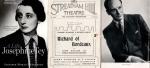
Josephine Tey – John Gielgud Collection of stunning Association copies of Plays which crucially defined both of their careers as writers and actors. The collection includes important, signed and inscribed association – copies of the two significant productions “Richard of Bordeaux” and “Queen of Scots”, both from John Gielgud’s personal library and with manuscript inscriptions to John Gielgud [and Laurence [Larry] Olivier] by Josephine Tey, aka Gordon Daviot, aka Elizabeth MacKintosh. The collection includes: 1. Gordon Daviot [Josephine Tey] – “Richard of Bordeaux – A Play in Two Acts” – With John Gielgud’s Bookplate (Ex Libris). The ultimate Association-copy, warmly and lengthy inscribed by Josephine Tey to John Gielgud. First Edition. London, Victor Gollancz, 1933 / 2. “Richard of Bordeaux” – Original Programme of “The Streatham Hill Theatre”, 1934. Signed by John Gielgud / 3. Gordon Daviot [Josephine Tey] – “Richard of Bordeaux” – Original File-copy with dustjacket and Publisher’s wrapper “The Play of the Year” at the New Theatre” – First Edition, 1933 / 4. Gordon Daviot [Josephine Tey] Gordon Daviot – “Richard of Bordeaux – A Play in Two Acts” – [Fifth Edition, 1933] – Special Cast, Producer and Production-Signed copy and inscribed to one “Eileen Grainger”, with the most interesting dedications in manuscript signatures – Signed and inscribed by lead actor and producer John Gielgud [Richard II], Signed and inscribed by leading Lady, actress Gwen Ffrangcon-Davies, Signed and inscribed by Gordon Daviot [Josephine Tey], Also beautifully signed and inscribed with a musical score by Shakespeare-composer and Musical Director for John Gielgud, Herbert Menges OBE ! / 5. “Queen of Scots – A Play in Three Acts” – The Ultimate Association-copy, inscribed by Josephine Tey to her producer: “John Gielgud – from ‘his Gordon Daviot’ / July 1934” / 6. Gordon Daviot – “Queen of Scots – A Play in Three Acts” – Association-copy, signed and warmly and lengthy inscribed by Josephine Tey to Laurence Olivier / 7. Gordon Daviot [Josephine Tey] – “Richard of Bordeaux” – A Softcover-Version of the Play in Fourth Impression, 1933 / 8. Josephine Tey – “The Daughter of Time” – First Edition, Second Impression (Second Printing). London, Peter Davies, July 1951 [The First Edition was in June 1951]. Original Hardcover with the slightly frayed original dustjacket in Mylar / 9. John Gielgud – “Early Stages” – New and Revised Edition. London, The Falcon Press, 1948. With pages of detail about the work of John Gielgud with Gordon Daviot [Josephine Tey] / 10. Jennifer Morag Henderson – “Josephine Tey – A Life” – With a Foreword by Val McDermid. Sandstone Press, 2015 //

London, Victor Gollancz, 1933 – 1948. Octavo. Hardcover / Original Publisher’s cloth. Very good condition with only minor signs of wear.

EUR 12.800,-- 

Show details   Add to cart

[West Highland Line] / [Scottish Railway Line Glasgow to Mallaig]

10. [West Highland Line] / [Scottish Railway Line Glasgow to Mallaig] / [Rathad Iarainn nan Eilean – “Iron Road to the Isles”]

Massive Photographic Documentation of The Western Highland Line [Glasgow to Mallaig] in 900 [ninehundred] vintage Photographs, taken over a period of 30 Years by a Railway and Nature-Explorer and placed in four massive XXL Folders with extensive, beautiful and detaild annotations and explanations. The photographs range from smaller formats (10 cm wide x 15.2 cm high) to a huge amount of Extra-Large Vintage Photographs (39.2 cm wide x 29.4 cm high) and many even measure 40 cm x33 cm, filling entire leaves. Many of the photographs are impeccably applied inside these High-End-Archival-Folders with often numerous captions in the handwriting of the Photographer / Highland Explorer. An inexplicably stunning and absolutely unique documentation of the scottish landscape along the West Highland Line between the years 1974 – 2002. The images document Scottish rivers, Lochs and Roads, Mountains and Hills alongside the Railway-Lines but landscapes are also often shown without the Railway present. Besides the nature we also find photographs of architectural features like overpasses or industrial buildings and railway-track-imagery masterfully photographe, bordering on the abilities of a New Objectivity – photographer like Albert Renger-Patzsch. An important, maybe even singular photographic Impact-study of Railway to the Scottish Highlands. The anonymous photographer has injected himself occasionally in the images, beautifully showing his pitched tent and motorcycle in order let the viewer understand the dedication his travels have cost him. The masterful photographer also showcases his love for detail and artistry by ever so often partially and sparsely coloring Railway-Waggons or Locomotives within his black-and-white-photography, highlighting the technology in the vulnerable landscape, giving the whole collection an artistic and critical component of focusing the viewer on the object of his desire, yet contrasting how lost even a magnificent Locomotive and its carriages seems when vanishing in front of the majestic scottish landscape. The documentation is meticulous, often allowing for multiple vintage photographs on one page showing the same location during different times, exhausting all questions of functionality of the Railway opposed to the landscape with or without Railway in the shots. For the conservation-movement of the Scottish Highlands this collection is an unbelievable chance to preserve the memory of this landmark Railway-Line, connecting the extreme remote with the urban. For those who research the scottish landscape this is a unique opportunity to acquire the life’s work of one man’s obsession with “Railway and Landscape” in the Scottish Highland.

Scotland, 1974-2002. Oblong-Folio (44 cm wide x 36 cm high). Hardcover / Original Full-Leather Folders with stong, black cardboards and original tissue-guards. Excellent condition with only minor signs of wear. With hundreds of manuscript annotations on the photography, the photography-technique, film used and with extensive elaborations on each photograph in these albums. More images on request !

EUR 12.800,-- 

Show details   Add to cart

Page: 1 2 3
: