


Drummond, The Habitant and Other French-Canadian Poems.
The Habitant and Other French-Canadian Poems. With an Introduction by Louis Frechette and with illustrations by Frederick Simpson Coburn.
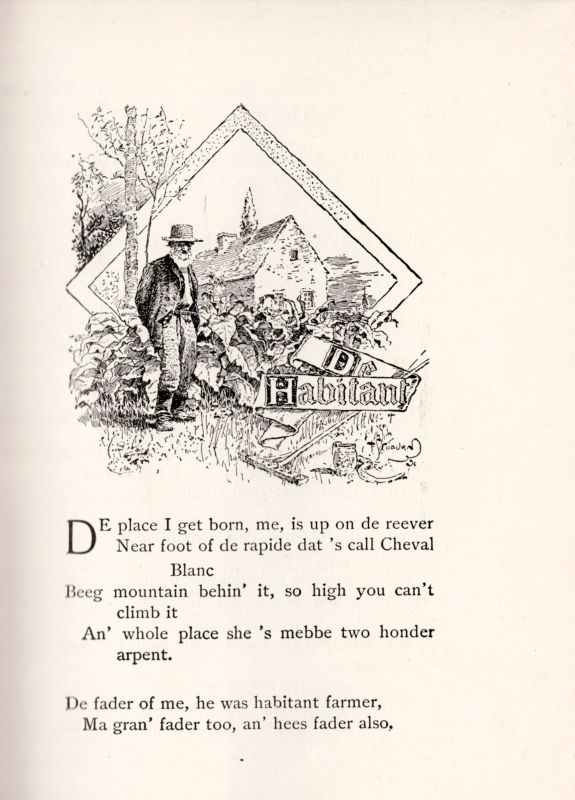
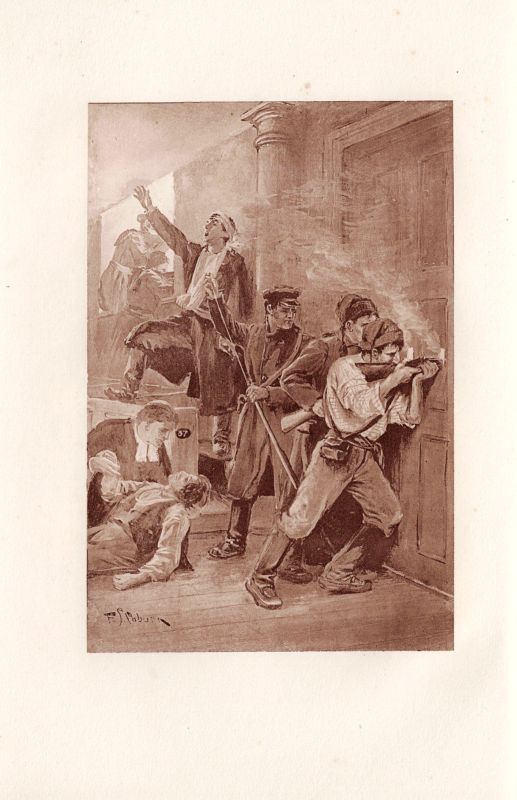
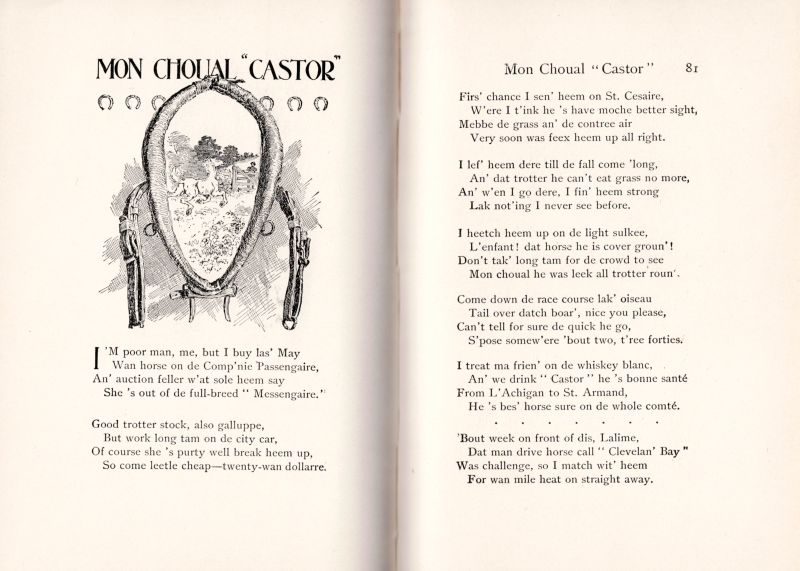
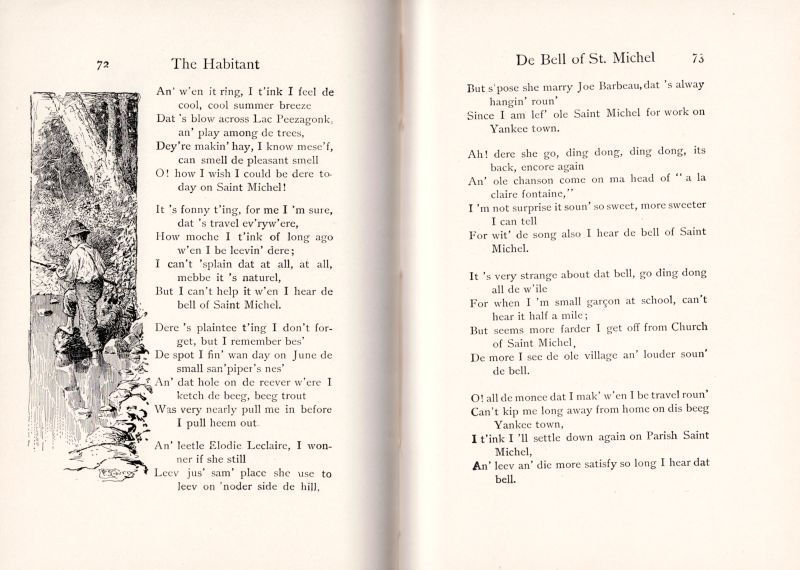
54th Thousand. New York, G.P. Putnam’s Sons, 1911. 20 cm. Frontispiece-Illustration with original tissue-guard. XIV, 137 pages. With some black and white illustrations and beautiful vignettes throughout the text. Original illustrated hardcover. Good condition with signs of external wear. Interior in excellent condition with text and illustrations in fresh condition. A beautiful publication. Includes newspaper cuttings relating to the William Henry Drummond’s life and work. Former library-copy of the Secondary School in Skibbereen, County Cork, Ireland.
Important collection of French-Canadian Poetry by heroic physician and poet William Henry Drummond.
This collection of French – Canadian Poems “that had been passed from hand to hand and were known everywhere, from the clubs pf Montreal and Quebec to the frontier lodges of the wilderness, had value” and were collected in print for the first time by this irish0born new and later true Canadian. An important example how expats often have the necessary distance and audacity to see more value in a local tradition, folklore or history and often contribute to its saving.
William Henry Drummond (April 13, 1854 – April 6, 1907) was an Irish-born Canadian poet whose humorous dialect poems made him “one of the most popular authors in the English-speaking world,” and “one of the most widely-read and loved poets” in Canada.
″His first book of poetry, The Habitant (1897), was extremely successful, establishing for him a reputation as a writer of dialect verse that has faded since his death.”
He was born near Mohill, County Leitrim, Ireland in 1854, as William Henry Drumm, the oldest of four sons of George Drumm and Elizabeth Morris Soden. Shortly after his birth Drummond family moved to Tawley, where he attended school. The family emigrated to Canada in 1864, settling in Montreal, Quebec.
George Drumm died in 1866, leaving the family facing poverty. Mrs. Drumm opened a store, and the boys all delivered newspapers. When he was 14, William was apprenticed as a telegraph operator. He trained and worked at L’Abord-à-Plouffe, now in Laval, on the Lake of Two Mountains, “a Quebec lumber town where he had his first encounters with the habitants and voyageurs who were to inspire (and even to preoccupy) the poet.” In 1875 (when he was 21, legally the head of the household), he changed the family name to Drummond.
In 1876, Drummond went back to the High School of Montreal. He then studied medicine (unsuccessfully) at McGill College and (successfully) at Bishop’s College. After interning in 1885, he practised medicine first in the Eastern Townships, Knowlton and then in Montreal starting in 1888. He became professor of hygiene at Bishop’s in 1893, and of medical jurisprudence in 1894.
In 1894, Drummond married Miss May Harvey, of Savanna-la-Mar, Jamaica. Their first child was born in 1895 but died just hours after birth. Their second child, a son named Charles Barclay, was born in July 1897. Soon after Charles’s birth, Drummond’s The habitant and other French-Canadian poems was published, which helped Drummond become one of the most popular authors in the English-speaking world.
Drummond found himself besieged with requests for speaking engagements, for magazine submissions, for more books. He did as much as he could. Three more volumes of Habitant verse were issued by 1905. “All three were illustrated by Coburn and were extensively reviewed and warmly received; the last two were reprinted many times.” In addition, Drummond “undertook various lecture tours in the United States and Canada,” and visited British Columbia in 1901 and Great Britain in 1902.
In August 1904, Drummond’s only daughter, Moira, was born. That September his third son, William Harvey, died at three years of age. One of William Henry Drummond’s “most famous poems, ‘The last portage,’ which appeared in The voyageur and other poems, came to him as a result of a dream that he had on Christmas Eve 1904 while he was still mourning the boy’s death.″
In 1905, Drummond closed his Montreal medical practice. He began spending extensive time in Cobalt, Ontario, where he and his brothers had acquired interest in silver mines. “He served for a year as the town’s first doctor, was vice-president of Drummond Silver Mine, and wrote poetry of life in the north.″
In the early spring of 1907 Drummond returned to Montreal, and took his wife on a trip to New York City and Washington, D.C. By April, though, he had returned to Cobalt, where he died of a cerebral hemorrhage on the morning of April 6. “Probably no other Canadian poet has been so widely mourned.” His funeral was held at St. George’s Anglican Church (Montreal), where he had worshipped for much of his life, and he was buried in that city’s Mount Royal Cemetery. (Wikipedia)
- Keywords: Canadian Literature · Canadian Poetry · Catalogue No.10 – International Literature · Irish Poet · Irish-Canadian Poet · Italian Literature – Rare · Poetry – Rare
- Language: Mehrsprachig/Multilingual
- Inventory Number: 44425AB
EUR 78,--

We ship per DHL Express

Contact
Inanna Rare Books Ltd.
Woodley House
Castletownshend Road
P81 D262 Skibbereen, County Cork
Ireland
Phone: ++353 - (0) 87 - 102 5412
E-Mail: info@inannararebooks.com
Internet: https://www.inannararebooks.com
Online Bookshop specialized in rare
and secondhand books.
Newsletter and E-Catalogue Sign Up
Payment Options


© 2026 Inanna Rare Books Ltd. | Powered by HESCOM-Software
Follow Us

