Complete Catalog (8425 items)

William Blackstone / Edward Christian - Commentaries on the Laws of England by Sir William Blackstone

8341. Blackstone, William.

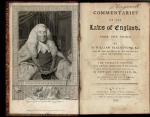
Commentaries on the Laws of England by Sir William Blackstone, Knt. One of the Justices of his Majesty’s Court of Common Pleas. The Twelfth Edition, with the Last Corrections of the Author; and with Notes and Additions by Edward Christian, Esq.

The Rare Edward Christian Edition. Four Volumes (complete set). London, A. Strahan and W. Woodfall, Law-Printers to the King’s most excellent Majesty, for T. Cadell, in the Strand, 1793,1794,1795. Octavo. Pagination: Volume I: X, [6], III, [1], 487 pages / Volume II: [8], 520, XX pages / Volume III: Frontispiece-Portrait, [8], 455, XXXV, [1], 16 pages with three more portraits bound-in / Volume IV: [8], 443, VIII, [72] pages. With four Portraits in total and one large folding table showing the “Table of Descents”. The Portraits which are bound into Volume III of the set are: I. Portrait of British Judge “William Murray, 1st Earl of Mansfield” / II. Portrait of “Lord Chief Baron Gilbert” [Sir Jeffrey Gilbert, Lord Chief Baron of the Exchequer in both Ireland and England] / III. Portrait of english Judge and Member of Parliament, Sir John Comyns, Knt. / IV. Portrait of english lawyer and Lord High Chancellor Philip Earl of Hardwicke. Hardcover / Original edition of the 18th century, rebacked by a master-binder with 20th century leather-spines in the style of the 18th century. This extremely rare edition Edward Christian – Edition of Blackstone, with the last corrections before Blackstone’s death, published for the first time by Edward Christian in the years 1793-1795. This set is used with some minor spotting to pages but overall a very desirable and important version of Blackstone’s commentaries on the Laws of England. [The set comes also with a stunning Limited Edition of the four-volume- Reprint of the First Edition of Blackstone’s Commentaries (1766)].

EUR 2.800,-- 

Show details   Add to cart

Levy, Archive / Collection of more than 300 letters, documents, ephemera

8343. Levy, Arthur Joseph / Zangwill, Israel.

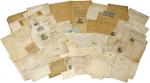
Archive / Collection of more than 350 items, letters, documents, ephemera, pamphlets, manuscript notes, receipts , manuscript letters from the private library of Providence (Rhode Island) lawyer, Arthur (Art) Joseph Levy. The collection includes an important, controversial typescript-essay (8 pages) on Israel Zangwill’s address before the American Jewish Congress at Carnegie Hall on October 14th, 1923 (″Watchmen, what of the Night ?”); with manuscript annotations and remarks on Israel Zangwill’s position “the hopes of Jewry for the establishment of a Jewish State in Palestine are doomed to disappointment”. The collection includes a plethora of interesting letterheads of jewish organizations and also important documentation of Levy’s contribution to and support for the “Palestine Foundation Fund”, (receipt from Boston, Mass. June 1923). Levy, who was a graduate of Brown and Boston University Law School, practiced law in Providence, Rhode Island and led an active life as a member and leader of several Jewish civic organizations, such as the Jewish Family and Children’s Service, which he established and led for twenty years, Rhode Island Jewish Historical Society, the Temple Beth-El Brotherhood, the Miriam Hospital, the Touro Fraternal Association and the Jewish Home for the Aged of Rhode Island. He was also a prominent member of the American Bar Association, the Brown University Alumni Association and the Brown Club of Rhode Island. Highly regarded as a jurist, he was a member of the Commission to Consolidate State Laws, a member of the Advisory Committee of the Federal Tax Institute of New England and an editor of the Rhode Island Bar Journal. Included in this archive are a group of letters written during World War I discussing his role in the Jewish Welfare Board of the United States Army and Navy, an invitation to a fund-raising dinner for the Jewish Orphanage of Rhode Island, a group of documents and letters discussing the establishment of a Jewish country club in Providence, several documents from the early 1920s concerning the mostly Jewish fraternity Phi Epsilon Pi and several items relating to Levy’s personal life, such as personal letters, bills from clothiers and invitations to social events. (Main source of the description of this archive is the research of our colleague Greg Talbot from The Lawbook Exchange).

Providence (Rhode Island), Cambridge (Massachusetts), New York, 1917 – 1931. Octavo and A4. Two heavy folders with original documents. Very good condition with only minor signs of external wear.

EUR 2.800,-- 

Show details   Add to cart

Original, Esoteric, Biblical & Astrological Prophecy Manuscript / Astrology - Occulta - Manuscrip

8344. [Rowe, Walter T.].

Original Numerology-Manuscript – Deciphering the Bible, Deciphering the Esoteric, Jewish, Christian, Biblical & Astrological Prophecies // Manuscript / Astrology – Occulta – Manuscript on c. 400 pages with an astonishing, meticulous Chronology and source-comparison on Prophecy, Pyramidology [″Mystery of the Great Pyramid”], Numerology, Astronomy, Astrology, Drawings and Plans of Pyramids versus Occult – Proof and meditations on the Number 666 and 888: “666 v 888 in relation to Israel”, “the opposing numbers from the original Hebrew with the “Pi sign” etc. etc. The Manuscript reads like a Self-Instruction and Proof of Thought by an Esoteric, highly religious “Truth-Seeker”, ranging from early Biblical Explanations of Historical Events to elaborate comparisons of “Bible Metallurgy” showing the “relation between practical metal work and the Bible” by comparing the architectural design of a “Blast Furnace” to “The Image of Daniel”, and continuing all the way to explanations for the Rise of Tyrants like Hitler. “Great Pi—Ratio in regard to Great War”, the “Atomic Scale” is discussed as well as the “Luciferian Sudama or Nigode Cave Temple”. The amount of connections to Jewish History is interesting: “Tracing Israel to Britain by Old Coinage”, “The Jewish Question”, “Testimony of Men of Letters as to Nationality of the British Race”, “Objections to British Israel” “The Statesmanship of Jesus”, “Fulness of the Gentiles”, “Reference to the lost House of Israel”, “Battle of the Gold Standard” etc. etc.

[Brixton], c. 1935 – 1950. Octavo (19 cm x 22,5 cm). 362 pages plus 58 pages, later inserted between page 304 and 305, plus XVIII pages of a thorough Index. With numerous illustrations and diagrams throughout the manuscript. Original Hardcover – Binder with manuscript / autographed pages. Very good condition with some minor signs of wear only. “Peel”-Memo Binder with Name-Label of the author to pastedown: “Walter T Rowe, 106, Dalberg Road, Brixton, SW2”.

EUR 2.800,-- 

Show details   Add to cart

Sikes, Personal Papers and Archival Material Related to the Life and Career of S

8346. Sikes, Sylvia / [Natural History of the African Elephant]

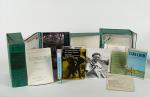
Personal Papers / Archive of Material Related to the Life and Career of Zoologist Sylvia Sikes, the Foremost African Elephant Specialist of her time. All materials from her personal collection / working copies and manuscript material. Including her extensive, two-volume-thesis: “Cardiovascular Disease in Freeliving Wild Animals with particular Reference to the African Elephant (Loxodonta africana)”. A collection of professional and academic papers, copies of Sikes’ monographs, zoological manuscripts and a plethora of photographs and personal newsletters, letters, pamphlets and manuscripts spanning seven decades of Sikes’ personal and professional life in Africa and the UK. The collection is composed of 92 specific pieces (some of which are comprised of one or more items). A detailed bibliography of the collection has been outlined in a Word Document (please request). The collection also includes personal copies of three monographs Sylvia Sikes has published, an original copy of her two-volume doctoral thesis, 37 academic articles and 5 unpublished draft manuscripts. There are also 7 booklets and a book by a third author among the collection. The collection is rounded off by a large number of vintage colour and monochrome photographs, letters, single-sheet newsletters, newspaper and magazine cuttings.

Africa and the UK, Various, 1937 – 2012. 21 cm x 26 cm – 24.5 cm x 31 cm. Circa 2,500+ pages. Numerous monochrome and colour photographs throughout the collection. Includes Hardcover book with dustjacket, softcover book, reprints of academic journal articles in paper wrappers and a variety of loose material in cellophane files. The archive, running from 1937 to 2012, is contained in two green (24.5 cm x 31 cm x 10.5 cm) boxes, four additional folders (32 cm x 24 cm) and two hardcover volumes (21.5 cm x 26cm). Very good condition.

EUR 2.800,-- 

Show details   Add to cart

[Gore-Booth, Two Manuscript Sketch-Books [12” x 10”] bearing the Bookplate "Lady Gore Booth - Lissadell, Sligo

8347. [Gore-Booth, Colum Robert] / [Lady Eva Selina Laura Gore-Booth] / [Constance Georgine Markievicz née Gore-Booth] / [Lissadell House County Sligo].

Two Manuscript Sketch-Books [12” x 10”] bearing the Bookplate “Lady Gore Booth – Lissadell, Sligo [No.43]”. Both Folio-Size Sketch Books titled ‘The “Wood” Sketch Book’, both issued by ‘St. John’s Wood Art School’: 29, Elm Tree Road, London, NW 8. [Founded 1878]. Each Sketch-Book has 50 pages and most pages have manuscript sketches with a few loose sketches tipped in. The very accomplished drawings all appear to be in pencil and show landscapes, trees, horses, portraits, male and female figures, skulls. They all appear to be in the same hand. Also, tipped in is a b/w photo, 6” x 4” mounted on a card. It is signed in pencil by Roberts of Paris. Stamped on the back is “Roberts” 11, Rue du Havre. In pencil, it states “Elizabeth aged 11, May 1922”. From our research it is certain, that Colum Robert Gore-Booth (1913-1959) attended St.John’s Wood Art School and these appear to be his Sketch-Pads, the only other member of the Gore-Booth family who went to London in order to become an artist was Colum’s aunt, Constanze Markiewicz, who attended Slade School of Art at the turn of the century but the drawings do not fit her style.

Two Volumes. London, St.John’s Wood Art Schools / Lissadell House County Sligo, c.1920 – 1930. Folio. Volume I: 118 pages (59 perforated sheets), with 87 studies, often with sketching on both sides of the sheets / Volume II: 100 pages (50 perforated sheets), with 46 studies inside the sketch-book plus two portrait-sketches loosely inserted, plus the photograph of one “Elizabeth”, dated May 1922 and signed by photographer “Roberts” 11, Rue du Havre, Paris. Publisher’s illustrated Hardcover. Very good condition with only minor signs of wear.

EUR 2.800,-- 

Show details   Add to cart

Small Archive of personal correspondence between irish-american writer John Montague and irish artist Louis Le Brocquy plus many and related items

8349. Le Brocquy, Louis / Montague, John / [Dupin, Jacques] / [Samuel Beckett].

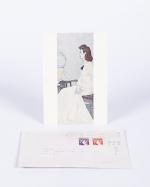
Small Archive of personal correspondence between irish-american writer John Montague and irish artist Louis Le Brocquy plus many related items. The correspondence also includes John Montague touching on Samuel Beckett. The core of the collection includes 1. Extremely insightful and important, very personal manuscript-letter from John Montague to Louis Le Brocquy – Inside an envelope addressed by John Montague to Louis Le Brocquy at his french residence ‘Domaine des Combes’ with Louis Le Brocquy’s answer carefully tucked into the same envelope, treasured by John Montague. The densely filled, very personal 4-page-manuscript letter from John Montague, is dated Christmas 1981, written after “a sabbatical [..] on a long tour which led me as far as Los Angeles” and is a strong reflection of John Montague’s personal struggles, thoughts and influences as a writer; he talks about his ten years of teaching in the US “after O’Riada’s death led to a vacuum” and “enduring the semi-bourgeois limbo of Cork”. Montague speaks about the time “after the harness came off” and he “felt quite strange, and after thirty years my stammer returned in painful, nearly uncontrollable force”. Montague even touches on his fears about his health and continues “I clocked into a clinic for a rest cure….so far liver excellent, so it is not Sean or Brendan all over again (in any case, loving the stuff, as you do, I can’t overdrink; the tastebuds are against it)”. Montague dives into comparisons with Samuel Beckett: “″Did you realize that Sam Beckett was under analysis at the Tavistock Clinic for two years ? – The early Beckett is a smart alec; the break comes when he has to survive in post-war France and accept “his own darkness”. Montague also touches on his struggle with his mother “Isn’t it terrible that we spend up to nearly middle-[a]ge coping with the traumas of youth, with no way round it ? – I have cleared/cleaned/buried & forgiven my mother in my next book “The Dead Kingdom”….” – The letter continues to talk about books, “the Landslide Manuscript”, poetry and his work etc. etc. He mentions a Dupin “play” which “will travel in my Paris luggage”. Montague also touches on the subject of the Irish Troubles and writes “I have always, by the way, believed that 1916 may have been a mistake as Yeats said: “For England may keep faith – For all is said and done” / Montague speaks about “My own area of Tyrone is blessedly free from all but minor incidents” – Amazing document of confidence and trust between two irish landmark personalities. 2. Louis Le Brocquy’s answer to John Montague is dated “New Year’s Day 1981”[which should have been 1982]: A. Very personal manuscript Letter – a direct answer to Montague’s letter from “Christmas 1981” (1 sheet with both pages filled in ink and signed “Louis”) in which Le Brocquy reflects on the tense political situation with Northern Ireland and the overall worldwide tension of a looming war / Le Brocquy writes that he did have a “wild hope that when Charlie took office…that he and Thatcher might between them opted a ‘Rhodesian’ solution in the North” / Le Brocquy also writes about the eagerly awaited publication of “Selected Poems” of John Montague and he also asks John if “you thought of collecting Esteban’s and Dupin’s poems in French with your translations ?” – Le Brocquy offers to help with illustrations etc. – Both letters together in an envelope which suggests that John Montague received his letter to Louis le Brocquy back from the Le Brocquy-estate after Le Brocquy’s death. / Also included: B. A manuscript postcard with Le Brocquy’s “Girl in White” as a postcard-reproduction in which Le Brocquy suggests a project with John Montague and sends greetings to Montague’s wife Evelyn and the kids (in envelope from Carros,France) / C. In his function as chairman of Amnesty International, Le Brocquy sends a callout by Amnesty International to John Montague and kindly asks him to support the cause. He sends the callout to John by adding a few manuscript, personal lines of affection (in envelope from Carros,France).

France / Ireland, Carros / Cork, 1980-1981. A4. 4 pages on two sheets (main Montague-letter), 2 pages on 1 sheet (Le Brocquy – answer), 1 postcard, 1 manuscript-letter from Jacques Dupin to John Montague (25.10.1978) about a translation of “L’Éboulement” (Dupin also speaks about Louis le Brocquy in the letter), several pages of letters (mostly typed and signed) from other figures in irish and international literature and art. Original Envelopes. Very good condition with only minor signs of external wear. Besides some ephemeral materials from personalities in Literature and Art, addressed to John Montague, the small collection includes several vintage photographs of John Montague, taken during his acceptance of a honorary Doctorate of Literature at UCC, Cork, as well as a Legislative Resolution by the State of New York (Senator Daly), recognizing and thanking the distinguished author and poet John Montague with this decree on May 26, 1987. Among the lesser interesting materials is a pamphlet titled “Ireland’s Literary Renaissance – 20th century Portraits” in which portraits by Louis Le Brocquy of John Montague and Thomas Kinsella are included. The pamphlet is accompanied by a letter from James White to John Montague in which he explains this being a publication that was released for an exhibition in Chicago and he apologises for the entries being “necessarily short but hopefully reasonably correct”. Provenance: From the private collection of John Montague’s papers in his recently sold West Cork Home.

Show details

Montague / Dorgan - Typescript Draft MS for a book of poetry by Theo Dorgan. With occasional manuscript corrections

8350. [Montague, John] Dorgan, Theo.

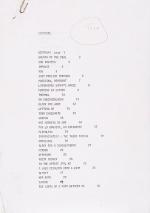
Typescript Draft MS for a book of poetry by Theo Dorgan. With occasional manuscript corrections / suggestions / annotations by Dorgan’s early mentor John Montague, the Typescript MS was held among the private papers of John Montague in his West Cork Home. The typescript includes poems like “Closed Circuit”, “The Promised Garden”. Montague is approving several of the poems by simply applying a tick. John Montague made suggestions in pencil on the structure of “Elegy for a Schoolfriend” and more in depth-suggestions on “Nasty Archer”, “Her Body”,″The Width of a Room Between Us”, “Return”, “Reconciliation”, “Sunday Afternoon”. When asked about helping to date this early draft of his poetry, Theo Dorgan immediately gets back to us and he places it from memory into the early 1980’s. Theo Dorgan was surprised and seemingly chuffed that John Montague held on to this Manuscript and he recalls: “These poems, some in revised versions, make up the backbone of my first published collection, ‘The Ordinary House of Love’.” Dorgan continues: “I’m happy to say that most of them survived Montague’s eagle eye, which was of course a great comfort to me at the time. Still is!” Some of these poems selected had previously been published as broadsheets etc. but the skeleton of the Draft hints already at readying it for publication. Theo Dorgan graciously gives us even more information: “Some of the poems in the eventual book go back to when I was a student, others were definitely written in the second half of the 80s. The bulk of it, however, is in this MS. I base my estimation in part on the fact that what you have is a typescript produced, it appears, on the IBM golfball machine that was the pride and joy of Triskel Arts Centre. That machine was bought in 1980 or 1981, I’m fairly sure of that. I was Literature Officer there, then.” Theo Dorgan was part of John Montague’s circle of mentored poets, even though in an email-exchange with him about this typescript he mentions that “John Montague worked far more with Thomas McCarthy, Maurice Riordan and Gregory O’Donoghue than he did with me, and in many ways Gregory O’Donoghue was at that stage the most accomplished of us all – the only one included in JM’s Faber Book.” What followed then in our conversation with Theo Dorgan is a great example why manuscripts, letters, autographs, typescripts and the connections we often make with documents from the past have such meaning in explaining our emotional ties with people who matter to us on our way of forming personality. They are memories transforming into images, floods of empathy and nostalgia for personal moments lost but treasured because they helped us form our values. Presented with the old typescript, Theo Dorgan’s emotionality is tangible and he confesses more in an internal dialogue with himself and John Montague than with us: “I’m sorry to say that the reason John Montague worked with those others more than he did with me is because, in my shameful, youthful arrogance, I much preferred to trust my own judgement, and also, I suspect, because I was closest to John in temperament and feared coming unduly under his influence. That said, there was no-one whose good opinion of a poem I valued more, and we were close all our lives after. Very likely it was a case of old stag/young stag ! Montague taught us by indirection, he made his extensive library of modern and contemporary poetry available to us without stint, would wait for us to find an affinity (as, e.g. mine with Robert Graves and Galway Kinnell) and would then, in a long, ongoing conversation, help us to understand what it might mean for our own poems that we felt such affinities. A guided companionship in reading and making, if you will.”

Ireland, c.1981-1982. A4. 43 pages typescripts. Paperclipped. Very good condition with only minor signs of external wear. Some fingerstaining and residue of rust from the paperclip. Wonderful and extremely valuable document of not only a collaboration between two of Ireland’s landmark writers but moreover witness to the becoming, the birth of a true poet. Also included (from a different source) is a second printing of the first edition of the subsequent publication “The Ordinary House of Love” – signed by Theo Dorgan. Right at the beginning of the printed version, instead of a dedication to John Montague, Theo Dorgan placed a quote from Montague’s poem “Wine Dark Sea”: ‘For there is no sea / it is all a dream there is no sea / except in the tangle / of our minds; / the wine dark / sea of history on which we all turn / turn and thresh / and disappear.’ (Collected Poems, page 255). Provenance of the annotated typescript: From the private collection of John Montague’s papers in his recently sold West Cork Home.


EUR 2.800,-- 

Show details   Add to cart

Page: 1 2 ... 832 833 834 835 836 837 838 ... 842 843
: