


[Zinn, Hiroshima.
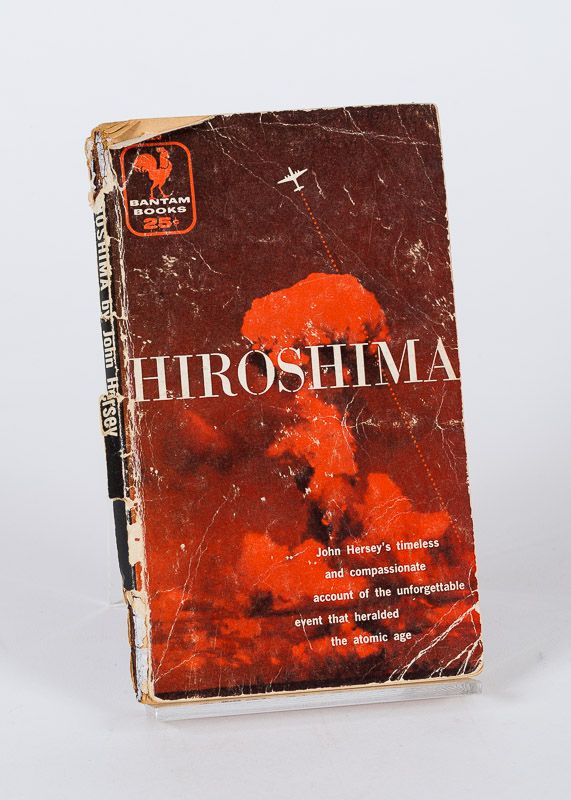
Hiroshima [Howard Zinn’s personal copy with his name signed in full to the endpaper, markings in the text and some comments in Zinn’s hand inside the rear cover].
New York, Bantam Books, 1965. 10.6 cm x 17.7 cm. 117 pages. Original Softcover. Very Poor condition. Tears to last few pages. Pages heavily tanned. Contains blue ink markings by influential Anti-War Historian Howard Zinn. This book would have been extremely personal to him and it is telling that he marked the part of the text on page 61 in which a Hospital in Hiroshima was invaded by patients who scolded doctors, sleeping from exhaustion, into helping them. Zinn, an army veteran of World War II, would have known the cost of war and especially would have been able to imagine the cost of nuclear war.
Includes for example the following chapters: A Noiseless Flash / The Fire / Panic Grass and Feverfew etc.
John Richard Hersey (1914–1993) was an American writer and journalist. He is considered one of the earliest practitioners of the so-called New Journalism, in which storytelling techniques of fiction are adapted to non-fiction reportage. Hersey’s account of the aftermath of the atomic bomb dropped on Hiroshima, Japan, was adjudged the finest piece of American journalism of the 20th century by a 36-member panel associated with New York University’s journalism department.
“At exactly fifteen minutes past eight in the morning on August 6, 1945, Japanese time, at the moment when the atomic bomb flashed above Hiroshima, Miss Toshiko Sasaki, a clerk in the personnel department of the East Asia Tin Works, had just sat down at her place in the plant office and was turning her head to speak to the girl at the next desk.″
—Opening sentence, Hiroshima, John Hersey, 1946
Soon afterward John Hersey began discussions with William Shawn, an editor for The New Yorker, about a lengthy piece about the previous summer’s bombing. Hersey proposed a story that would convey the cataclysmic narrative through individuals who survived. The next May, 1946, Hersey traveled to Japan, where he spent three weeks doing research and interviewing survivors. He returned to America during late June and began writing about six Hiroshima survivors: a German Jesuit priest, a widowed seamstress, two doctors, a minister, and a young woman who worked in a factory.
The result was his most notable work, the 31,000-word article “Hiroshima”, which was published in the August 31, 1946, issue of The New Yorker. The story dealt with the atomic bomb dropped on that Japanese city on August 6, 1945, and its effects on the six Japanese citizens. The article occupied almost the entire issue of the magazine – something The New Yorker had never done before. (Wikipedia)
- Keywords: American History – Rare · Catalogue No.19 – American History and Politics · Hiroshima · Historic Document · HISTORICAL ACCOUNTS · Howard Zinn · Japan · Japanese History – Rare · Military History – Rare · Nuclear Holocaust · Nuclear Weapons · World War II · World War Two · World War, 1939-1945
- Language: English
- Inventory Number: 200424AB
EUR 475,--

We ship per DHL Express
Contact
Inanna Rare Books Ltd.
Woodley House
Castletownshend Road
P81 D262 Skibbereen, County Cork
Ireland
Phone: ++353 - (0) 87 - 102 5412
E-Mail: info@inannararebooks.com
Internet: https://www.inannararebooks.com
Online Bookshop specialized in rare
and secondhand books.
Newsletter and E-Catalogue Sign Up
Payment Options


© 2026 Inanna Rare Books Ltd. | Powered by HESCOM-Software
Follow Us

