Complete Catalog (8246 items)

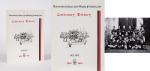
Louis Cobbett - Two Manuscript Books of Laboratory Notes by student of bacteriology and later publisher of "The Causes of Tuberculosis", Louis Cobbett (1863 - 1947)

7714. [Cobbett, Louis] [mentioned are: Behring, Emil von / Koch, Robert / Metchnikoff, Ilya (Élie) / Dönitz, Friedrich Karl Wilhelm / Ehrlich, Paul / Shield, Marmaduke and others]

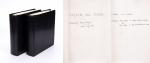
Two Manuscript Books of Laboratory Notes by student of bacteriology and later publisher of “The Causes of Tuberculosis”, Louis Cobbett (1863 – 1947), dealing in these lab notes with the discovery of remedies for Tuberculosis and Diphtheria. Original, two-volume Manuscript-Compendium of research-notes regarding all the important discoveries in Bacteriology (Diphtheria and Tuberculosis) by contemporaries of Louis Cobbett during the years 1885 – 1908 (Behring, Koch, Metchnikoff etc.). The notes were started by Louis Cobbett in 1885, after graduating from Trinity College, Cambridge and while he was working towards his degree in 1899. The stunning documents are not only reading like a first-hand-journal of discoveries, citing and reflecting on all the important developments and medical advancements of the outgoing 19th and beginning 20th century, but these notes were written parallel to Robert Koch, Emil von Behring and others making their breakthrough discoveries for mankind’s desperately needed cures against Tuberculosis and Diphtheria. Cobbett reflects on the publications in the “Zeitschrift fuer Hygiene” and separately published books and articles. Louis Cobbett lists all the important and also the critical publications leading up to (for example) Koch’s discovery of Tuberculin (e.g.: Beck – “Ueber die diagnostische Bedeutung des Kochschen Tuberculins”), he mentions Emil von Behring, Paul Ehrlich’s “Ueber die Constitution des Diphteriegiftes”, he cites A.Jeffery Turner’s “Statistics on the Diphtheria mortality of the 3 principal Australian Colonies for the past 15 years” (published in 1899), he writes about Tuberculin production in fowl, he reflects on A.Calmette and G. Guerin, “supporting [Emil von] Behring in his contention that pulmonary tuberculosis is of intestinal origin”. Other mentions are “TB of human origin (from a cervical gland)”, he speculates on the publication by Fiebiger and Jensen regarding the transmission of tuberculosis from human to animal, he offers drawings of cultures with Rabbit emulsions, Bovine Characters, Avian cultural characters etc. A few lectures are referred to, including one by Sims Woodhead, a colleague of Louis Cobbett and no doubt attended by Cobbett himself; one newspaper report has been pasted in: ‘Important conference’ in Leeds, from Yorkshire Post 1899 / Louis Cobbett intensely elaborates on Kossel and his report on the english Tuberculosis – Commission in 1908 (H. Kossel – Die Tuberkulosefrage und die Arbeiten der englischen Tuberkulosekommission).

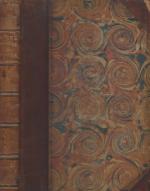
[Cambridge], c. 1885 – 1908. Octavo (17 cm x 21 cm). 90 blank leaves with manuscript entries in each volume, usually written on rectos only. Hardcover / Original half leather with dark blue cloth-covered boards bearing paper-labels to covers, detailing some of the sources cited within; marbled endpapers and edges. Very good condition with only minor signs of external wear.

EUR 1.000,-- 

Show details   Add to cart

[Gore-Booth, Two Manuscript Sketch-Books [12” x 10”] bearing the Bookplate "Lady Gore Booth - Lissadell, Sligo

7716. [Gore-Booth, Colum Robert] / [Lady Eva Selina Laura Gore-Booth] / [Constance Georgine Markievicz née Gore-Booth] / [Lissadell House County Sligo].

Two Manuscript Sketch-Books [12” x 10”] bearing the Bookplate “Lady Gore Booth – Lissadell, Sligo [No.43]”. Both Folio-Size Sketch Books titled ‘The “Wood” Sketch Book’, both issued by ‘St. John’s Wood Art School’: 29, Elm Tree Road, London, NW 8. [Founded 1878]. Each Sketch-Book has 50 pages and most pages have manuscript sketches with a few loose sketches tipped in. The very accomplished drawings all appear to be in pencil and show landscapes, trees, horses, portraits, male and female figures, skulls. They all appear to be in the same hand. Also, tipped in is a b/w photo, 6” x 4” mounted on a card. It is signed in pencil by Roberts of Paris. Stamped on the back is “Roberts” 11, Rue du Havre. In pencil, it states “Elizabeth aged 11, May 1922”. From our research it is certain, that Colum Robert Gore-Booth (1913-1959) attended St.John’s Wood Art School and these appear to be his Sketch-Pads, the only other member of the Gore-Booth family who went to London in order to become an artist was Colum’s aunt, Constanze Markiewicz, who attended Slade School of Art at the turn of the century but the drawings do not fit her style.

Two Volumes. London, St.John’s Wood Art Schools / Lissadell House County Sligo, c.1920 – 1930. Folio. Volume I: 118 pages (59 perforated sheets), with 87 studies, often with sketching on both sides of the sheets / Volume II: 100 pages (50 perforated sheets), with 46 studies inside the sketch-book plus two portrait-sketches loosely inserted, plus the photograph of one “Elizabeth”, dated May 1922 and signed by photographer “Roberts” 11, Rue du Havre, Paris. Publisher’s illustrated Hardcover. Very good condition with only minor signs of wear.

EUR 2.800,-- 

Show details   Add to cart

Vintage Photo Album of "Cruise No. 2 to 'The Norwegian Fjords'  in June 1913 on the R.M.S.P. Arcadian"

7729. [Davey & Hackney] / R.M.S.P. Arcadian.

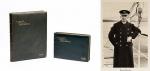
Two Vintage Photo Albums / Portfolios of “Cruise No. 2 to ‘The Norwegian Fjords’ in June 1913 on the R.M.S.P. Arcadian”. Fantastic combination of two photo logbooks of one of the last trips for this beautiful passenger liner before she served with the Royal Navy and was sunk by a U-boat, the German submarine SM UC-74, in 1917. These luxury photographic records were created by Davey & Hackney, Alexandra Palace, London. I. Album One: On 24 pages (12 stiff cardboards with photographs on both sides) with 44 vintage high-quality photographs, the cruise was documented by not only focusing on the natural beauty of Norway but also by documenting the captain (Captain Custance) and crew of the Arcadian, one large photograph shows the captain and all his officers. Some striking images of the ship itself are showing this liner in all its glory. The ship was built in 1899 by Vickers, Sons & Maxim Ltd. for the Pacific Steam Navigation Company as SS Ortona. This unusually luxury Album also documents in an appendix with a small map of Norway the Itinerary of the cruise. All mileage covered and dates the cruise would reach the scheduled destinations in Norway are mentioned (Grimsby, Wed. 18 June / Leith, 235 miles, Thursday 19 June / Aalesund 493 Miles Sat. 21 June / and so on and so on). The cruise would stop at Molde (Moldefjord), Aandalsnaes (Romsdalfjord) / Oie (Jorundfjord) / Hellesylt (Sunelvsfjord) / Merok (Geirangerfjord) / Olden (Invikfjord) / Loen (Nordfjord) / Mundal (Fjaerlandsfjord) / Balholmen (Sognefjord) / Gudvangen (Naerofjord) / Sundal (Maurangerfjord) / Norheimsund (Hardangerfjord) / Bergen / back to Grimsby on July 2nd, 1913 with a total of 2127 miles covered in 14 days. The photographs of the “Arcadian” are differing in size from a beautiful full ship image in 17.5 cm x 28.7 cm to detailed photographs of the deck in 11.5 cm x 16.4 cm; a nice photo of the “Arcadian’s” Launch (with small steem funnel), interior of the ship (Dining Salon), a photograph of a visiting steam Tender (″The Grimsby Tender”), Deck tennis – scenes, Playing Bull Board, Letting go the Anchor with two crew members. / II. Album Two: This additional, smaller Album, on an additional 24 pages (12 stiff cardboards with photographs on both sides) shows a further 24 vintage, high-quality photographs. These additional photographs show The Hardangerfjord / Folgefond Glacier / An Arcade in the Dining Salon / Photograph of Captain Custance / Sundal / The Landing Stage in Norheimsund / Fysse / The Landing Stage in Trondheim with many locals waiting / The Landing Stage in Forhatten / Digermulen / The Raftsund Fjord / Lyngenfjord / A boat full of Lapps in traditional clothing, showing and offering livestock and handmade dolls for tourists on board the “Arcadian” / Hammerfest / North Cape & Midnight Sun from the “Arcadian” / Tromso, with a large gathering of schoolchildren / A Boxing Match on the “Arcadian”, showing two pugilists fighting it out to the bemusement of bystanders / Pillow Fighting as Pastime for Tourists on the “Arcadian” / Molde from the Hill, showing the “Arcadian” in the Fjord / Aandalsnes / View from Aandalsnes / Bergen and Bergen Harbour with a few nice local Yachts in the foreground // The quality of the photography in both of these Album is excellent.

London / Norway, Davey & Hackney Photo (Alexandra Palace), 1913. Sizes: Vol. I: Folio (25.5 cm x 32 cm) / Vol.II: Oblong Octavo (25 cm x 17 cm). Volume I: 12 cardboard sheets with 24 pages (of which 24 are with photographs) with foldable appendix / Volume II: 12 cardboard sheets with 24 pages (of which 24 are with photographs) Hardcover / Green soft morocco with gilt lettering on cover and ornament around the pastedowns of the inner boards. Some minor rubbing to the binding but overall in excellent, near Fine condition with only minor signs of external wear.

EUR 1.280,-- 

Show details   Add to cart

Typed Letter signed from american philosopher John Wild to Philosopher Henry David Aiken

7733. [Maluf, Brother Francis] Wild, John / Aiken, Henry D.

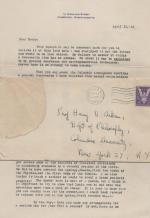
Typed Letter signed from american philosopher John Wild to Philosopher Henry David Aiken, informing Aiken: “I missed you especially two weeks ago when I attempted to defend a realistic view of ethics in terms of the concept of natural law. I am not sure, but I think you might have been in agreement with some of the points I tried to make as over against Lewis’ Kantian subjectivism and Demos’ [Raphael Demos] extreme Platonism….”. Besides some further niceties, John Wild talks in this letter intensely about Christian Arab Philosopher Francis Maluf, from Mashrah, Lebanon, who could be in John Wild’s mind the perfect “section man for your Phil A course”. Wild continues to praise the syrian, Maluf, who had been “teaching Mathematics and Physics in a war job out of Worcester and who has been keeping up his interest in philosophy by attenting courses around here, organizing discussion groups and other intellectual activities which amaze me by their versatility and intensity”. John Wild continues: “He has been offered a permanent job at the University of Beirut in Syria to teach Philosophy there (he is a friend of Malik’s) but if possible wants to stay around here for another year to study and learn before he goes back.” [Maluf had converted to catholicism in 1940 and was later known as Brother Francis Maluf.

Cambridge, April 15th, 1945. Octavo. 2 pages. Softcover. Very good condition with only minor signs of wear. Original two-page-letter with original envelope.

Show details

Hans Jonas / Henry David Aiken, Typed letter, signed by German-born, American Jewish philosopher Hans Jonas

7734. Aiken, Henry David / [Hans Jonas] / Quine, W.V.O.

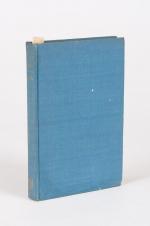
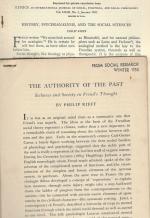
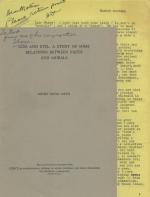
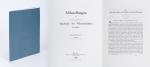
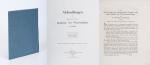
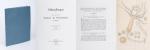
Typed letter, signed by German-born, American Jewish philosopher Hans Jonas, loosely inserted in Henry David Aiken’s pamphlet “God and Evil: A Study of Some Relations Between Faith and Morals”. The Essay by Aiken is inscribed and signed by Aiken in a sarcastic manner: “To God, from one of his congregation – Shem”. In the letter, Jonas reflects on two pages on an evening with Henry David Aiken and his then wife Lillian Woodworth. In his letter to Aiken, Hans Jonas reports back to Aiken after reading his essay [″God and Evil”] and calls it “a beautiful piece of work – in style and content worthy of your “master” who wrote on natural theology….”. Jonas goes on encouraging Aiken: “you are also dead wrong n not publishing a collection of your essays in ethical theory. If your pal Quine can do it “from a logical point of you [sic]”, so can you “from a moral point of view”. Jonas also mentions “that it is worth writing about the ancient problem opf a theodicy in a contemporary context”. [The Essay is n Offprint from Ethics, An International Journal of Social, Political and Legal Philosophy, Volume LXVIII, No. 2].

New York / Washington, DC, 1958. 16,8 x 24 cm. 21 pages (pages 77-97 of the Journal) plus two page-letter (on one leaf), signed by Hans Jonas Original Offprint / Original TLS (Typed letter signed). Very good+ condition. Stapled. Only minimal signs of staining. The letter also discusses a Reference for one “Ed Sayles” and Jonas suggest that Aiken writes “casual but fairly strong” to Howard R. Bartlett, professor of history and head of the Department of Humanities at MIT.

Show details

Montague / Dorgan - Typescript Draft MS for a book of poetry by Theo Dorgan. With occasional manuscript corrections

7735. [John Montague Collection] – [Montague, John] Dorgan, Theo.

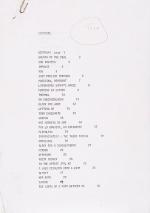
Typescript Draft MS for a book of poetry by Theo Dorgan. With occasional manuscript corrections / suggestions / annotations by Dorgan’s early mentor John Montague, the Typescript MS was held among the private papers of John Montague in his West Cork Home. The typescript includes poems like “Closed Circuit”, “The Promised Garden”. Montague is approving several of the poems by simply applying a tick. John Montague made suggestions in pencil on the structure of “Elegy for a Schoolfriend” and more in depth-suggestions on “Nasty Archer”, “Her Body”,″The Width of a Room Between Us”, “Return”, “Reconciliation”, “Sunday Afternoon”. When asked about helping to date this early draft of his poetry, Theo Dorgan immediately gets back to us and he places it from memory into the early 1980’s. Theo Dorgan was surprised and seemingly chuffed that John Montague held on to this Manuscript and he recalls: “These poems, some in revised versions, make up the backbone of my first published collection, ‘The Ordinary House of Love’.” Dorgan continues: “I’m happy to say that most of them survived Montague’s eagle eye, which was of course a great comfort to me at the time. Still is!” Some of these poems selected had previously been published as broadsheets etc. but the skeleton of the Draft hints already at readying it for publication. Theo Dorgan graciously gives us even more information: “Some of the poems in the eventual book go back to when I was a student, others were definitely written in the second half of the 80s. The bulk of it, however, is in this MS. I base my estimation in part on the fact that what you have is a typescript produced, it appears, on the IBM golfball machine that was the pride and joy of Triskel Arts Centre. That machine was bought in 1980 or 1981, I’m fairly sure of that. I was Literature Officer there, then.” Theo Dorgan was part of John Montague’s circle of mentored poets, even though in an email-exchange with him about this typescript he mentions that “John Montague worked far more with Thomas McCarthy, Maurice Riordan and Gregory O’Donoghue than he did with me, and in many ways Gregory O’Donoghue was at that stage the most accomplished of us all – the only one included in JM’s Faber Book.” What followed then in our conversation with Theo Dorgan is a great example why manuscripts, letters, autographs, typescripts and the connections we often make with documents from the past have such meaning in explaining our emotional ties with people who matter to us on our way of forming personality. They are memories transforming into images, floods of empathy and nostalgia for personal moments lost but treasured because they helped us form our values. Presented with the old typescript, Theo Dorgan’s emotionality is tangible and he confesses more in an internal dialogue with himself and John Montague than with us: “I’m sorry to say that the reason John Montague worked with those others more than he did with me is because, in my shameful, youthful arrogance, I much preferred to trust my own judgement, and also, I suspect, because I was closest to John in temperament and feared coming unduly under his influence. That said, there was no-one whose good opinion of a poem I valued more, and we were close all our lives after. Very likely it was a case of old stag/young stag ! Montague taught us by indirection, he made his extensive library of modern and contemporary poetry available to us without stint, would wait for us to find an affinity (as, e.g. mine with Robert Graves and Galway Kinnell) and would then, in a long, ongoing conversation, help us to understand what it might mean for our own poems that we felt such affinities. A guided companionship in reading and making, if you will.″

Ireland, c.1981-1982. A4. 43 pages typescripts. Paperclipped. Very good condition with only minor signs of external wear. Some fingerstaining and residue of rust from the paperclip. Wonderful and extremely valuable document of not only a collaboration between two of Ireland’s landmark writers but moreover witness to the becoming, the birth of a true poet. Also included (from a different source) is a second printing of the first edition of the subsequent publication “The Ordinary House of Love” – signed by Theo Dorgan. Right at the beginning of the printed version, instead of a dedication to John Montague, Theo Dorgan placed a quote from Montague’s poem “Wine Dark Sea”: ‘For there is no sea / it is all a dream there is no sea / except in the tangle / of our minds; / the wine dark / sea of history on which we all turn / turn and thresh / and disappear.’ (Collected Poems, page 255). Provenance of the annotated typescript: From the private collection of John Montague’s papers in his recently sold West Cork Home.


Show details

Page: 1 2 ... 152 153 154 155 156 157 158 ... 164 165
: