Signed (336 items)

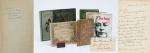
Vere Foster, "Presentation Copy of "The Two Duchesses" with Autograph / Manuscript-Letter

22. Foster, Vere [Henry Louis / Lewis] / [Emily Albinia “Alba” Foster] / [Georgiana Duchess of Devonshire / Elizabeth, Duchess of Devonshire].

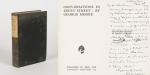
Amazing Vere Foster-Collection including Educational Materials and as a centerpiece the “Presentation Copy of “The Two Duchesses” with Autograph / Manuscript – Letter by Vere Foster to his niece, Emily Albinia “Alba” Foster. With a stunning, unpublished, two-page-letter, revealing several important details about the immediately favorable reviews and reception of the book [″in the Daily Telegraph”] and Vere Foster’s disdain about some criticism from one J.Donohue [which led to an alteration in the second edition of the book]. Vere Foster is also expecting a review to appear in the “Athenaeum” but reports “the Athenaeum has nothing yet”. Vere Foster apologizes to his niece for the delay in sending the book and explains that he had left 12 “parcels″£ with Blackie’s agent and gave instructions to send them but a few days later found they had been “untouched”. / The Two Duchesses – Georgiana, Duchess of Devonshire / Elizabeth, Duchess of Devonshire – Family Correspondence of and Relating to Georgiana, Duchess of Devonshire / Elizabeth, Duchess of Devonshire, Earl of Bristol (Bishop of Derby), The Countess of Bristol, Lord and Lady Byron, The Earl of Aberdeen, Sir Augustus Foster Bart, and Others, 1777-1859. [See Full list of items which are part of this collection, on our website under the topic “Libraries & Collections”].

First Edition. London / Glasgow and Dublin, Blackie & Son Limited, 1898. Octavo (15 cm x 22 cm). Pagination: Frontispiece, IX, [3], 497 pages with 18 Illustrations (including frontispiece and one Vignette of the two Duchesses opposite page 1). Hardcover / Original, publisher’s green cloth with gilt lettering on spine. Very good condition with some minor signs of wear only. This is an astonishing find for the Vere Foster Research Community and the letter gives significant insight into the importance the publication had for him, its reception as seen by Vere Foster and it solves the riddle why an altertaion was necessary for the second edition [which Vere Foster explains in a brief note to the reader at the beginning of the second edition]. The heartfelt inscription to his niece Albinia Foster is also of great importance and to our knowledge the only presentation-copy of this book on the international market for the several decades we can look back at auction records.

EUR 4.800,-- 

Show details   Add to cart

[Schneemann, Eshleman, Bearings.

39. [Schneemann, Carolee] Eshleman, Clayton.

Bearings. [Two fantastic association copies of this limited edition / Both copies from the library of Carolee Schneemann / Both, beautifully inscribed by Clayton Eshleman to Carolee Schneemann and one copy with an annotation and several interesting textmarkings by Carolee Schneemann].

First Edition. Santa Barbara, Capricorn Press, 1971. 22.5cm x 15.3cm. 22 (6) pages. Original illustrated softcover. Excellent condition of noth editions, with only minor signs of external wear. This is one of Eshleman’s most personal works, which explains why he inscribed it in two consecutive years to Carolee Schneemann. Clayton Esleman writes about the impact Rilke’s “Letters to a Young Poet” had on him in 1959. Carolee Schneemann has marked several passages which were important to her, among which is: “for in the sense that what is deeply sick in man today is his hate for his body, in that he has loaded the most energetic word he has for love-making with all the hostility he feels against the act of love. Don’t fuck with me, we say. Keep your fucking hands off. Fuck you. And that word, like a jungle interwoven with all kinds of lianas and vines of tensions, desires, and hate, can’t now possibly convey just its erotic energy – “. / Eshleman also leaves a short biographical note (in print) at the end of this Volume in which he critically describes his consequential status quo: “…..Moved to New York City the summer of 1966…..the bottom fell out: I left my family, moved into a hole in the corner of Greenwich Avenue and Bank Street and entered Reichian Therapy…..Presently living in Sherman Oaks, California, with my wife Caryl – and, as of last week, loaned orgone accumulator sitting expectantly in Garage….– 28 January 1971”.

EUR 480,-- 

Show details   Add to cart

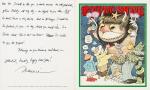
Small Collection / Small Archive of two very rich and personal, handwritten & signed letters on cards by Sendak, together with a wonderful collection of fourteen (14) loose gicleé prints

51. Sendak, Maurice (1928 – 2012).

Collection / Archive of two very rich and personal, handwritten & signed letters on cards by Sendak, plus a rare, multi-folded, advertising-leporello of Maurice Sendak’s publications, together with a wonderful collection of fourteen (14) loose gicleé prints of original drawings by Maurice Sendak in colour or black and white: ‘A Kiss for Little Bear’ x 2 (26.5 cm x 34.5 cm) / ‘Zlateh the Goat’ x 2 (24 cm x 30 cm and 37.5 cm x 30 cm) / ‘Mr. Rabbit and the Lovely Present’ x 1 (33.4 cm x 41.5 cm) / Lullabies and Night Songs’ x 2 (35 cm x 26.5 cm and 44.5 cm x 33.5 cm) / ‘Hector Protector’ x 1 (46 cm x 26 cm) / ‘In the Night Kitchen’ x 4 (50 cm x 36 cm) / Higglety Pigglety Pop x 2 (28 cm x 35.5 cm). The two cards are addressed to “Minnie” [that is “Minnie Kate”] and were written at Christmas 1986 and Christmas 1987. According to a colleague in the trade, who helped us to identify the recipient “Minnie”, Minnie Kate, together with her mother, maintained a long friendship with Maurice Sendak by sending him colored stones or rocks that they sourced from local beaches in the northwest of the United States (Washington Statel). Most of Maurice Sendak’s correspondence with Minnie Kate and her mother, is preserved at the Rosenbach Museum & Library, Philadelphia. Both cards are similar in content. One of the cards featuring Sendak’s art from the cover of Nutcracker and addressed to Minnie, reading in part “I worked all year on a picture-book – a Grimm tale (my first book in 8 years !!). I am in love with it and it gets published next year….my wild things celebrate their 25th anniversary. I hope i enjoy it all. Am hoping for a quiet year ahead illustrating a Grimm tale and staying put – I am tired of travelling and theatre projects. And look forward to creeping back into my old role as book illustrator” / “The rocks arrived while I was away working in England. They are wonderful, of course, and very much appreciated. Thank you again and again. My animals. I have but one. My darling Golden Retriever, Io, had to be put to sleep 2 weeks ago. She was 15 1/2 and I held her and stayed with her to the end. It is so sad, naturally, but the memory fills me with a kind of joy. I have a 3 1/2 year old German Shepherd named Runge after a German painter (19th century). It was anything but a lazy year – too full! This coming year will be lazy-ish”.

Letters: 4 pages on two cards / Gicleé prints: 15 sheets (unsigned). [New York], 1986 – 1987. Very good condition.

EUR 1.280,-- 

Show details   Add to cart

David Puttnam - Collection of original Film / Movie - Memorabilia, inscribed/signed books and the extensive Record Collection

54. Puttnam, David.

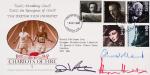
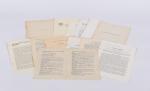
Collection of Film / Movie & Music – Memorabilia with rare, inscribed/signed books, photographs and promotional ephemera as well as related materials from the private library of Lord David Puttnam and few other sources. The collection includes a large amount of international publications and important monographs on the History of Film and Movies and also several signed and/or inscribed/dedicated Vinyl-Records by early friends of David Puttnam (Ringo Starr, Barbra Streisand etc.) together with some publications on Literature, History, Photography. Also included are several amazing association-copies from David Puttnam’s time as producer at Columbia Studios; like a signed and spectecularly inscribed book by important Director Spike Lee, Director and friend Alan Parker etc. etc. We list here a few items but the complete list of items, described in detail and photographed, will be visible over time on our website under “Libraries & Collections”. Among the titles are for example: 1. A xeroxed copy of the second draft of “Chariots of Fire”, which David Puttnam signed in 2019 and to which he added a wonderful manuscript note and story of the Script: “This is a very interesting early Draft of ‘Chariots of Fire’ – A year later we started shooting the film in Cambridge – Almost exactly two years later the film won the BAFTA Best Picture Award and a few weeks later The ‘Oscar’ ! – Colin Welland also won for Best Screenplay that same evening. Reading this you can see why. Regards – David Puttnam”/ 2. Collection of signed vintage Vinyl owned by Lord David Puttnam, signed and inscribed Records by famous artists and musicians like Barbra Streisand, Ringo Starr, Jean-Michel Jarre as well as soundtracks of his own films (included are Local Hero [not signed by Mark Knopfler but signed by David Puttnam], Midnight Express) etc. / 3. Amazing, absolutely wonderful association copy of Alan Parker’s “Cartoon Version” of his movie “Evita” with which he thanked his cast and crew. This being a personally inscribed copy from Alan Parker to his friends David & Patsy Puttnam. Accompanied by a two-page letter, signed by Parker and citing a quote of David Puttnam reflecting on his own experiences in the movie-business with a bit of ironic advice for his friend Alan Parker on how to exit the movie-business. / 4. Collection of books by writers befriended to David Puttnam, often signed and/or inscribed (Nick Hornby – Fever Pitch etc.) / 5. Collection of monographs and biographies on and by Actors, Directors, Film and Movie-MakingTechnique, Sociology of Film etc. etc. / 6. Large collection of photographical stills as well as portraits of Directors on set during the act of directing, etc. etc.

London / UK / USA, c.1968-1996. Octavo. Original Hardcover with the rare illustrated dustjacket in protective collector’s Mylar. Very good condition with only minor signs of external wear.

EUR 25.000,-- 

Show details   Add to cart

Collection of important and rare publications by and on american philosopher Stanley Cavell

56. [Stanley Cavell Collection] – Cavell, Stanley [Stanley Louis Goldstein].

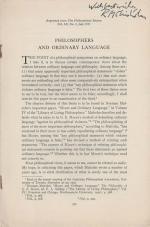
Collection of important and rare publications by and on american philosopher Stanley Cavell. The books in this collection originate from the personal library of Stanley Cavell, his friends Victor and Jacqueline, as well as from the library of philosopher Graham Parkes [Please see each title described and photographed in our section “Libraries & Collections” and search for “Stanley Cavell Collection”]. The collection includes: 1. Must We Mean What We Say ? – Modern philosophical essays in morality, religion, drama, music and criticism. First Edition, 1969. Signed and inscribed by Stanley Cavell / 2. Stanley Bates and Ted Cohen – More on what we say. First Edition. Chicago, Middlebury College, 1972 / 3. Cavell, Stanley – Themes out of School. Effects and Causes. San Francisco, North Point Press, 1984. Signed and inscribed by Stanley Cavell / 4. Cavell, Stanley. The World Viewed – Reflections on the Ontology of Film. New York, The Viking Press, 1971. Signed and inscribed by Stanley Cavell in the year 1971, to his friends Victor and Jacqueline / 5. [Cavell, Stanley] Oksenberg Rorty, Amélie. The Many Faces of Philosophy. Reflections from Plato to Arendt. First Edition. Oxford and others, Oxford University Press, 2003. Signed and inscribed by the Editor to Cavell. / 6. [Cavell, Stanley] – Massimo Cacciari – Architecture and Nihilism: On the Philosophy of Modern Architecture – Stanley Cavell’s personal copy with notes and annotations. / 7. [Cavell, Stanley] Desan, Wilfrid – The Tragic Finale – An Essay on the Philosophy of Jean-Paul Sartre – with interesting annotations and textmarkings by Stanley Cavell / 8. Cavell, Stanley. Pursuits of Happiness – the Hollywood Comedy of Remarriage. Massachusetts, Harvard University Press, 1981. From the librray of philosopher Graham Parkes / 9.Cavell, Stanley. The World Viewed- Reflections on the Ontology of Film. Enlarged Edition. Massachusetts, Harvard Universaity Press, 1979. From the library of philosopher Graham Parkes.

New York / Cambridge / and others, Charles Scribner’s Sons / Harper / Yale University Press / Oxford University Press / Viking Press etc., 1969-2003. Large Octavo (17 cm x 23,5 cm). XXIX, 365 pages. Hardcover / Original cloth / Softcover. All books in very good or better condition; many signed or inscribed. A rare opportunity to look into the mind of an important philosophical thinker through his annotations and notes, especially in the book on Sartre.

EUR 1.480,-- 

Show details   Add to cart

Franz Rosenzweig - Der Stern der Erlösung [Hand-Exemplar des Walter Benjamin-Freundes Florens Christian Rang].

65. [Walter Benjamin Collection] – [Rang, Florens Christian / Benjamin, Walter] Rosenzweig, Franz.

Der Stern der Erlösung [Personal copy of Walter Benjamin’s friend “Florens Christian Rang” / Persönliches Exemplar aus der Bibliothek des Walter Benjamin-Freundes “Florens Christian Rang”. Voll signiert von Rang auf dem Titelblatt. Besitzvermerk von Florens Christian Rang in Tinte. Mit sehr interessanten Text-Markierungen in Buntstift und Bleistift, sowie zwei Annotationen zu Text-Verweisen im hinteren Einbanddeckel [hier kann nicht einwandfrei gesagt werden ob alle Anstreichungen von Rang sind da es zwei Formen von Anstreichungen gibt / Rang selbst hat nachweislich auch mit Buntstift markiert]. Die Handschrift mit dem Textverweis im Innendeckel deckt sich nicht mit online verfuegbaren Schriftproben Rang’s (siehe Abbildungen auf der Webseite des Florens Christian Rang Archivs)]. Bedeutender Fund für die Florens Christian Rang-Forschung da Walter Benjamin beide, Franz Rosenzweig und Florens Christian Rang, in seinem Essay, “Privilegiertes Denken – Zu Theodor Haeckers Vergil”, in einem Atemzug als bedeutende Kämpfer “gegen die Idolatrie des Geistes” nennt. Leider wird Benjamin’s Erwähnung von Rosenzweig und Rang oft nur verkürzt zitiert obwohl Benjamin in seinem Essay [1932] zu Haecker’s Vergil-Polemik noch einen Schritt weitergeht und die Bedeutung von entschärfenden, informierten und kompetenten Stimmen wie Rosenzweig und Rang hervorhebt. Benjamin schreibt in der wichtigen Passage: “Es ist nicht unsere Schuld, wenn der Verfasser [Haecker] das realpolitische Äquivalent seiner »Idee des Men­schen« in so peinliche Nähe rückt: jenes, im drastischen Sinne privilegierte, Verständnis der nichtabendländischen Völker, welches gekennzeichnet ist durch das Ineinanderwirken von Ausbeutung und Mission. So pflegt nun einmal die Kontrebande auszuschauen, die in das Musselin des reinen Geistes gewickelt, die Reisenden nach Wolkenkuckucksheim mit sich führen. Am allerwenigsten sollte die Theologie ein solches Wolkenkuckucksheim sein. Es sind denn auch in der Tat theologische Denker gewesen, die gerade in unserer Generation erschienen, um den Kampf gegen die Idolatrie des Geistes aufzunehmen: der Jude Franz Rosenzweig von der Sprache, der Protestant Florens Christian Rang von der Politik her. Nun hält allerdings auch Haecker sich für einen Sprachdenker so gut wie er ein Politiker ist, wennschon er vielleicht vorzieht, nicht dafür zu gelten. Aber das eben schließt ihn aus der Reihe der echten theologischen Denker aus, daß er die Philosophie der Sprache wie der Politik vom Geiste aus handhaben zu können meint, ohne weder mit der Philologie noch mit der Ökonomie näher sich einzulassen. Freilich – und so erst rückt der Sachverhalt ins rechte Licht – bei Rosenzweig und vollends bei Rang handelt es sich um häretisch gestimmte Männer, denen es nichts Unmögliches ist, die Tradition auf ihrem eigenen Rücken zu befördern, statt sie seßhaft zu verwalten.″ Die zahlreichen und sehr aufschlussreichen Anstreichungen in Rosenzweig’s Werk, bestätigen Benjamin’s Auffassung, da Sie uns erlauben Rang’s Transformierung vom Nationalisten zum politisch moderat eingestellten Konservativen, teilweise nachvollziehen zu können. Die Publikation Rosenzweigs fällt ausserdem in die kritische Phase von Rang’s Wandlung. Die “Deutsche Bauhütte”, Rang’s publizistisches Testament seiner Entfernung vom Nationalismus, erschien nur drei Jahre später. Die vorliegende Ausgabe ist eindrucksvoller Nachweis für die immer neue Bereitschaft Rangs zur völligen Aufgabe seiner Ideale und zur Offenheit gegenüber einem philosophischen und politischen Erweckungserlebnisses, begonnen mit der Abkehr vom Christentum und vollzogen mit der Lektüre des Magnum Opus eines jüdischen Philosophen dessen Werk er mit seinem Besitzeintrag für sich ganz privat legitimiert. Zum Zeitpunkt der Lektüre von Rosenzweig’s “Stern der Erlösung”, hatte Rang bereits durch Mitarbeit im Forte-Kreis seine wilhelminischen “Phantasmagorien einer preussischen Religion” [Christine Holste – “Der Forte-Kreis 910 – 1915”] abgelegt und war durch solch disperaten Kontakte wie zu Martin Buber und Gustav Landauer ein Kandidat für eben jene Evolution die Benjamin in ihm spüren musste. Benjamin, der Rang nicht nur persönlich kannte sondern ihn auch “erkannte”, schrieb an Scholem, dass er „seltsamerweise […] diesem Mann, ebenso wie seine Unterstützung und Bestätigung, das zu danken vermochte und danken mußte, was ich von deutscher Bildung Wesentlichstes in mich aufgenommen habe. Denn nicht nur, daß in diesem Bereiche die Hauptgegenstände unserer beharrlichen Betrachtung fast sämtlich dieselben waren – das Leben, das in diesen großen Gegenständen lebt, habe ich menschlich ganz allein in ihm lebendig gesehen, ausbrechend mit desto mehr vulkanischer Gewaltsamkeit, als es unter der Kruste des übrigen Deutschland erstarrt lag. Wenn ich mit ihm sprach, war nicht sowohl Harmonie in unsern Gedanken, als daß ich, wetterfest und athletisch, an dem unmöglichen, zerrissenen Massiv der seinigen mich versuchte und oft genug eine Zinne mit weitem Ausblick auf eigne unerschlossne Gedankenbereiche gewann. Sein Geist war von Wahnsinn durchzogen wie ein Massiv von Schluchten. Aber durch die Moralität dieses Mannes gewann Wahnsinn keine Macht über ihn.” / Of utmost interest for the evaluation of Rang’s development from nationalist to empathetic centrist. Benjamin famously mentions both, Florens Christian Rang and Franz Rosenzweig as equally important influences for his Generation in “fighting the Idolatry of the Spirit/Mind”. This makes Rang’s personal copy of Rosenzweig’s masterpiece an enormously interesting find; possibly even a key to Rang’s ideological and religious transformation].

Erste Ausgabe. Frankfurt am Main, J.Kauffmann Verlag, 1921. Oktav (16 cm x 22,5 cm). 532, [2] Seiten. Hardcover / Originaler Verlagseinband mit illustriertem und beschriftetem Einbanddeckel. Die seltene Publikation, aus der Bibliothek von Florens Christian Rang, wurde mit einem neuen Einbandrücken versehen und das originale Rückenschildchen wurde neu aufgezogen. Die Bindung ist firm, die originalen Vorsatzblätter wurden erhalten. Das sonst notorisch schlecht erhaltene Papier der Publikation, hier generell in aussergewöhnlich guter Erhaltung; allerdings mit einigen kleineren Schäden: Kleine Einrisse ohne Textverlust auf den Seiten 7-8 / Sehr feine Einrisse ohne Textverlust auf den Seiten 207 – 210 / Unschöne Ausrisse mit nur geringem Textverlust am Rand der Seiten 409 – 414.


Show details

Taylor, Collection of six (6) items/original, vintage and personal materials

81. Taylor, Tom / [Abraham Lincoln].

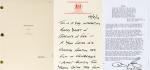
Exquisite collection of six (6) items/original, vintage and personal materials by/of Tom Taylor. The collection includes a 2 1/2 page, signed manuscript letter [MLS] by Tom Taylor to an unknown recipient , discussing a memorial he sent to Robert Browning’s patron, John Kenyon and mentioning former Prime Minister Lord Aberdeen [George Hamilton-Gordon, 4th Earl of Aberdeen]. The collection also includes two vintage 19th century cabinet photographs [Carte de Visite’s] of Tom Taylor, a later edition of Ballads and Songs of Brittany and two beautifully inscribed and signed presentation copies of his major works: 1. The first edition of Ballads of Brittany – London/Cambridge, MacMillan and Co.,1865 with many illustrations by Tissot, Tenniel etc. (This first edition is signed and inscribed by Tom Taylor to Emilia Ventana at Xmas 1864, before the publication of the book commenced) and 2. Tom Taylor’s Historical Dramas. London, Chatto & Windus, 1877. Signed and inscribed by Tom Taylor to Marie de Beauvoisier in March 1879.

London / Cambridge etc., Chatto & Windus / Routledge & Sons / etc., c. 1850-1879. Octavo. Ballads and Songs of Brittany (1865 edition): Frontispice, XXII, 239 pages / Ballads and Songs of Brittany (Later Routledge edition): XVI, 176 pages / Tom Taylor’s Historical Dramas: VIII, 466, 32 pages. / Manuscript Letter: 2 1/2 pages. Original Hardcover / The manuscript letter in a Folder, it includes an A4 manuscript leaf from a 19th century autograph-collector describing the letter by Taylor. / The two vintage cabinet photographs of Taylor included in the Folder with the autograph. Very good condition with only minor signs of external wear.

EUR 1.480,-- 

Show details   Add to cart

Page: 1 2 3 4
: